Tag Archives: Datashielder

EviDNA DNA Cryptography | Jacques Gascuel Memory

Illustration scientifique EviDNA avec double hélice d’ADN stylisée et symboles de sécurité numérique

EviDNA DNA cryptography: Freemindtronic complementary reference memory — EviDNA, Digital DNA, cryptographic genome, cybersecurity and digital trust (CryptPeer / EviSKMS) — July 2026.

© 2026 Jacques Gascuel — Freemindtronic®. All rights reserved. Intellectual property protected. This page is an original literary and scientific work. Its expression, structure, terminology and scientific positioning — including the author’s original framing of a « fourth family of entropy » relative to PRNG, TRNG and QRNG — are protected by copyright. It is not a technical reproduction notice. Unauthorized reproduction of this formulation or appropriation of authorship is prohibited.

EviDNA DNA cryptography — express summary

Read. This express abstract presents the purpose, industrial trajectory, and scope of the dissertation before the detailed executive summary. IP note. Intellectual property protected. The form of expression of this mémoire is protected by copyright (© Jacques Gascuel / Freemindtronic). It is not a technical reproduction notice.

EviDNA cryptography DNA refers to the Freemindtronic trajectory in the cryptographic universe mobilizing the expression “DNA” in the procedural and architectural sense — non-molecular by default. The thesis documents three milestones: EviDNA (human profile, industrialized 2024), DNA Digital and the cryptographic genome (industrialized 2026 in CryptPeer/EviSKMS).

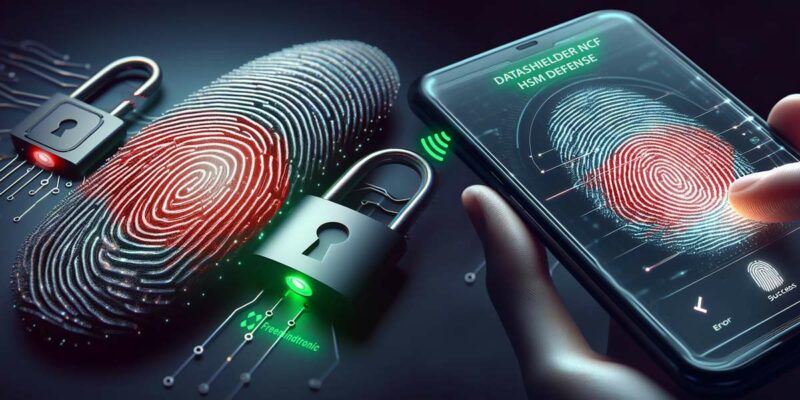
The central thesis is simple. Freemindtronic has been laying an R& R& line since 2022 (Eurosatory, project presentation) D distinct from institutional molecular OTP: trusted material derived from a human profile, segmented material, field use. In 2024 (Eurosatory Lab), this trajectory materialized in DataShielder Defense NFC HSM. In 2026 (Eurosatory), it is generalized in CryptPeer via the cryptographic genome and the TPM/vTPM anchoring.

The thesis establishes documentary comparisons with the state of the art: classic digital trust (FIDO, PKI, Zero Trust), academic genomic data encryption, iDASH/Beacon ecosystem, and CNRS 2026 approach (synthetic DNA, OTP/Vernam). He does not claim any authorship on the third-party works; It specifies distinct technical objects.

The Freemindtronic positioning is treated with methodological caution. The granted international patents WO/2018/154258 (segmented key) and WO/2017/129887 (access control) allow for an enabling public description at the architecture level. Industrialization is documented by observable evidence (product, CryptPeer runtime, time-stamped videos). The internal EviDNA mechanisms, Gen2 extensions and unpublished know-how remain in the B and C registers — see §1.12.

This document is a scientific-industrial memory complementary to the framework predictive intelligence architectures — EviSKMS. It does not claim to be a peer review or product certification.

Playback settings

Reading time express summary: ≈ 4 minutes
Reading time executive summary: ≈ 5 minutes
Estimated full reading time: ≈ 1 h 15
Initial ReleaseJuly 2026
Last updated: 21 July 2026 (pre-filing IP hardening — copyright preserved; technical risk language removed)
Level of complexity Expert / research
Technical density ≈ 78%
Available language EN
Specificity: Complementary thesis on EviDNA, Digital DNA, cryptographic genome, DNA cryptography, CNRS comparisons and CryptPeer
Reading orderExpress Abstract→ Executive Summary → §1 Genome and trajectory → Limitations and falsifiability → Conclusion
Accessibility:Optimized screen readers, internal anchors, and summaries included
Editorial type:Scientific and industrial reference memory
Main topic: EviDNA cryptography DNA
Secondary Topics: EviDNA, Digital DNA, Cryptographic Genome, CNRS, CryptPeer, EviSKMS, Segmented Trust
Criticality Level:High — 8 / 10 — genetic data, cybersecurity and digital identity
Author:Jacques Gascuel, inventor and founder of Freemindtronic®.
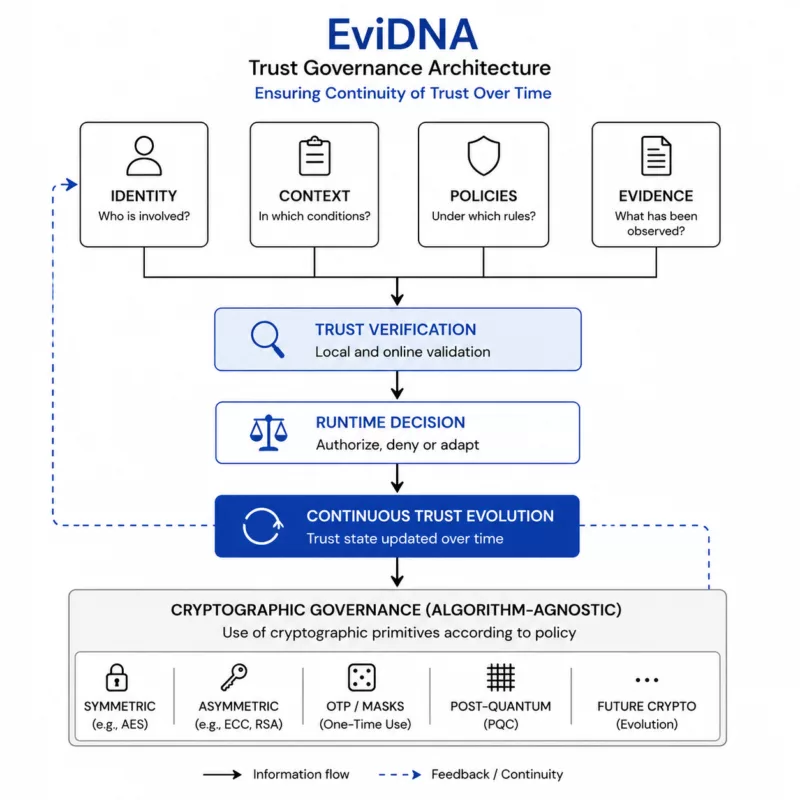
EviDNA DNA Cryptography trust governance architecture showing identity, context, policies, evidence, trust verification, runtime decision, continuous trust evolution and algorithm-agnostic cryptographic governance.

Publish status

This thesis on EviDNA cryptography DNA is a position and reference document Freemindtronic and an original work protected by copyright (© 2026 Jacques Gascuel / Freemindtronic®). It does not constitute a peer review, third-party audit, or product certification. It is a non-enabling publication (register A): it does not disclose unpublished procedural means or enabling reproduction records.

Editorial note. This quick summary presents the objectives, the industrial trajectory (Eurosatory 2022 project → 2024 Defense → 2026 CryptPeer) and the scope of the thesis EviDNA DNA cryptography. It precedes the detailed executive summary and is part of Freemindtronic Andorra’s editorial transparency approach. It distinguishes between state-of-the-art knowledge, observable evidence of industrialization and mechanisms relating to unpublished intellectual property. This content is written in accordance with Freemindtronic Andorra AI Transparency Statement — FM-AI-2025-11-SMD5.

EviDNA DNA cryptography — executive summary

This complementary thesis documents the Freemindtronic trajectory in the cryptographic universe mobilizing the expression “DNA” in the procedural and architectural sense — non-molecular by default: EviDNA (human profile, 2024), ADN Digital, cryptographic genome and industrialization CryptPeer/EviSKMS (2026).

It establishes documentary comparisons with the state of the art: classic digital trust mechanisms (FIDO, PKI, Zero Trust, HSM/TPM), academic genomic data encryption (PROMISE, Varlock), and institutional approach CNRS 2026 (synthetic DNA, OTP/Vernam). He does not claim any authorship on the third-party works; It specifies distinct technical objects. Canonical definition EviDNA: §1.11.

The publication respects the registers A (public), B (confidential) and C (IP): two international patents granted are publicly cited (WO/2018/154258 — segmented key; WO/2017/129887 — access control); no records enabling the reproduction of EviDNA, genome, Gen2 or advanced runtime mechanisms (C registry).

Controlled publication (register A). This limitation is not a documentary gap, but an assumed methodological constraint: the dissertation distinguishes between what can be discussed publicly and what would constitute a reproduction record. It exposes the inventive trajectory, distinct technical objects, observable evidence, and relevant comparisons — including integration into CryptPeer/EviSKMS at a high level — while preserving unpublished internal mechanisms of EviDNA, DNA Digital and the cryptographic genome. See §1.12; Roadmap: §1.15.

For the interdisciplinary framework linking predictive AI, cybersecurity, and cyber-physical trust, see EviSKMS reference memory.

Key Points — EviDNA Cryptography DNA

  • Trajectoire salon : Eurosatory 2022 (projet EviDNA) → 2024 Defense NFC HSM → 2026 CryptPeer/EviSKMS industrialisé.
  • EviDNA canonical definition: §1.11 · Chronology: Appendix A.
  • CNRS 2026 comparisons, academic genomic encryption, iDASH/Beacon, classical digital trust.
  • Publication controlled non-enabling: §1.12 · roadmap§1.15.
  • Add-on predictive intelligence architectures — EviSKMS.

© Author’s positioning — « fourth family of entropy »

Jacques Gascuel authors an original literary-scientific framing that situates the Freemindtronic EviDNA trajectory relative to three established families of randomness sources (PRNG, TRNG, QRNG). The expression « fourth family of entropy » designates that authored positioning — not a recipe, not a technical reproduction notice. © 2026 Jacques Gascuel / Freemindtronic®. Unauthorized reproduction of this formulation or appropriation of authorship is prohibited.


☰ Navigation rapide

🔝 Back to top

Scope and controlled perimeter of this publication

This complementary thesis presents the EviDNA / Digital DNA / cryptographic genome trajectory in a controlled publication framework (register A). It documents the industrialization observable in DataShielder Defense NFC HSM (2024) and CryptPeer/EviSKMS (2026), without providing a technical reproduction notice of internal mechanisms. The form of expression of this mémoire is protected by copyright (© Jacques Gascuel / Freemindtronic).

The document distinguishes clearly between:

  • State‑of‑the‑art references (FIDO, PKI, Zero Trust, TPM/vTPM, CNRS 2026, PROMISE, Varlock, Beacon/iDASH).
  • Observable industrial evidence (product, runtime, tests, logs, time‑stamped demonstrations).
  • Patented foundations publicly citable (WO/2018/154258 segmented key; WO/2017/129887 access control).
  • Unpublished mechanisms (EviDNA internal structures, Digital DNA formats, cryptographic genome Gen2) preserved under IP constraints.

This section clarifies what the thesis covers and what it does not expose, ensuring methodological rigor and compliance with Freemindtronic Andorra’s AI Transparency Statement — FM‑AI‑2025‑11‑SMD5.

EviDNA DNA cryptography — Relation to the “predictive intelligence architectures — EviSKMS”

Document Perimeter
EviSKMS memory/predictive AI Taxonomy of predictive architectures, LAMP-C, agentic memory, causality, benchmarks, applied cyber component (§29.1–§29.13)
ADN / EviDNA Cryptographic Genome, EviDNA, Digital DNA, CryptPeer proofs, CNRS comparisons and digital trust

The two dissertations are complementary: the first sets the broad scientific framework; The second deepens the cryptographic trajectory and state-of-the-art comparisons without diluting the debate on artificial general intelligence.

1. Cryptographic genome, EviDNA and industrial trajectory

Scientific positioning and intellectual property. The cryptographic genome is presented here as a Freemindtronic trajectory articulating a first generation already industrialized in CryptPeer via EviSKMS and an extension of applied research on digital identity evolving over time. This section does not constitute an enabling technical disclosure, as it does not disclose the detailed technical mechanisms, internal structures, verification sequences, transition rules or operational formats that may fall within the scope of intellectual property protections, including pending or future patent filings. The elements presented are also part of a formalization work protected by copyright.

In the context of this thesis, the expression “cryptographic genome” does not refer to biological DNA, nor to a direct exploitation of biometric data, nor to a form of DNA computing. Nor does it refer to a new fundamental cryptographic building block intended to replace existing standards, encryption algorithms, signature mechanisms, PKIs, HSMs, TPMs or digital identity repositories.

It refers to a digital trust architecture approach aimed at organizing, over time, evidence, contexts, policies, states of trust, and local and online verification mechanisms around a continuity of trust. This does not prescribe a single encryption algorithm: it is agnostic with respect to cryptographic bricks — symmetric (including OTP / single-use masks), asymmetric, post-quantum (PQC), etc. — in accordance with the governance policy. It should be understood as a structuring, governance and verifiability, and not as a substitute for existing cryptographic standards.
A first generation of this approach is already industrialized in CryptPeer via EviSKMS. It materializes, at an operational level, a segmented, locally verifiable, policy-driven, and runtime-oriented trust. This Gen1 is a return to industrialization: it demonstrates that an identity, a session, an execution context or a trusted object can be treated not as a simple static identifier, but as a controlled, reassessable and governable trust structure.

Jalon EviDNA — three-step timeline (registry A).

Phase Period Content
1 — Socle commercial 2017 → QR chiffré + NFC sur M24LR 64K NFC (STMicroelectronics) — commercialisé sans couche ADN ; smartphone + papier + puce NFC
1b — R& D EviDNA 2022 Eurosatory — primer / presentation project EviDNA (R& D)
1c — Développement EviDNA 2022–2024 Compatibilité ST25 64K NFC ; couche ADN (EviDNA)
2 — Defense + DNA humain 2024 → Eurosatory LabDataShielder Defense NFC HSM industrialisé ; divulgation mai–juin 2024 (§1.9)
3 — DNA Digital + génome 2024–2026 Eurosatory 2026 — industrialisation CryptPeer/EviSKMS ; TPM/vTPM

Synthetic chronology (text schema, register A).

2017 ──► QR chiffré + NFC M24LR (commercial, sans couche ADN)
           │
2022 ────► Eurosatory — seed / EviDNA project (R& D)
           │
2022-24 ─► ST25 64K +EviDNA Development
           │
2024 ────► Eurosatory Lab — DataShielder Defense NFC HSM (industrialisé)
           │
2024-26 ─► Digital DNA + giscryptographique name
           │
2026 ────► Eurosatory — CryptPeer/EviSKMS industrialisé · TPM/vTPM

Defense / EviDNA detail: §1.11 · Product Proof§1.10. Digital DNA / CryptPeer 2026: §1.7.

To preserve scientific rigor, the qualification of industrialized Gen1 must remain attached to observable elements: code, frozen contracts, tests, runtime flows, implementation logs, technical documentation or product integration. Unpublished implementation details are not set out in this supplementary brief.

1.1. Non-sensitive level of evidence and Gen1</h4 industrialization perimeter> This subsection is part of the same methodological logic: it does not aim to impose recognition by personal authority, but to link an inventor’s intuition to verifiable, non-sensitive and observable elements. The weak and strong signals identified in the field serve here as raw material for a cautious scientific formalization, without enabling disclosure of internal mechanisms.

This thesis does not seek to publish the internal mechanisms of the cryptographic genome. It establishes its scientific and industrial positioning: a segmented, local, temporal and governable digital trust architecture, whose Gen1 and Gen2 are industrialized in CryptPeer via EviSKMS.

In order to avoid any enabling technical disclosure, the evidence mentioned below is formulated at a non-sensitive level. They indicate the scope of industrialization without exposing the detailed mechanisms, internal structures, operational formats, verification sequences or transition rules.

Patented, publishable parentage. The principle of segmented key and conditional reconstitution of trust can be publicly cited under the international patent WO/2018/154258 (FR3063365 B1, EP3586258, US20210136579, CN110402440, JP2020508533, KR1020190120317). This foundation covers segmentation, physical proximity, token, ephemeral volatile memory, segment governance and a variant of the invention — the scrambling module of authentication data — without allowing the disclosure of post-patent extensions not yet registered (genome, detailed EviDNA, advanced runtime).

1.1.1. Jamming module — public variant of patent (WO/2018/154258)

The granted international patent WO/2018/154258 (FR3063365 B1, EP3586258B1) describes, in addition to the segmented key, a variant of the invention relating to a scrambling module authentication data. This mechanism is freely accessible in the public description of the title: when typing on an untrusted channel (keyboard, interface, clipboard), additional characters are inserted at predetermined positions known to the legitimate user, who removes them before transmission. The documented objective is to reduce the exposure of the real secret in the face of a keylogger or any direct observation of the input surface.

Cryptographic positioning (ledger A). This module is not an OTP/Vernam schema: it protects the transient representation of the secret at the time of input, not the content of an encrypted message.

Limits and C.</strong registry> Any auto-extension, runtime generalization, or correlation with EviDNA, cryptographic genome, or EviSKMS falls under the C registry as long as no additional repositories are secured. This paragraph is limited to the variant of the issued title.

Classification legend: A = possible audience in the memory · B = confidential (private file, audit under NDA) · C = reserved IP (before filing or validation by patent advisors).

Observed Element Status Type de preuve Non-sensitive functional description Maturité Classification Synthesis
Brevet clé segmentée documented · Issued brevet · documentation International FR3063365 / WO2018154258 Family: Peering Key Segmentation, Physical Proximity, Conditional Status, Token, and Protected Credentials Industrialized (granted title) A “The architecture is based on the international patent Segmented Key Authentication System, extended in EviSKMS.”
Module de brouillage documented · issued (patent variant) brevet · documentation Variant WO2018154258: Insertion of decoy characters at predetermined positions during input; Documented patented variant (without automatic extension) (§1.1.1) Documented (public patent) · architectural extension A (patented principle) / C (procedural shunting) “The patent describes an anti-keylogger jamming module; The patented variant covers manual jamming on input.
CryptPeer implemented · Tested · Integrated product code · Test · Documentation · deployment Sovereign collaborative platform: license, E2EE, admin, local or Internet transport, packaging and runbooks Industrialisé A “CryptPeer is an industrialized application based on EviSKMS.”
EviSKMS Runtime implemented · Tested · Documented code · Test · Product integration Trust Runtime consumed by CryptPeer: Startup enforcement, state projections, architectural freeze Industrialisé A / C (Core) “The product runs in an EviSKMS trusted runtime.”
Runtime Integrity implemented · Tested · Integrated product code · test · journal Runtime health references, append-only local anchor, fail-closed operator projection Industrialisé A / B / C “Runtime integrity is embodied in verifiable references and traceable local anchoring.” · Runtime Integrity (site)
DRT implemented · Tested · Integrated product code · Test · Contract Distributed Runtime Trust Check on Startup, Persistence Continuity, Restart Tests Industrialized (integration) A / C (gate Core) “CryptPeer has a built-in DRT check at startup with documented v1 freeze.”
RSCC implemented · Tested · Documented code · test Posture-integrated sovereign runtime configuration certificate Integrated A / C “A sovereign runtime certificate accompanies the operational posture.”
Confiance segmentée implemented · Tested · Integrated product code · Testing · brevet Optional software and hardware segmentation; Patent filiation WO2018154258 Integrated/Industrialized A (principe) / C (recomposition) “Trust is segmented between a sovereign software base and optional hardware reinforcements.”
Vérification locale implemented · tested code · test · runtime Doctors operator, log string integrity, readiness without network required Industrialisé A “Local controls validate cryptographic status before mining.”
Continuité runtime implemented · Tested · Documented code · test · journal State Persistence, Regression Detection, Sovereign Backup/Restore Integrated A / C “Runtime trust continuity is monitored across sessions.”
Politiques fail-closed implemented · Tested · Documented code · test · documentation Default deny on startup, authentication, and sensitive modes Industrialisé A “The fail-closed doctrine applies to critical surfaces.”
Anti-rejeu implemented · Tested · Integrated product code · Test · Schema License, API and passwordless protection by nonces and atomic consumption Industrialisé A / B “Anti-replay guardrails cover sensitive surfaces.”
Crypto Governance implemented · Tested · Documented documentation · code · test Gel release, profils crypto, supply-chain licence E2E, coffre de confiance Industrialisé A “Crypto governance combines release freeze and supply-chain acceptance.”
Preuves composées implemented · tested code · test Converge heterogeneous signals into a verifiable snapshot without misleading promotion Integrated A / C “Heterogeneous evidence is converged into a composite state of trust.”
Journaux / ledger / traces implemented · Tested · Integrated product code · test · journal License (DB) logs, JSONL lineage, fingerprint snapshots, passwordless audit, and RI Industrialisé A “Traceability is based on chained newspapers with distinct roles.”
Passwordless Freemindtronic implemented · Tested · gel V1.1 code · Test · Product integration Passwordless Authentication, Trusted Terminal, Local Sovereign Mode Industrialisé A / C “A sovereign passwordless mode is qualified and frozen for documented local execution.”
DDNA Gen1 implemented · Tested · Integrated product code · test Category-normalized footprints, with no raw data in transit Integrated A (categories) / C “The Gen1 base materializes identity proofs by standardized fingerprints.”
Trust Identity implemented · Tested · Integrated product code · test Verifiable Cryptographic Identity Integrated into the Product Integrated A / C “Each actor has a verifiable identity of trust.”
Tests sécurité tested · Documented test · documentation Automated Security Test Campaign (Unpublished Volume) Industrialisé A “An automated security testing campaign covers trust mechanisms.”
Sovereign Deployment implemented · Documented configuration · documentation Docker souverain, agent TPM isolé optionnel, transport sovereign-local, runbooks FQC Integrated/Industrialized A “Deployment artifacts accompany controlled release.”
SVTM implemented · Tested · frozen test · documentation Runtime official sovereign software by default; Optional Hardware Industrialisé A “The sovereign software runtime is the default operational foundation.”
Transport sovereign-local implemented · Tested · frozen V1 code · test · runtime TLS local, gateway HTTPS/WSS, PKI locale, services runtime locaux Industrialisé A / B “A sovereign local execution mode provides TLS and runtime services without required internet.”
Advanced Truth Assessment Module implemented · tested code · test Conjunctival evaluation of high criteria; Safeguards against unsubstantiated insurance claims Integrated A / C “A high-level truth module arbitrates maximum assurance claims.”
Gen2 / genome avancé implemented · Integrated product code · test · documentation Gen2 Genomic Extensions in CryptPeer/EviSKMS; detailed mechanisms in register C Industrialisé A / C Gen2 Genome Extensions Operational in CryptPeer

This matrix does not purport to be a complete technical publication. It establishes a level of maturity that can be read by the scientific reader: the Gen1 and the Gen2 are industrialized in CryptPeer, anchored on an international patent issued for segmentation; the detailed mechanisms of Gen2 fall under the C register.

Full scientific recognition of this approach will require additional publications, intellectual property filings when necessary, as well as comparative evaluations documenting its contributions to traditional authentication, passwordless, PKI, access control and runtime trust mechanisms.

1.2. Towards controlled scientific recognition: evidence, comparisons and publication after PI</h4 securitization> The full scientific recognition of this approach presupposes a complementary step, carried out after securing intellectual property when necessary. This stage will have to articulate three levels: non-sensitive evidence of industrialization, structured comparisons with the state of the art and controlled publication. A first appendix of non-sensitive evidence, resulting from a local analysis of the EviSKMS-CryptPeer repository, now makes it possible to document this first level without exposing the internal mechanisms protected.

Non-sensitive evidence will be able to document the existence of operational implementation without disclosing the protected internal mechanisms. They may include product scope, functional architecture, maturity levels, usage scenarios, general flows, test categories, trust policies, execution logs, and validation criteria.

Comparisons will have to situate the Freemindtronic approach in relation to the existing mechanisms of authentication, passwordless, PKI, HSM, TPM, Zero Trust, WebAuthn/FIDO externally, machine identity, IoT and runtime trust. The objective will not be to replace them with affirmation, but to show where the genomics approach to digital trust brings a different layer: segmentation, local verification, temporal continuity, contextual governance and reassessment of the level of trust. A first comparative document matrix is proposed in §1.4.

The controlled publication can then take the form of a position paper, a scientific white paper, an evaluation report or a documented demonstrator. It should remain non-enabling until intellectual property protections are finalized, while providing sufficient elements to allow scientific discussion: problem addressed, hypotheses, scope, comparison, limitations, use cases and evaluation protocol.

Publication doctrine (register A). This thesis deliberately adopts a controlled publication logic: it documents scientific subject-matter, prior art, state-of-the-art comparisons and evidence of industrialization observable, without disclosing the internal mechanisms that may be the subject of complementary patent filings. This applies in particular to the advanced implementation in CryptPeer/EviSKMS, where only functional effects, architecture principles, and non-sensitive elements are exposed. The rules of derivation, transition, genomic correlation, internal formats and operating parameters remain in the B or C register. Detail: §1.12.

This trajectory makes it possible to clearly distinguish three registers: what is already industrialized, what can be made public without risk to intellectual property, and what must remain reserved for deposits, confidential annexes or evaluations under confidentiality agreements. It thus avoids two opposing pitfalls: an unproven assertion of innovation, or a premature disclosure of protected technical mechanisms.

The Gen2 is implemented in CryptPeer via EviSKMS. It extends the Gen1 trajectory towards an evolving, contextual, memory and verifiable digital identity over time. The detailed technical mechanisms fall under the C registry and are not disclosed in this supplementary submission.

The emergence of predictive artificial intelligence makes this development particularly important. Attacks are no longer just about isolated passwords or certificates. They can target identity continuities: progressive spoofing, deepfakes, session compromise, hijacking of AI agents, cloning of connected objects, context alteration, memory poisoning or behavioral manipulation.

Faced with these risks, one-time authentication becomes insufficient. A future identity architecture will need to verify not only what an entity knows, owns, or is, but also the context in which it operates, the consistency of its interactions, the governance of its rights, the continuity of its evidence, and the reassessment of its level of trust over time.

The cryptographic genome thus constitutes a two-stage trajectory: a Gen1 and a Gen2 industrialized in CryptPeer via EviSKMS. Gen1 embodies segmented, local and runtime-governed trust; Gen2 extends this approach to an evolving and contextual identity. Gen2 technical details are protected when they are likely to fall under additional intellectual property protections.

This approach should be thought of as distinct from the FIDO/Passkeys mechanisms, which Freemindtronic does not use as a foundation of trust. It can be situated in relation to existing repositories—NIST SP 800-63-4, Zero Trust, ETSI EN 303 645, Cyber Resilience Act, and, for external comparison, WebAuthn/FIDO—but not limited to or dependent on it.

Freemindtronic is also developing its own passwordless approach, based on EviSKMS and the Gen2 evolution. In order to preserve current or future intellectual property protections, this brief does not disclose the detailed technical mechanisms.

The public positioning can nevertheless be formulated as follows: this digital trusted genomic technology aims for a segmented, local, temporal and verifiable approach to identity and authentication. It is intended to apply to many contexts where it becomes necessary to establish, maintain or reassess a trusted identity: humans, connected objects, software agents, digital services, cyber-physical environments, critical access, secure exchanges and runtime continuity.

Its interest lies in the fact that it no longer considers identity as a simple one-off authentication event, but as a continuity of trust that is evolving, governable and verifiable over time. This orientation becomes especially important in contexts where traditional passwordless mechanisms and traditional authentication are becoming insufficient in the face of predictive AI, autonomous agents, synthetic identities, session compromises, and behavioral attacks.

This perspective is in line with the general axis of this thesis: predictive AI transforms the conditions of trust. The more systems become capable of anticipating, acting and adapting, the more identity itself must become reassessable, memorial, contextual, verifiable and governable over time.


1.3. EviSKMS-CryptPeer</h4 industrialization proof-of-the-mill summary> A synthesis of evidence of industrialization was established from a local analysis of the EviSKMS-CryptPeer repository. It does not reproduce any source code, pseudo-code, operational format, verification sequence, transition rule or repeatable mechanism. Its goal is to provide the scientific reader with proof of existence and maturity, without enabling disclosure.

This appendix confirms that CryptPeer is an integration and operational governance layer aligned with EviSKMS. It documents, at a high level, the existence of a trusted runtime, Runtime Integrity controls, DRT continuity, sovereign runtime certificate (RSCC), fail-closed policies, anti-replay guardrails, chained logs, cryptographic governance, compound proofs, frozen sovereign passwordless mode V1.1, DDNA Gen1 foundation, automated security testing campaign, and sovereign deployment artifacts.

Filiation brevete. The observable industrialization is in line with the international patent Segmented Key Authentication System (WO/2018/154258, FR3063365 B1). This title allows for the public disclosure, without weakening the residual IP, of the principles of segmented key, physical proximity, conditional reconstruction, protection of authentication data and the variant of the jamming module (§1.1.1) — the foundation on which EviSKMS and CryptPeer have been industrialized. The extensions genomic Gen2, the engine DRT complete, the convergence multi-criteria advanced, and non-patented internal mechanisms remain outside the public perimeter.

The scientific value of this synthesis does not lie in the disclosure of internal mechanisms, but in the methodological distinction between three registers:

Registre Definition Formulatable examples in the dissertation
A — Public possible Verifiable elements or already covered by a granted patent; High-level formulation without reproduction Patented segmentation, fail-closed, integrated RI/RSCC/DRT existence, Gen1 (high-level) standardized fingerprints, testing and deployment
B — Confidentiel Evidence to be kept as a private appendix, client file or audit under NDA Operational Runbooks, Red Team Scenarios, Operator Topologies, Enrollment Procedures
C — Réservé PI Elements to be protected before technical publication or supplementary filing Gen2, Fingerprint Normalization (Internal Detail), Runtime Continuity Engine (Internal), Convergence, Runtime Signature (Internal), Secondary Segment Recomposition

Disclosure perimeters (text schema).

                    ┌─────────────────────────────────────┐
                    │ C — Reserved PI │
                    │ Gen2, Continuity Engine (internal), runtime extensions (internal) │
                    │ passwordless, genome transitions │
                    │  ┌───────────────────────────────┐  │
                    │ │ B — Confidential / NDA │ │
                    │  │ runbooks, red team, code privé│  │
                    │  │ ┌─────────────────────────┐   │  │
                    │ │ │ A — Public (memory) │ │ │
                    │  │ │ brevet, fail-closed,    │   │  │
                    │ │ │ │ High-level events │ │ │
                    │  │ └─────────────────────────┘   │  │
                    │  └───────────────────────────────┘  │
                    └─────────────────────────────────────┘

EviSKMS–CryptPeer Stacking (Text Schema, A Register).

Applications / opérateur
        │
        ▼
CryptPeer — governance, integration, sovereign deployment
        │
        ▼
EviSKMS runtime ──┬── Runtime Integrity (RI) / RSCC
                  ├── DRT (continuity of trust)
                  ├── DDNA Gen1 (empreintes normalisées)
                  ├── Passwordless V1.1 (sovereign-local)
                  └── Fail-closed · Anti-Replay · chained newspapers
        │
        ▼
Hardware Anchor: TPM / vTPM (2026) — segments, policies

Directly usable public evidence (Registry A): EviSKMS–CryptPeer architecture; software-sovereign-first ecosystem gel; Runtime Integrity and RSCC as posture artifacts; built-in DRT continuity; multi-surface anti-replay; Logs with separate rolls. passwordless V1.1 qualified sovereign-local; DDNA Gen1 by standardized impressions; security test campaign; Filiation patent WO2018154258.

Do not publish: code, pseudocode, canonical payloads, check sequences, transition rules, red team fixtures, secondary segment details, advanced multi-criteria composition, Gen2.

This separation supports the credibility of the brief — and the associated industry communications — without turning the public document into a technical reproduction record. It establishes that the Gen1 of the cryptographic genome has a double anchor: an international patent granted on segmentation, and industrialization observable in CryptPeer via EviSKMS.

The exact scope of this evidence is deliberately limited: it does not constitute independent scientific validation or peer review. However, it constitutes a sufficient documentary basis for a controlled publication, a white paper, an evaluation report or a client file, after securing the patentable elements that have not yet been filed. The limits and conditions of falsifiability of the brief specify what this proof does not establish.

1.4. Structured comparison — digital trust and identity

This subsection responds to the need, formulated in §1.2, of an explicit comparison with the state of the art in terms of digital trust. It is not a quantified performance benchmark, nor a third-party audit, but a documentary positioning at a non-enabling level.

Scope compared. The following are compared, at a high level: WebAuthn / FIDO / Passkeys (external comparison — Freemindtronic does not use FIDO as a trust base), PKI / X.509, Zero Trust (NIST framework), HSM / TPM, OAuth / Federated OIDC, and EviSKMS Gen1 / CryptPeer as documented in the A</strong register> in this supplementary submission and the Appendix C.

Qualitative rating: Low · Medium · Strong · Very strong · N/A (not applicable to the perimeter).

Critère WebAuthn / FIDO PKI / X.509 Zero Trust (cadre) HSM / TPM OAuth / OIDC EviSKMS Gen1 / CryptPeer
Strong Authentication Spot Very strong Fort Medium (frame) N/A Fort Fort
Continuous Trust over time Faible Faible Moyen Faible Faible Fort
Trust Segmentation Faible Moyen Moyen Fort Faible Very strong
Conditional Trust Faible Faible Faible Moyen Faible Fort (filiation brevet WO2018154258)
Sovereign Local Verification (without cloud required) Moyen Moyen Faible Fort Faible Very strong
Verifiable Runtime Integrity Faible Faible Moyen Moyen Faible Fort
Runtime fail-closed policy Faible Faible Moyen Moyen Faible Fort
Anti-rejeu multi-surface (licence, API, auth) Faible Moyen Moyen Faible Moyen Fort
Role-Complementary Trusted Logs Faible Moyen Moyen Faible Faible Fort
Machine Identity / IoT / Agent (General Framework) Faible Moyen Moyen Moyen Moyen Moyen (Gen1/Gen2 — continuité temporelle)
Broad Ecosystem Interoperability Very strong Very strong Fort Fort Very strong Low/medium
Standardisation normative mature Very strong Very strong Fort Fort Very strong Low (proprietary, patent granted)
Documented Evidence of Public Industrialization (2026) Fort Very strong Fort Fort Very strong Means (non-sensitive annex, not to that third party)

Methodological reading. This table does not classify EviSKMS as “superior” on all axes. It shows a difference in function:

  • FIDO/OAuth/PKI excel at interoperability, standardization and large-scale one-time authentication
  • Zero Trust provides a framework for governance and policies, but is not a local sovereign trust runtime on its own.
  • HSM / TPM reinforce the material anchor, often in addition to other layers.
  • EviSKMS Gen1 aims for an layer additive: trust segmented, continuous over time, verifiable locally and governed to the runtime, as an extension of the segmented key patent — at the cost of less immediate interoperability and independent scientific validation still to be conducted.

What the comparison does not establish. It does not demonstrate the operational superiority of EviSKMS over FIDO or PKI in all contexts. It does not replace comparative numerical trials, published red team campaigns or certification. It situates the Freemindtronic positioning for a structured scientific and industrial discussion.

1.5. Cryptographic genome vs. point identity (time T)

Verification of the distinction. Recent institutional work on synthetic DNA and OTP (CNRS communication April 2026, HAL hal-05560338) describe a protocol where two correspondents have identical copies of synthetic DNA sequences, then just before a communication select and sequence fragments to produce a common binary key at time T — key distribution logic synchronized to an event, not a identity architecture evolving over time. The classic authentication mechanisms (password, certificate, WebAuthn, point biometrics) obey the same functional structure: prove “it’s me” at the moment T, then grant or deny access.

The Freemindtronic cryptographic genome is part of a different technical object: a digital trust architecture that organizes, over time, proofs, contexts, policies, runtime states, normalized fingerprints (DDNA Gen1), session continuity, fail-closed reevaluation and — in Gen2 — contextual identity, Memory and governable. This is not a marketing metaphor for molecular DNA: the expression refers to a procedural structuring of trust (segments, inheritances, dependencies, traceability), publicly formalized in this thesis and initiated by EviDNA (2024) then ADN Digital (2026).

Dimension Instant Authentication / OTP (generic, incl. Synthetic DNA OTP 2026) Génome cryptographique Freemindtronic (Gen1/Gen2)
Horizon temporel Point event: Evidence or key at time T Continuity: reassessable trust between T₀ and Tn
Protected Object Message, Session, or Immediate Access Trusted Identity, Mission, Runtime, Trajectory
Rôle de l’ADN Molecular material source of shared entropy, synchronized at time T (CNRS 2026) EviDNA (2024): human profile, trusted material (detail of B/C register); Digital DNA/genome (2024–2026)
Proof of implementation Experimental protocol / application for academic patents Sources publiques 2024 + dépôt GitHub privé DataShielderHSM (registre B) · Gen1 CryptPeer 2026

Time horizon: time T vs continuity (text diagram).

 punctual auth / CNRS OTP (time T) Cryptographic genome (continuity)
────────────────────────────────────          ────────────────────────────────────

    T₀ T₀ T₁ T₂ Tn
     │                                                │         │         │         │
 [Proof] ──► Granted or refused?       [Confidence inValuable ─────────────►]
     │                                                │
     ✕ (end of event) fail-closed · DDNA · DRT · segments

Synthèse. This precise distinction between distinct technical objects: the CNRS mobilizes synthetic DNA to a single scheme (OTP/Vernam at a given time); The Freemindtronic trajectory can also produce OTP keys, but in a broader architecture — segmented and continuous trust over time, with interchangeable mechanisms. The Freemindtronic Public Disclosures (2018–2026), the online submission (freemindtronic.com) and the patent WO/2018/154258 are elements of documented prior art on this trajectory. For the CNRS approach as publicly formulated, see §1.6.

1.6. Documentary synthesis — CNRS DNA cryptography (external reference, register A)

Status. This subsection does not claim any authorship on CNRS work. It faithfully transcribes, for documentary comparison purposes, what third-party public sources (institutional popularization video, press release of 01/04/2026, preprint HAL hal-05560338) describe the Franco-Japanese “DNA cryptography” approach. Freemindtronic welcomes this research and reminds us that the technical objects differ from EviDNA (2024) and the cryptographic genome (2026).

What the corporate video exposes (non-empowering summary).

A Franco-Japanese team (Gulliver, CNRS/ESPCI Paris — PSL laboratory: Matthieu Labousse, Yannick Rondelez; XLIM, University of Limoges: Philippe Gaborit; partner University of Tokyo) presents cryptography by DNA as a new chapter in the The history of encryption.

  1. Material. The DNA here is fully synthetic produced outside of any biological process. Four bases A, T, C, G form a “quaternary language” analogous to the binary (0/1): an ordered sequence encode information.
  2. Cryptographic property sought. Synthesis is used to generate statistically random sequences — source of entropy for cryptography.
  3. Encryption scheme. The protocol chosen is the (OTP — One-Time Pad): a random mask, as long as the message, used once; combined with the binary message to encrypt; recombined on the recipient side to decrypt. Theoretical safety is based on the randomness of the mask.
  4. Role of the molecule (explicit video wording). The synthesized DNA molecule does not contain the message: it carries the future encryption key. Two identical samples are prepared (Tokyo / France demonstration); Each matching sequence their sample just before the communication to get the same binary key.
  5. Operational chain. Sequencing (reading nanopore: differential current per base A/T/C/G) → software reading of the ATGC sequence → conversion to binary → encryption of the digital message in France → sending of the encrypted message (e.g. email) → decryption in Japan with the identical key.
  6. Applications mentioned. Critical communications: defense, diplomacy, patents, financial exchanges; so-called “unconditional” security in the sense of OTP.

CNRS Operational Chain — Molecular OTP (text diagram, public sources).

 random synthetic DNA
        │
        ▼
Duplication ──► copy France ════ Japan copy
        │
        ▼  (just before the message)
Nanopore sequencing (×2) ──► IdenticalATGC sequence
        │
        ▼
ATGC → binary → OTP mask (|mask| = |message|)
        │
        ▼
Message ⊕ Mask ──► Channel (e.g. email) ──► Encryption ⊕ samemask

Advantages and disadvantages of Vernam encryption (literature review of a classical scheme, register A). The protocol adopted by the CNRS is based on the Vernam encryption (One-Time Pad), the properties of which have been established in the cryptographic literature since the work of Claude Shannon (1949). This reminder, which is unrelated to the Freemindtronic mechanisms, sheds light on the trade-offs of the institutional scheme.

Avantages.

  • Perfect secret proved (perfect secrecy, Shannon): Under its three conditions, the cipher alone does not reveal none information about the clear message.
  • Resistance to any computing power, including a future quantum computer: security is informational, non-computational.
  • Simplicity of operation: The encryption is reduced to a bitwise XOR between message and mask.

Disadvantages (structural constraints).

  • Key as long as the message: encrypting n bytes requires n bytes of mask — hence a storage and distribution cost proportional to the volume exchanged (the press release mentions messages up to several hundred megabytes, so as much key material).
  • Strictly one-time use: Any reuse of a mask breaks the perfect secret (encryption correlation attack).
  • Distribution and synchronization of the mask: both correspondents must have a identical and secret mask before the exchange — this is the central problem that the molecular chain (DNA duplication, physical transport, sequencing “moment T”) seeks precisely to solve.
  • Perfect random required: Any statistical bias of the mask degrades the theoretical guarantee.
  • Lack of intrinsic authentication and integrity: the Vernam cipher but does not prove the origin or non-alteration of the message; it must be supplemented by separate mechanisms (MAC, signatures).

These properties explain why the OTP, although theoretically optimal, remains operationally demanding and lends itself above all to punctual critical communications — a framework claimed by CNRS sources. They also shed light on the cross-reading of §1.6.1: a cryptographically monolithic scheme (an imposed mechanism) is opposed to an agnostic layer admitting several mechanisms depending on the policy.

Vernam Principle / OTP (text schema, classical cryptography).

Émetteur                              Destinataire
────────                              ────────────
clear message (M) encrypted message (C)
random mask (K) ── channel ──► samemask (K)
     │                                      │
     ▼                                      ▼
C = M ⊕ K                            M = C ⊕ K

Conditions: |K| ≥ |M|  ;  K used only once;  K perfectly random

Three “DNA” trajectories — distinct technical objects (text diagram).

         ┌──────────────────┬──────────────────────┬─────────────────────────┐
         │ CNRS 2026 │ EviDNA 2024 │ Genome / Digital DNA │
         │ (réf. externe)   │ (Freemindtronic)     │ 2026 (Freemindtronic)   │
├────────┼──────────────────┼──────────────────────┼─────────────────────────┤
 Source │ Synthetic DNA │ Human DNA Profile │ Procedural Generator │
 Secret │ Tube + Sequencing │ NFC + Paper QR │ TPM/vTPM + runtime │
 Crypto │ Vernam/OTP only │ mechanisms according to policy* │ PQC agnostic layer* │
 Time │ Instant T │ Enrollment + session │ T₀ → Tn (continuity) │
└────────┴──────────────────┴──────────────────────┴─────────────────────────┘
         * OTPs and other mechanisms according to policy — not imposed as a single scheme

What the CNRS press release (01/04/2026) adds. Preparation of duplicated DNA sets of synthetic origin; just before communication key generation by sequencing; Messages up to several hundred megabytes demonstration during the presidential trip to Japan; HAL title: Synchronized DNA sources for unconditionally secure cryptography (Jaudou, Gasnier, Boudjella, et al.).

Dimension CNRS 2026 (video + HAL, external ref) EviDNA Freemindtronic (2024, registre A) Génome / ADN Digital Freemindtronic (2026)
Nature de l’ADN synthetic, random, no biological connection with living DNA Human DNA profile imported (structured file) Generalized DNA Digital procedure; Gen1/Gen2</td governance>
Finalité cryptographique Distribution of symmetrical OTP/Vernam masks (unique) Trusted material derived from a DNA</strong profile> (detail B/C register); Standard Mechanisms according to Policy Segmented trust runtime, continuity, DDNA, fail-closed; OTP and other mechanisms according to governance
Moment d’usage Sequencing and key at time T, before a message Shunt to enrollment; Sharing on demand; Encrypted session Re-evaluation of trust between T₀ and Tn
Support du secret Duplicated physical molecule (tube, transport) M24LR 64K (2017) · ST25 64K (2022–2024) — chiffré STMicroelectronics</td token> TPM / vTPM (2026) — segments, policies, fingerprints (CryptPeer)
Remote Sharing Physical transport of a DNA</td sample> encrypted QR: Paper, email, display — key on NFC only EviSKMS Distributed Governance (CryptPeer)
Support papier No (tube molecule) A4 printing: 16 QR × 2,331 car. Unicode; zero trace of the secret on paper Beyond Paper (Runtime, Continuity)
Message dans l’ADN ? No (key only — video) No (key → profile, not the plaintext) No (procedural metaphor, not molecular storage)
Random generation modality Statistically random molecular DNA synthesis; enzyme duplication; nanopore sequencing at time T; ATGC → binary</td conversion> Derivation from an imported human DNA profile (enrollment) Procedural generator governed by the cryptographic genome (structural inspiration of living things: segments, continuity) — without molecular synthesis
Operational Complexity (Registry A) High: laboratory, sequencing machines, physical transport of samples, biological constraints (noise, bias, interception detection — third-party sources); France-Japan proof of concept Moderate: smartphone + NFC + QR; Three documented actions Weak carrier-side post-configuration (import certificates initial, then transparent — §1.7)
Architectural complexity Moderate at the cryptographic level (OTP/Vernam, single schema); Complexity driven by the molecular chain Product Layer + PKI + RSA/QR</td Share> High: segmented trust, runtime, time continuity, fail-closed; interchangeable cryptographic bricks
fundamental cryptographic brick Vernam/OTP exclusively (CNRS protocol constraint) AES-256 CBC, RSA 4096, ECC, OTP (exemples documentés) Layer agnostic: OTP and any encryption or signature algorithms that are acceptable under the policy — including PQC
Freemindtronic public ance Post-EviDNA 2024 May–June 2024 (web + videos §1.9) July 2026 (memory, Digital DNA)

Read-across (register A, without legal advice). The CNRS video confirms that the 2026 institutional approach is focused on molecular OTP: random synthetic DNA → Vernam mask → physical synchronization of two copies → point sequencing. EviDNA (2024) previously documented another invention: DataShielder Defense NFC HSM product using a human DNA profile (technical detail B/C register). The cryptographic genome and the ADN Digital (2024–2026) extend a third trajectory: time-trusted architecture, beyond the distribution of keys at a given time. The three axes share the word “DNA” but do not cover the same technical object. For the analysis of the generation of randomness and operational complexity respectively, see §1.6.1.

1.6.1. Random Generation and Operational Complexity — Comparative Reading (A-Register)

Purpose of this subsection. Check, using public sources only, whether the two trajectories use comparable of random generation and similar levels of operational complexity. This analysis does not constitute a value judgment on the scientific quality of CNRS work; It specifies distinct technical dimensions useful for cross-reading the dissertation.

What CNRS sources document (April 2026). The Franco-Japanese approach aims to solve a classic constraint of the OTP/Vernam: to produce and synchronize, between distant correspondents, a key perfectly random, as long as the message and single-use. To do this, researchers are mobilizing a molecular and instrumental chain:

  1. Synthesis of entirely artificial DNA, whose order of bases A/T/C/G is statistically random;
  2. Enzymatic duplication in strictly identical copies, kept at the sender’s and recipient’s premises;
  3. Physical transport or pre-distribution of such samples;
  4. Nanopore just before communication, on both sides, to read the same sequence;
  5. Conversion ATGC → binary key → Vernam encryption of the digital message.

Two axes of complexity — non-interchangeable (text schema).

CNRS 2026                              Freemindtronic (ADN Digital / génome)
─────────                              ─────────────────────────────────────

OPERATIONAL COMPLEXITY OPERATIONAL COMPLEXITY
        ▲  ISLEVISE                              ▼  FAIBLE (post-config)
        │ lab · Sequencing │ Smartphone · TPM · runtime
        │ Physical transport │
        │                                      │
CRYPTO Complexity CRYPTO Complexity
        ▼ LOW (OTP only) ▲ HIGH(agnostic layer)
        │ Imposed Vernam │ Multiple mechanisms · continuity

Third-party sources (CNRS press release, IMT Atlantique, press popularization) also highlight biological and instrumental locks: sequencing noise, statistical bias in database pairing, the need to detect an interception of DNA material, sequencing machines and molecular biology protocols. At this stage, it is a proof of concept in a controlled environment, whose processing times are not intended for general public use on mobile devices.

What the Freemindtronic trajectory documents (Digital DNA/genome, registry A). The DNA Digital and the cryptographic genome do not use /strong<> molecular synthesis or biological sequencing. The expression “DNA” here refers to a procedural metaphor: an organization of trust inspired by the structural principles of the living genome (segmentation, inheritance, continuity, reevaluation over time) — without exploitation of biological DNA or DNA computing (see EviSKMS memory §29.6 on the authentication of living beings).

In this trajectory, the generation of random or pseudo-random material for the trusted identity is done by a procedural generator integrated with the cryptographic genome and governed by the EviSKMS/CryptPeer runtime. The internal mechanisms of derivation, genomic transition and digital DNA correlation → segments fall under the C register; in the A register, only the operating result is documented: after the initial import of the certificates, the usage becomes transparent for the operator (§1.7).

Comparative synthesis — two axes of complexity, not interchangeable.

Axis CNRS 2026 (public sources) ADN Digital / génome Freemindtronic (registre A)
Source of randomness Synthetic molecule (ATGC) read by sequencing Software procedure governed by cryptographic genome
Inspiration du vivant No link to human biological DNA; Random molecular Genome structural inspiration (segments, continuity) — not sequencing
Operational Complexity High: lab, duplication, T-sequencing, biophysical constraints Low user-side post-configuration (smartphone/TPM, no lab)
Architectural complexity Moderate cryptographic (classic OTP); Heavy weight carried by the physique High software (continuous trust, runtime, segments, fail-closed)
Finalité Symmetric OTP key at point T to encrypt a message (unique scheme) Segmented and continuous trust over time; multiple mechanisms including OTP if required by policy
fundamental cryptographic brick Vernam/OTP seul (schéma imposé) Polymorphic: OTP, AES, RSA, ECC, PQC, etc. — the genome structures trust and key governance, not limited to a single schema

Documentary conclusion (register A). The CNRS approach is operationally more demanding (molecular infrastructure) and cryptographically monolithic: the public protocol retains only Vernam/OTP. Freemindtronic’s DNA Digital / genome trajectory is based on a software architecture that can be industrialized, capable of producing OTP</strong keys> when the policy requires it, without limitation — and mobilizing other cryptographic bricks according to the governance policy, in a logic of continuous trust beyond the mere distribution of masks at a given time. For a mapping of the other global “DNA + security” families, see §1.6.2.

1.6.2. International mapping — “DNA + security” families and Freemindtronic distinction (Registry A)

Status. This subsection does not claim authorship on the third-party works cited. It synthesizes, from public sources (journals, preprints, research programs), a documentary taxonomy useful for locating the Freemindtronic trajectory (EviDNA, ADN Digital, cryptographic genome, CryptPeer/EviSKMS) in the face of all the global research mobilizing the “DNA” and “security” couple — including cyber, storage and molecular cryptography.

Observation Two recent syntheses (IEEE Access, 2023; iComputing, 2024) converge: the field is fragmented, poorly standardized, and often mixes — in the literature — real molecular approaches, software simulations inspired by DNA, and structural metaphors. The word “DNA” thus covers several non-interchangeable technical objects — which this thesis formalizes to avoid any confusion of authorship or reproducibility.

Seven documentary families (text schema, register A).

F1 Molecular OTP / Synchronized Entropy CNRS 2026 · ANR DNA Sec (in progress)
F2 Origami / Structural Nano Cryptography Zhang 2019 · 3D extensions (lab)
F3 Molecular Steganography Clelland 1999 · NAPDISS 2024 (Cover-Up)
F4 Pseudo-DNA software many articles · especially simulation
F5 DNA Storage + Hybrid Encryption Noise Channels · Massive archiving
F6 DNA Database Security DNA Sec Program (Theft · Tampering)
F7 Freemindtronic Procedural Genomic Cryptography 2018–2026 (≠ molecule)
Family Documented Representatives Statut public Objet technique principal Direct relationship with Freemindtronic
F1 — OTP moléculaire HAL hal-05560338 ; program ANR DNA Sec ; IMT Atlantic France-Japan Demo 2026; ongoing</td program> Duplicated synthetic DNA-synchronized Vernam mask + T</td sequencing> Distinct object: Freemindtronic can produce OTP by political, without a molecular chain (§1.6.1)
F2 — Origami crypto Zhang et al., Nature Communications 2019 ; extension 3D (2025) Proofs of concept laboratory Strand bending wrench; Combinatorial space of nano</TD structures> Distinct: No continuous runtime trust; No documented product industrialization
F3 — Stéganographie Clelland et al. (1999, history); NAPDISS nanopore (2024) Specialized demos Hide a message in or through DNA; Key sometimes = light or structure Distinct: Freemindtronic does not claim the molecular concealment of plaintext
F4 — Pseudo-ADN Littérature « DNA-inspired » (cf. surveys 2023–2024) Especially simulation computer science Biomimetic operations on simulated chains + classic crypto Distinct: The Freemindtronic genome is a trusted architecture, not a simulation of tube</td reactions>
F5 — Stockage cipher DNA storage channel work; Molecular archiving industry Active Search; Few crypto</TD standards> Encryption to survive the noise of the biological storage channel Indirect complementary: Archiving problem ≠ trusted identity over time
F6 — Sécurité bases ADN Objectifs ANR DNA Sec (MoleculArXiv / France 2030) En cours Protect molecular bases against theft, copying, forgery Distinct: Freemindtronic does not use a physical DNA database as a foundation
F7 — Procédural</td genome> Freemindtronic : brevet WO/2018/154258 ; EviDNA 2024 (sous-jalon profil humain) ; ADN Digital / génome 2026 Industrialized (CryptPeer); Post-2018 inventions on deposit forthcoming Trust segmented and continuous; governed procedural generator; agnostic</TD mechanisms> Proper line: see §1.11

Read-across matrix — dimensions that distinguish F7 (Freemindtronic).

Dimension F1–F6 (third-party state of the art, synthesis) F7 — Génome / ADN Digital Freemindtronic
Support matériel Molecule, nano-structure, or purely simulated software Software Runtime + TPM/vTPM anchor (historical NFC option) — no sequencing
Horizon temporel Instant T (key, concealment) or static archiving T₀ → Tₙ : réévaluation, fail-closed, continuité
Mécanisme crypto Often unique (OTP, structure, concealment) or fixed hybrid Polymorphic: OTP, symmetric, asymmetric, PQC — according to policy
Documented public implementation Articles, academic demos, programs Patent segmented key issued + non-sensitive product proofs (§1.3, §1.10)
Industrialisation grand public Limited (lab, heavy infrastructure except F4 software) CryptPeer/EviSKMS: initial friction certificates then transparent use (§1.7)
Cyber / IA prédictive Not explicitly addressed in the molecular DNA literature Reassessable Identity, Agents, Session Compromise — EviSKMS</td Memory Articulation>

Indirect valuation (Ledger A, no legal opinion).

  • Functional coverage. The F1–F3 families cover perfect secret distribution, structural nano and concealment, respectively. None of them publicly documents, to date, an industrialized continuous trust architecture on a terminal — the object of F7.
  • OTP without exclusivity. F1 demonstrates the institutional interest of molecular OTP; F7 can use the OTP as a mechanism among others, without depending on a laboratory or imposing Vernam as a unique scheme (§1.5).
  • Anteriority. The public disclosure EviDNA (May–June 2024) precedes the CNRS communication April 2026 on a different object (human profile vs. synthetic pool) — see §1.9.
  • CNRS program still open. The ANR DNA Sec is also aiming at securing DNA storage databases and a nascent “molecular cryptography”: F7 responds to another problem — governing digital trust over time on sovereign software infrastructure.
  • No copying, no technical convergence. No third-party public source describes the combination procedural genome + industrialized segmented key + runtime continuity + OTP/PQC</strong agnostic layer> as documented at Freemindtronic.

Authorized public implementation — patented parentage (register A). The granted patents WO/2018/154258 (segmentation) and WO/2017/129887 (local access control) allow for an strongenabling description. The CryptPeer/EviSKMS industrialization is based on this observable foundation (runtime, integrity, PKI, TPM) without exposing the mechanisms of the cryptographic genomic generator nor the inventions discovered since the formalization of the genomic cryptography system.

Segmented key post-patent inventions — register C. The following extensions are mentioned as positioning but undisclosed as long as no follow-up filing is secured: correlation DNA Digital → genomic segments; genomic transition rules; procedural derivation of trusted material; extensions Gen2 Advanced runtime couplings discovered as industrialization progresses. This thesis documents their operational effects (continuous trust, fail-closed, OTP possible by policy) — not the parameters, formats, sequences or internal algorithms allowing reproduction.

Anti-Reproduction Doctrine (Register A — editorial intent). This document is written for scientific discussion and state-of-the-art comparison, not as a reverse-engineering notice. Are deliberately absent or aggregated at a non-reconstructive level: derivation graphs, constants, transition sequences, correlation schemes between layers, and any detail equivalent to a parametric recipe of the genome generator. This omission also applies to automated processing (extraction by language models or reverse engineering pipelines): the public text must not provide, by completion or recombination, a sufficient specification to reconstruct inventions classified C. The detailed audit evidence remains in the B register (audit under NDA) or in future filing files.

Documentary conclusion (register A). The F1–F7 mapping shows that Freemindtronic occupies a family of its own (F7): cryptography genomics procedural and trust continues, industrialized, polymorphic on cryptographic mechanisms — distinct from the CNRS molecular OTP (F1), origami (F2), steganography (F3) and software pseudo-DNA (F4). The reinforce</strong comparisons> the distinction without attributing authorship to third-party works; the valuation of Freemindtronic’s trajectory is based on the public anteriority, the industrialization and the two patented titles issued to date for the documented enabling implementation (access control; segmented key).

1.7. Digital Gen1 DNA — TPM/vTPM anchor and CryptPeer user experience (2026, Registry A)

Relevance to Digital DNA and the cryptographic genome. This subsection complete the 2024–2026 trajectory: it describes how the procedural logic ADN Digital / genome Gen1 materializes in CryptPeer/EviSKMS on the operator experience side — without disclosing the mechanisms genomic shunt or transition (B/C registry).

Hardware anchor evolution (2026). In 2026, the industrialized Gen1 in CryptPeer no longer requires dedicated NFC support (M24LR / ST25): the trusted anchor is based on TPM hardware or vTPM, in continuity with the doctrine software-sovereign-first and the elements already documented in Appendix C (optional TPM agent, EviSKMS runtime) — see also EviSKMS Sovereign Runtime Anchors and EviSKMS Core Runtime (Freemindtronic publications, Registry A). The public interview Eurosatory TV (5 Jul 2026) describes, at the product level, the automatic detection of TPM and the deposition of a non-extractable genomic fingerprint in the chip — popularized formulation correlated with the A</strong registry>; the details of the fingerprint formats are the responsibility of the register C (§1.9.1). The trajectory 2017–2024 (NFC chip) and 2026 (TPM/vTPM) illustrates a generalization: from point-in-time hardware evidence to a time-governed runtime trust.

CryptPeer User Experience (Registry A, Product Level).

Étape Documented Behavior User Friction
Mise en route terminal Import initial of trusted certificates/hardware into the trusted terminal (PKI Runtime) Only sticking point explicitly identified at this point
Exploitation locale (100 % sovereign-local) Communication E2EE, passwordless, runtime EviSKMS — usage transparent après mise en route Low (post-configuration)
Exploitation distante TLS via Let’s Encrypt certificates (or public equivalent) for deployments that are not 100% on-premises Weak; blind server pattern: The server does not read the content of the exchanges

After the initial import of the certificates on the terminal, CryptPeer allows transparent use in 100% local mode; in remote mode, transport relies on Let’s Encrypt in a server blind model where the content remains end-to-end encrypted.

CryptPeer Modes of Exploitation (Text Schema, A Register).

                    ┌── Import initial certificats (friction unique)
                    ▼
              Approved Terminal
                    │
        ┌───────────┴───────────┐
        ▼                       ▼
  100 % sovereign-local    Mode distant
  E2EE · passwordless      TLS Let's Encrypt
  Transparent Blind Server Runtime (E2EE)
        │                       │
        └───────────┬───────────┘
                    ▼
        Confiance continue Gen1 (TPM/vTPM · DDNA · RI)

Limits (Registry A). Correlation details DNA Digital → genomic segments → TPM/vTPM anchor, internal formats, and transition rules fall under the C registry. This paragraph does not constitute a reproduction notice. For the published infrastructure layer (doctrine, PKI, anchors, runtime integrity), see §1.8.

1.8. EviSKMS Technology Publications (Freemindtronic.com, Register A)

Freemindtronic has published on its website four technology pages which complete this thesis on the trajectory DNA Digital / Gen1 genome / CryptPeer — without replacing the evidence appendix or disclosing any enabling mechanism (C registry). They articulate the sovereign doctrine, the PKI evidence-bound, the anchor runtime (TPM) and the integrity runtime — pillars of industrialization 2026.

Publication URL Role in the Digital DNA/genome</th trajectory>
EviSKMS Core Runtime — Sovereign Trust Doctrine & Infrastructure freemindtronic.com/technology/eviskms-core-runtime-sovereign-trust-doctrine-infrastructure/ Doctrinal foundation: segmented trust, fail-closed, offline-first, sovereign orchestration — the foundation of the Gen1 cryptographic <>genome in CryptPeer
EviSKMS PKI Runtime — Sovereign Evidence-Bound PKI freemindtronic.com/eviskms-pki-runtime-sovereign-evidence-bound-public-key-infrastructure/ Segmented certificates governance, detached verification, PKI offline-capable — sheds light on the initial friction (import certificates) and then CryptPeer transparency (§1.7)
EviSKMS Sovereign Runtime Anchors freemindtronic.com/eviskms-sovereign-runtime-anchors/ Anchor TPM-assisted, forensic continuity, out of centralized dependency hardware extension 2026 (TPM/vTPM)
EviSKMS Sovereign Runtime Integrity freemindtronic.com/eviskms-sovereign-runtime-integrity/ Integrity runtime, forensic lineage, governance fail-closed — aligned Runtime Integrity and §1.3

Read-across memory ↔ site. The dissertation formalizes the scientific framework and the trajectory DNA / genome; Freemindtronic pages detail the industrialized sovereign trust infrastructure. Together, they document the continuity DataShielder (NFC, 2017–2024)CryptPeer/EviSKMS (TPM, genome, 2024–2026).

1.9. Public Sources of Disclosure and Anticipation

This section lists time-stamped public disclosures prior art of Freemindtronic inventions — cryptographic genome, ADN Digital, EviDNA, segmented trust — without duplication of enabling mechanisms (A registry only). The common thread is the inventive trajectory (2018 patent → CryptPeer implementations → industrialization); The videos and web publications below are the correlated public proofs. Defense fairs (Eurosatory, etc.) are cited as contexts of disclosure, not as the main subject of the dissertation.

Date Jalon Contenu public formulable Sources
2017 Socle QR chiffré + NFCcommercialisé sans ADN Puce M24LR 64K NFC (STMicroelectronics) ; impression papier, scan smartphone, clé sur support NFC Registers B · §1.10
2016–2020 Patent access control (local wireless) Protected Device/Memory/Device <strong<>/strong> access; Local wireless link (NFC in implementation mode); combined factors; Path closed by default WO/2017/129887 · FR3047099 B1 · bib.
2018–2019 Segmented Key International Patent Key Segmentation, Conditional Reconstruction, Physical Proximity, Token, Protected Credentials WO/2018/154258 · FR3063365 B1 · bib.
2022 Eurosatory — primer EviDNA (R& D, project presentation) DNA Reflection + Cryptography; The trajectory starts with EviDNA Trade Show Presentation — Freemindtronic SL</td Chain>
2022–2024 Développement EviDNA + compatibilité ST25 64K Added ST25 64K NFC (STMicroelectronics) in addition to M24LR; EviDNA layer (human DNA profile); Internal validation 02/02/2024 Dépôt GitHub privé Freemindtronic/DataShielderHSM (registre B) · §1.10
14 May 2024 Eurosatory Lab — publication DataShielder Defence Defense industrialized with DNA</td innovation> Annonce Freemindtronic
25 June 2024 Divulgation publique EviDNA Human DNA Demonstration; DataShielder Defense NFC HSM Vidéo 1 · Video 2
2024–2026 ADN Digital + génome cryptographique Procedural generalization; TPM/vTPM anchoring (without NFC required); CryptPeer transparent post-certificates §1.7 · §1.8 · Videos Jul 2026
5 Juil. 2026 DNA Digital and CryptPeer genomics Genome Generator; authentication over time; CryptPeer/EviSKMS Video 1 — Eurosatory TV · synthesis §1.9.1 · Video 2
1er avr. 2026 Communication CNRS — Cryptography on DNA (external reference) DNA synthetic random; OTP/Vernam; Two physical sequenced copies just before the message. molecule = key, not the plaintext — distinct approach of EviDNA 2024 HAL hal-05560338 · CNRS press release 01/04/2026 · §1.6
juil. 2026 Mémoire et annexe d’industrialisation Scientific Formalization; EviSKMS-CryptPeer Evidence Matrix; Public/Confidential/IP</TD Classification> This document · §1.3
2026 (Eurosatory) ADN Digital / génome — industrialisation CryptPeer Presentation of the show; Gen1/Gen2 genome in CryptPeer/EviSKMS; TPM/vTPM §1.7 · Videos Jul 2026
juil. 2026 Thesis published online Public Reference Predictive Intelligence Architectures / EviSKMS freemindtronic.com — mémoire
2026 Publications technologiques EviSKMS (site Freemindtronic) Doctrine Core Runtime ; PKI evidence-bound ; Runtime Anchors (TPM) ; Runtime Integrity Core Runtime · PKI Runtime · Runtime Anchors · Runtime Integrity · §1.8
1.9.1. Interview Eurosatory TV — cryptographic genome (5 July 2026, register A)

Source and rights. Public interview broadcast on the YouTube channel Eurosatory: https://www.youtube.com/watch?v=amwVAGp9LHw — Jacques Gascuel (Freemindtronic SL) and David Amsellem (AMG PRO, distribution). English subtitles (SBV lounge). This synthesis cite and structure public statements; it does not constitute not an enabling record beyond the A register. It sets out the documentary correlation between the oral disclosure at the fair and the present thesis (copyright on the inventor’s formulation; work of formalization protected).

Objet. Verify, after public broadcast, that the interview remains aligned with the formalized trajectory of the dissertation — segmentation, trust over time, ADN Digital, CryptPeer — and specify what is not disclosed (internal mapping, generator parameters, detailed DDNA formats: registry C).

Chronological synthesis (public statements).

Period Formulation interview Memory Reference
2022 DNA Reflection Primer + Cryptography §1.9 · Eurosatory project
2024 Demonstration with his own DNA EviDNA§1.11
2026 Pathway genome; → AUTH, signature, encryption</TD generator> §1.7 · F7</td family>

Technical topics — read-across register A.

Public Theme (interview) Memory Read Registre
Beyond “it’s you”: validity over time, mission, criteria Confiance continue T₀ → Tₙ ; fail-closed A
Imprint genomics; segmentation (entity key + operator key) Clé segmentée WO/2018/154258 A / C
Modification rejected (e.g. GPS drone) Illustration fail-closed A
ADN Digital: human, animal or synthetic import Post-EviDNA</td procedural generalization> A
CryptPeer: clean genome; Digital</TD DNA generation> Industrialisation Gen1 A / C
Detection TPM; Non-Extractable Footprint §1.7 · Runtime Anchors A
eIDAS ; certificats PQC autonomes §1.8 PKI evidence-bound A
Blind server; ephemeral keys CryptPeer Doctrine — §1.7 A

Formulations to be nuanced. “Impossible to falsify”, “inviolable” or “end of cyberattacks” are part of the vulgarisation salon. The brief translates them into falsifiable terms: segmented trust, fail-closed, attack surface reduction — with no absolute guarantee. See Limits and falsifiability.

Out of scope (register C). Internal mapping, generator algorithms, detailed DDNA formats, ASC modules — §1.12.

Documentary conclusion. The interview publicly confirms the 2024 pivot → 2026 and the focus on segmentation and confidence over time — without reproduction instructions. Bibliography: Eurosatory TV 2026.

1.10. EviDNA Proof of Implementation — DataShielder Defense NFC HSM (Registry A)

The commercial base (encrypted QR + NFC, without DNA) is marketed since 2017 on M24LR 64K NFC (STMicroelectronics). Between 2022 and 2024, Freemindtronic is adding the ST25 64K NFC compatibility and the layer EviDNA (human DNA profile → keys). The Defense with human DNA is publicly disclosed in 2024 (web, videos — §1.9). Between 2024 and 2026, the trajectory extends into ADN Digital and cryptographic genome (CryptPeer/EviSKMS).

Material filiation (register A).

Period Composant NFC (STMicroelectronics) Rôle
2017 → M24LR 64K NFC Encrypted QR Business Base + Hardware Key — without DNA layer
2022–2024 + ST25 64K NFC (compatibility added) Layer support EviDNA; encrypted hardware token (B/C registry detail)
2024 → M24LR + ST25 (Defense) DataShielder Defense NFC HSM — Operational Human DNA

Public Proof of Anteriority (Registry A). The demonstrations and publications of May–June 2024 (§1.9) establish the existence of a product DataShielder Defense NFC HSM mobilizing a human DNA profile for cryptographic trust, without this brief reproducing the detailed technical chain (derivation, encapsulation, sharing) — this is the responsibility of the B/C registry as long as no additional repositories are secured.

What Registry A allows to formulate. Commercial product; NFC hardware support (M24LR / ST25); EviDNA layer publicly documented in 2024; accesscontrol architecture to protected memories (WO/2017/129887) and segmented key (WO/2018/154258); field use without molecular infrastructure. What remains unpublished: derivation parameters profile → trusted material, internal formats, detailed sharing schemes, encrypted QR capabilities, code module names.

Source anchor — two evidentiary registers.

Registre What is established Accès
A — Public Web publication May 14, 2024; videos June 25, 2024; present memoir; Anteriority product without detailed technical chain Third Party Verifiable Without Code Access
B — Internal / confidentiel Code source DataShielder Defense NFC HSM (dépôt GitHub privé Freemindtronic/DataShielderHSM) ; commercialisation socle 2017 (M24LR) ; compatibilité ST25 2022–2024 ; archives produit, factures, attestations ; empreintes SHA-256 Audit under Confidentiality Agreement

Important (Registry A). A GitHub repository private is not a public disclosure in the patent sense: it does not replace public sources (web, video, memory), but reinforce the proof of implementation in the B registry.

The detailed implementation (code structure, modules) falls under the B register. Explicit limits (register A). The public anteriority is based on the demonstrations and publications of 2024, prior to the institutional announcements of 2026; the detailed proof of implementation (private repository, commits, code) falls under the B registry.

Distinction vs CNRS 2026 (registry A). EviDNA mobilizes an imported human DNA <> as a trusted material for encryption and signature (B/C registry detail) — it is not nor a pool of duplicated synthetic DNA, ni a molecular OTP synchronization “just before the message” as described by the CNRS. The cryptographic genome (2026) extends this trajectory towards a trust governed over time; it can produce OTP</strong keys> depending on the governance policy, without limitation to this scheme — beyond the point-in-time identity “it’s me” at time T (§1.5).

Distinction méthodologique 2024 / CNRS 2026 / Freemindtronic 2026. The milestone EviDNA (2024) documents a implemented invention: DataShielder Defense NFC HSM product (technical detail registry B/C), with public disclosure by time-stamped videos (§1.9). The CNRS communication of April 2026 describes a distinct approach (synthetic DNA, OTP/Vernam, HAL hal-05560338). The 2026 Freemindtronic milestone documents the Digital DNA and the cryptographic genome in CryptPeer/EviSKMS. Gen2 is implemented in CryptPeer; mechanisms detailed in register C.

Perceived proximity and risk of confusion. Reading institutional press releases, listening to interviews or watching videos, the public can perceive a strong semantic proximity between “DNA” and “cryptography”. This media proximity must not lead to confusion of authorship or to the absorption of previous inventive trajectories — in particular the cryptographic genome, which aims at a trust continuous over time, distinct from the identity punctual at the time T (“it’s me” at the time of authentication or the generation of OTP keys). See §1.5. For the canonical definition of EviDNA, its direct comparisons and its patented parentage, see §1.11

1.11. EviDNA — technical object, patented parentage and direct comparisons register

© Author’s positioning — « fourth family of entropy »

Jacques Gascuel authors an original literary-scientific framing that situates the Freemindtronic EviDNA trajectory relative to three established families of randomness sources (PRNG, TRNG, QRNG). The expression « fourth family of entropy » designates that authored positioning — not a recipe, not a technical reproduction notice. © 2026 Jacques Gascuel / Freemindtronic®. Unauthorized reproduction of this formulation or appropriation of authorship is prohibited.

Purpose of this section. Centralize, at a non-enabling level, everything that specifically concerns the invention EviDNA (2024): definition, stacking with the segmented key patent, operator pathway, comparisons with the neighboring state of the art, bridge to Digital DNA (2026), limits and regulatory positioning. The internal mechanisms of derivation profile → trusted material fall .

1.11.1. Canonical definition — what EviDNA is (and what it is not)

EviDNA refers to the Freemindtronic layer (public milestone May–June 2024) that mobilizes an imported human DNA profile — a structured file provided by the operator — as trusted material to produce cryptographic material (encryption, signature; mechanisms according to policy — detail registry B/C). It is industrialized in the product DataShielder Defense NFC HSM, on an encrypted QR pad + NFC</strong token> (STMicroelectronics M24LR / ST25).

Affirmation (registre A) Précision
Entrée Human DNA profile imported (enrollment) — no molecular sequencing in the product
Sortie Trusted Hardware for Crypto Operations (Retail B/C)
Support matériel Jeton NFC HSM (clé segmentée sur puce) + QR chiffré sur papier + smartphone
Horizon temporel Enrollment and then sessions — no OTP synchronization “just before the message” (CNRS)
What it isn’t synthetic DNA in pool; molecular origami; DNA steganography; cloud-based genomic storage/analysis platform; Live biometrics at each session

Sub-milestone in the F7.</strong family> In the mapping §1.6.2, EviDNA is the sub-milestone “human profile + NFC product”; DNA Digital / genome (2026) is the procedural generalization without breaking philosophy (materialized trust, not molecule).

1.11.2. Patented parentage and technical stacking (register A)

Patented stack — three separate layers (A register).

Layer Title issued Rôle public dans DataShielder NFC HSM (dont Defense)
Access Control WO/2017/129887 (FR3047099 B1) standalone (serverless) access to a memory or protected device; local wireless communication — NFC in documented embodiment. combined factors; Path closed by default
Segmentation crypto WO/2018/154258 Segmented key, physical proximity, token, conditional reconstruction, scrambling variant (§1.1.1)
Matériau EviDNA Registers B/C Human DNA Profile → Trusted Material — non publicly empowered to date

The industrialization DataShielder (M24LR / ST25, including Defense) combines layer access control (conditional opening of the chip’s protected memories via NFC token terminal ↔ local link) and layer segmentation (154258). Other wireless protocols local (Wi-Fi, Bluetooth, etc.) can extend the sameprinciple depending ondeployment; the NFC mode is the documenté for EviDNA 2024 (§1.10).

2016-2020 WO/2017/129887 — Access control · Local wireless · Protected memory
2018-2019 WO/2018/154258 — segmented key · Proximity · NFC token
        │
2017 ─────┴──► Encrypted QR Base + M24LR NFC (Commercial, DNA-Free)
        │
2022-24 ───► ST25 Compatibility +EviDNA Layer Development 
        │
2024 ──────► EviDNA: Human DNA Profile → Trusted Material
        │         DataShielder Defense NFC HSM
        │
2024-26 ───► Digital DNA + giscryptographique name (gisnisralisation)
        │
2026 ──────► CryptPeer/EviSKMS · TPM/vTPM (NFC non obligatoire)

The EviDNA layer does not replace patents: it stacks on the access control + segmentation base. No parametric correlation profile → segments is published here.

1.11.3. Operator journey — “three gestures” (register A)

Publicly documented (videos §1.9, press sheet): smartphone + paper + NFC chip. The secret of the reconstruction does not lie on paper: the encrypted QR allows remote sharing (email, display) while the hardware key remains on the NFC token only (physical proximity — patented principle).

 Legitimate Operator
     │
     ├─► QR scan (paper or screen) ──► no raw secrets on paper
     │
     ├─► NFC approach (M24LR / ST25) ──► conditional reconstruction (patent)
     │
 └─► Costed/ signed  session ──► memechanisms according to policy (B/C)

Paper printing (A register). A4 support with multiple encrypted QRs; The 2024 press release and demonstrations document a without exposing the secret on paper exchange capability — consistent with the segmented patent doctrine.

1.11.4. Comparison — encryption/computation on genomic data (Registry A)

Another branch of research protects the genomic file itself (cloud storage, homomorphic computation, allele masking) — EviDNA’s distinct object, which uses a profile as crypto trust material, not as a hosted medical database.

Dimension Academic Genomics Encryption EviDNA Freemindtronic (2024)
Protected Object VCF/BAM file, alleles, variants — health data Trusted Material for encryption/signature
Architecture Cloud + HE/masking/selective decryption tokens Terminal + NFC HSM; No Claimed Cloud Genomics Platform
Rôle du profil ADN Content to encrypt, hide, or scan Enrollment Input to Trusted Material (B/C)
Exemples documentés PROMISE ; Varlock ; outsourcing HE génomique DataShielder Defense NFC HSM ; divulgation 2024
Industrialisation produit Clinical trials / research prototypes Commercial since 2017 base; Defence 2024
1.11.5. Comparison — live biometrics and point identity (register A)
Dimension Biometrics / WebAuthn (external comparison) EviDNA
Proof at session Physiological trait live (finger, face) or FIDO</td hardware key> Profile imported to enrollment + NFC</td segmented token>
Révocabilité Biometrics difficult to revocable; Passkeys linked to provider Profile change/re-enrollment possible (Operator Policy — Registry A)
Couplage matériel Often software alone (Passkeys) or built-in sensor Proximity NFC explicit (segmented key patent)
Lien §1.4 / §1.5 Authentication at time T Initiates the continued trust trajectory (genome 2026)

Freemindtronic does not use FIDO as a foundation of trust (§1.4); The table above is an external literature comparison, not an interoperability claim.

1.11.6. Pont EviDNA (2024) → ADN Digital / genome (2026)
Dimension EviDNA 2024 ADN Digital / génome 2026
Matériau Profil ADN humain importé Genome<<>procedural genome/td generator>
Ancrage NFC HSM (M24LR / ST25) TPM / vTPM ; NFC optionnel (historique)
Produit phare DataShielder Defense CryptPeer / EviSKMS
Continuité Sessions product; Segmented Trust Primer T₀ → Tn ; DNA; fail-closed runtime
philosophy unchanged: “DNA” = procedural structuring of trust — not molecule or genomic cloud

EviDNA is not obsolete: it remains the documented founding milestone (prior 2024, video evidence) of the F7 lineage; ADN Digital is the industrialized generalization (§1.7).

1.11.7. Regulatory context, use cases and EviSKMS link (Registry A)

Genetic data (without legal advice). The GDPR treats genetic data as special category (art. 9). EviDNA does not claim not the massive hosting of genomes in the cloud: the profile is mobilized under operator control on terminal and token, in line with a sovereign local logic — distinct from DTC models (consumer tests) whose leaks have illustrated the risks of centralization.

Publicly Documented Use Cases.

  • Defense / counter-espionage — public primer 2022 (defense exhibition); version Defense Eurosatory Lab May 2024 (Freemindtronic announcement).
  • Sensitive exchanges — encryption and authentication with portable trusted hardware (NFC + QR).
  • Remote sharing — Encrypted QR without carrying a molecule or key in plain text on paper.

EviSKMS Memory Link. The authentication of living beings — presence, life, context (EviSKMS memory §29.6) deals with the living/artifact distinction; EviDNA, on the other hand, treats the imported profile as a trusted material produced — complementary axes, objects not confused.

1.11.8. Specific limits EviDNA (Registry A)
  • EviDNA does not provide molecular OTP or perfect informational secrecy in the Shannon sense of the CNRS.</li protocol>
  • It does not constitute a genomics research platform, GWAS cloud or homomorphic computation on third-party genomes.
  • It does not replace medical advice, genetic diagnosis or civil identity eIDAS.
  • The quality and provenance of the imported profile are the responsibility of operator governance (outside the public technical perimeter).
  • The dedicated falsifiable hypotheses are in § Limits — EviDNA component; the derivation mechanisms remain in the register C.

Synthesis (Registry A). EviDNA is the Freemindtronic invention that set the first public milestone of cryptography mobilizing a human DNA profile as a trusted material on commercial product, before the molecular OTP (2026) and distinct of encryption of genomic files. Its documented public implementation is based on the key</strong patent>; Its genomic extensions are part of future deposits. For the framework of assumed non-disclosure (including CryptPeer), see §1.12; For competitive reading and renowned laboratories, §1.13.

1.12. Controlled publication — upcoming complementary patents and CryptPeer scope (register A)

Status. This section explains, in scientific language, why the does not disclose everything — including the implementation in CryptPeer/EviSKMS. This is not an unintentional omission, but a methodological choice related to the protection of intellectual property in the process of being secured.

Principe. As long as complementary inventions (EviDNA detailed, Digital DNA, genome generator, Gen2 extensions, advanced runtime couplings) are not securely deposited, any enabling publication would risk anticipating the state of the art and weakening residual IP. The dissertation thus adopts a posture of non-reproducible scientific discussion: it establishes the problem, the trajectory, the distinctions, the proofs of maturity and the limits — without providing the parameters allowing a reconstruction.

Registre What the Brief Exposes What the brief does not expose (upcoming patents / IP)
A — Public Distinct Technical Objects; Anteriority 2017–2026; CNRS, academic, FIDO/PKI comparisons; segmented key patent (WO/2018/154258); CryptPeer proofs nonsensitive (§1.3); operational effects (fail-closed, continuity, E2EE) Bypass key → profile; genomic transitions; Digital DNA correlation → segments; internal formats; fine</TD governance settings>
B — Confidentiel Code, commits, runbooks, detailed proofs of implementation — auditing under NDA
C — PI Enabling mechanisms for post-patent inventions 2018; extensions discovered during the industrialization of CryptPeer

CryptPeer Perimeter (Registry A). The industrialization CryptPeer/EviSKMS is documented as proof existence and maturity runtime: integrity, evidence-bound PKI, TPM anchors, sovereign passwordless, DRT continuity, test campaign — without genomic core reproduction instructions. The reader can verify that a product exists and works; he cannot, from the dissertation alone, reconstruct inventions classified C. This frontier also applies to automated processing (LLM, assisted reverse engineering).

Closing Wording (Register A). As it stands, the granted international patents WO/2018/154258 and WO/2017/129887 allow for a public description enabling at the architectural level (segmentation; local access control). The derivation EviDNA and the genome remain attested (product, videos, industrialization) but not fully published — pending IP security. This reservation will be gradually lifted by controlled deposits and complementary publications (§1.2).

1.13. Competitive landscape, renowned laboratories and indirect valorization of EviDNA (Registry A)

Objet. Situate EviDNA in relation to the solutions and laboratories which, by their reputation and advancement, structure the “security + DNA / genome” market — without any claim of absolute superiority or legal opinion. The desired effect is a enhancement by documentary contrast: the more credible and active the adjacent state of the art, the more readable the distinct technical object of EviDNA becomes.

Constat. No identified public source documents, to date, the following combination: human DNA profile imported → operational trusted material→ segmented key HSM NFC token → QR encrypted without secrets on paper → commercial product disclosed in 2024. Renowned players mainly deal with other problems — protection of genomic files, OTP molecular, or centralization DTC — which, through intellectual capitalarity, strengthens EviDNA’s positioning rather than weakening it.

Actor / family Type Objet documenté Statut public Report with EviDNA (Registry A)
CNRS / Gulliver / XLIM / IMT — DNA Sec Laboratoires + ANR program molecular OTP; DNA</TD databases> Demo 2026; Current program Distinct — molecule vs human profile produced (§1.6)
PROMISE (CISPA, Universities DE, Heidelberg…) Consortium research EU Genome + smartphone encryption; Genomics Cloud Research; Non-consumer app Distinct — cloud genomic file, not field trust hardware (bib.)
SQUiD (Columbia / precision medicine ecosystem) Recherche HE on genetic data in the public cloud Publié 2024 Distinct — analyse chiffrée en cloud (bib.)
Varlock Recherche Masking + confidential storage sequenced genomes Publié 2021 Distinct — archivage BAM/VCF (bib.)
GenoGuard (EPFL, Cornell Tech…) Recherche Honey encryption ; biobanque mot de passe IEEE S& P 2015 Distinct — stockage long terme génome (bib.)
TX-Phase Recherche Private genome phasing in TEE Genome Research 2025 Distinct — pipeline bioinformatique (bib.)
GeneLock (A.D.A.M. Innovations) Commercial Platform Announced Distributed Fragmentation of Genomic Data Genomic Protection Offer Distinct — protection of genomic assets, not operational NFC profile→key
PrivDNA Service in development WGS air-gapped; Delivery on FIPS</TD encrypted media> Whitepaper public Distinct — sequencing + file delivery, not EviDNA</td segmented trust architecture>
DTC classique (23andMe, Ancestry, etc.) Commercial grand public Centralized DNA Testing; Cloud</TD databases> Industrialized; Documented Incidents Opposite — centralization vs. local sovereignty operator
EviDNA Freemindtronic Product + genome trajectory Human profile → trusted material; NFC HSM + QR; Defence 2024 Commercial; previous public disclosure CNRS 2026 Proper line — see §1.11

Indirect valuation reading (register A).

  • Scientific capital effect. The activity of prestigious laboratories (CNRS/ESPCI, CISPA, Columbia/Broad, EPFL, Genome Research) confirms that the “genome + security” boundary is strategic — but according to technical objects different from that of EviDNA.
  • No documented direct competition. None of the players mentioned publicly claims the same product stack (human profile + segmented NFC key + QR + 2024 defense field use).
  • Apparent complementarity. Cloud/HE searches could coexist with a operational trust layer on the terminal — objects not merged in this thesis.
  • Enhanced Anteriority. The EviDNA disclosure May–June 2024 precedes several recent public milestones (CNRS 2026, SQUiD 2024 in archiving) on related but not identical problems.

Limitations of this analysis (Register A). The table is not intended to be a comprehensive systematic review; It selects representative and verifiable references to inform positioning. The absence of an actor in the table does not mean the absence of related works not cited. Freemindtronic does not minimize the quality of third-party searches; it specifies the non-recouvreance with the EviDNA object.

Synthesis (Registry A). The global landscape validates the importance of the subject while showing that EviDNA occupies a niche of its own: trusted material derived from a human profile, industrialized, anchored on a segmented key patent — beyond genomic storage, homomorphic cloud and molecular OTP. This reading completes the thesis for a documentary closure of the comparative component. For the “genomic privacy” research ecosystem (iDASH, Beacon), see §1.14.

1.14. Genomic privacy — iDASH, Beacon (Broad/Stanford) and scientific equity (Registry A)

Objet. Complete §1.13 by the research on the sharing and re-identification of genomic data — a field that has been structured for more than fifteen years (MIT, Stanford, Broad Institute, Columbia, NIH/iDASH).

Historical observation. As early as 2008, Homer et al. showed that it was possible to infer the presence of an individual in an aggregated dataset (bib.). The Beacon (GA4GH) network enabled binary queries on research cohorts. In 2015, Shringarpure and Bustamante (Stanford) demonstrated re-identification attacks on these services (bib.). The iDASH Genomic Privacy & Security Workshop 2016 devoted tracks to Beacon mitigation and computation on encrypted genomes (bib.).

Family Institutions Problème vs EviDNA
Inférence statistique MIT, Broad… Re-identification from aggregated data Distinct — bases partagées
Beacon / GA4GH Broad, consortiums Federated Sharing Search Distinct — interrogation cohortes
iDASH NIH, universités Benchmarks HE, MPC, Beacon Distinct — archivage/analyse cloud
EviDNA Freemindtronic Profil → confiance locale Proper line§1.11

Capitalarity (Registry A). The intensity of genomic privacy research confirms the strategic importance of genetic data (GDPR art. 9, §1.11.7). No work cited documents the stacking produced EviDNA (2024). iDASH and Beacon indirectly reinforce its valuation by showing the limits of centralized or federated sharing models.

1.15. Roadmap for future publications (Register A)

Status. What can be published after securing PI — without a timetable commitment. Complete§1.12.

Phase Trigger Deliverables Registre
1 — PI EviDNA repositories, Digital DNA, genome, Gen2 Registered securities CA partiel
2 — Science Secure Titles Position Paper; Non-Enabling White Paper A
3 — Preuves NDA Technical Appendix; Client Audit B
4 — Mémoire Jalons PI Revision of this document; Appendix A A
5 — Démo Operator Policy Documented demonstrator without reproduction instructions A / B

Principe. Each phase expands the public register without transforming the memoir into a reproduction record. CryptPeer remains attested in phases 2–3 as proof of maturity runtime.
[/ux_text]

EviDNA cryptography — Limits, falsifiability and scope of validity

What this memoir doesn’t pretend to prove

  • An independent security audit or a certificate of compliance (eIDAS, Common Criteria, FIPS);
  • A published quantitative benchmark opposing EviSKMS to FIDO or PKI in all contexts;
  • An enabling technical notice allowing the reproduction of Gen2 or detailed EviDNA mechanisms (C registry);
  • An equivalence between the Freemindtronic procedural randomness and the CNRS molecular OTP perfect randomness;
  • Clinical or regulatory validation of the use of imported DNA profiles (EviDNA) beyond documented product demonstrations;
  • A substitution for a cloud genomics vault (PROMISE, Varlock, etc.) — separate search object (§1.11.4).

Falsifiable hypotheses — EviDNA (2024)

H-E1 — NFC Segmentation and Proximity. Utterance. Without an approved NFC token and physical proximity in accordance with the patented model, trust reconstitution for an EviDNA session fails (denied or no operation). Rebuttal. Successful session with QR only, with no expected token present.

H-E2 — Absence of paper secrets. Statement. Inspection of the paper medium (printed QR) does not allow the reconstruction of the trusted material equivalent to the NFC token. Refutation. Extraction of complete secrecy from paper alone, reproducible on documented sample.

H-E3 — Uniqueness of the trusted material. Statement. Two distinct DNA profiles, under the same product policy, do not produce an interchangeable trust material (black-box test on observable outputs). Refutation. Collision or interchangeability demonstrated without knowledge of the internal mechanism.

H-E4 — Distinction vs. Molecular OTP. Statement. EviDNA does not require nanopore sequencing or molecular sample duplication for a documented session. Réfutation. Molecular instrumental dependence identical to the CNRS protocol on the same product scope.

H-E5 — Anteriority product. Statement. The time-stamped public sources of May–June 2024 precede the CNRS communication April 2026 on a separate technical object. Rebuttal. Third-party public source establishing a prior disclosure of the same object (human profile + NFC HSM + QR) by another actor.

Falsifiable hypotheses — digital trust component (EviSKMS Gen1)

H-C1 — Continuity vs. point-in-time authentication. Utterance. A segmented trust architecture that is re-evaluated over time, and governed at runtime, reduces spoofing scenarios compared to point-in-time, comparable friction MFA. Refutation. Lack of measurable gain on a predefined battery of scenarios.

H-C2 — Fail-closed runtime. Utterance. If runtime integrity or continuity regression is detected at startup, the system denies exploitation. Rebuttal. Exploitable without alert after controlled corruption of continuity artifacts.

H-C3 — DDNA Gen1 without raw data exposure. Statement. The Gen1 foundation allows traceability by standardized fingerprints without transit of sensitive raw sequences. Refutation. Reproducible leakage of raw data in transit or logs.

H-C4 — Multi-surface anti-replay. Utterance. Anti-replay guardrails prevent successful reuse of queries that have already been consumed. Refutation. Successful replay attack on a qualified surface.

H-C5 — Documented differentiation vs. standards. Statement. EviSKMS Gen1 provides measurable value on at least two criteria of the comparative table §1.4. Refutation. No favorable deviation observable on the tested perimeter.

EviDNA DNA cryptography: PI</h3 constraint> The publishing strategy (A/B/C registries) strengthens IP protection but reduces immediate external tamperability on mechanisms classified C. See §1.2 and the mapping §1.6.2.

Publicly cited issued titles. The patents WO/2018/154258 (segmented key) and WO/2017/129887 (access control) constitute the two granted titles on which the dissertation can rely for an enabling architecture description. All inventions related to genomic cryptographic generator, detailed EviDNA, ADN Digital, extensions Gen2 and discoveries subsequent to the creation of the genomic cryptography system are included in the C register until further deposit.

Publication vs reverse engineering. The dissertation values observable results (product, runtime, comparisons, anteriority) and public patented filiation, without providing a reconstructive specification of the genomic core. This rule also applies to automated uses (LLM, code extraction, assisted reverse engineering): the A register text must not be sufficient, alone or recombined, to deduce internal parameters, transitions or derivations. Detailed evidence is reserved for the B (NDA) registry or intellectual property files in preparation.

CryptPeer and upcoming patents. Implementation in CryptPeer/EviSKMS is attested at the non-enabling level: architecture, functional effects, evidence of industrialization — not the internal mechanisms of segmented key post-patent inventions. This boundary is explained in §1.12. It does not indicate a deficiency in the memory, but a waiting for PI to be secured before any further disclosure.

Conclusion

This thesis establishes that the Freemindtronic trajectory (EviDNA 2024, ADN Digital, cryptographic genome 2026, CryptPeer/EviSKMS) constitutes a distinct object from recent institutional approaches on synthetic DNA and OTP/Vernam (CNRS 2026), while saluting the corresponding academic research.

It documents an industrialization observable (Gen1/Gen2 in CryptPeer) at a non-enabling level, a patented parentage (WO/2018/154258), the canonical definition EviDNA (§1.11), a controlled publication doctrine (§1.12), a international map, a competitive landscape (§1.13), the ecosystem genomic privacy iDASH/ Beacon (§1.14) and a roadmap complementary publications (§1.15).

GDPR positioning (register A, without legal advice). genetic data falls under the Article 9 of the GDPR (special category). EviDNA is part of a logic of minimization and local control by the operator: profile imported as a trusted material on an approved terminal/hardware, without cloud centralization comparable to DTC players (§1.13). Purpose, security (Art. 5 and 32) and impact assessment (Art. 35) remain the responsibility of the data controller — see §1.11.7.

The broader framework — predictive AI, agentic memory, cyber-physical trust — is developed in the EviSKMS reference memory.

EviDNA DNA cryptography — Selected bibliography

Entries cited in this memoir. Full IA bibliography: EviSKMS memory.

Gascuel, J. — Système de contrôle d’accès / Access Control System (2016–2020).

Links: WO/2017/129887 · FR3047099 B1 · EP3408777 Usage: standalone memory/protected device access control; local wireless communication (documented NFC); DataShielder NFC HSM stacking — §1.11.2 · §1.10.

Gascuel, J. — Segmented Key Authentication System (2018–2019).

Links: WO/2018/154258 · FR3063365 B1 Usage: patented parentage, segmented key, conditional trust reconstruction, variant jamming module (§1.1.1).

NIST SP 800-63-4 — Digital Identity Guidelines.

Links: NIST Usage: identity and authentication framework, external comparison.

NIST SP 800-207 — Zero Trust Architecture.

Liens : NIST Usage : comparaison cadre Zero Trust.

FIDO Alliance — Passkeys.

Links: fidoalliance.org/passkeys Usage: WebAuthn/FIDO external comparison (Freemindtronic does not use FIDO as a base).

W3C — Web Authentication Level 3.

Liens : W3C WebAuthn Usage : comparaison externe authentification forte.

ETSI EN 303 645 — Cyber Security for Consumer IoT.

Usage: comparison of IoT and connected objects.

EU Cyber Resilience Act (2024).

Usage: regulatory framework for connected products.

OWASP Top 10 for LLM Applications (2025).

Usage: AI threat context and continuous trust.

Eurosatory TV (2026) — Interview Jacques Gascuel, cryptographic genome and CryptPeer.

Links: YouTube amwVAGp9LHw Usage: public disclosure salon (5 Jul 2026); segmentation; confidence in time; Digital DNA; TPM; synthesis register A §1.9.1 — without enabling reproduction.

CNRS / HAL hal-05560338 (2026) — Synchronized DNA sources for unconditionally secure cryptography.

Links: HAL hal-05560338 Usage: CNRS external reference — OTP/Vernam, synthetic DNA; documentary comparison without claim of authorship.

Survey — DNA-Based Cryptography and Steganography (IEEE Access, 2023).

Links: doi.org/10.1109/access.2023.3324875 Usage: natural taxonomy / pseudo-DNA / steganography; Framework§1.6.2.

A Review of DNA Cryptography (iComputing / Science Partner J., 2024).

Links: doi.org/10.34133/icomputing.0106 Usage: state of the art, lack of standardized protocols; distinction F4 vs F7.

Zhang et al. — DNA origami cryptography for secure communication (Nature Communications, 2019).

Links: doi.org/10.1038/s41467-019-13517-3 Usage: F2 family — structural nanocryptography; indirect comparison.

ANR — DNA Sec : DNA data and Cybersecurity (ANR-24-CE39-3908).

Links: anr.fr · IMT Atlantique DNASec Usage: current F1/F6 program; Context Franco-Japanese research.

PROMISE — Controlling my genome with my smartphone (2021).

Links: doi.org/10.1007/s00392-021-01942-8 Usage: comparison of cloud genomic encryption + smartphone; distinction vs EviDNA (§1.11.4).

Varlock — Privacy-preserving storage of sequenced genomic data (BMC Genomics, 2021).

Links: doi.org/10.1186/s12864-021-07996-2 Usage: masking and confidential storage of sequenced genomes; separate object of EviDNA.

GDPR — Regulation (EU) 2016/679, Art. 9 (genetic data).

Links: EUR-Lex 32016R0679 Usage: special category frame; cautious positioning EviDNA (§1.11.7) — without legal advice.

Blindenbach et al. — SQUiD: ultra-secure storage and analysis of genetic data (Genome Biology, 2024).

Links: doi.org/10.1186/s13059-024-03447-9 Usage: HE / genomics cloud; distinction vs EviDNA (§1.13).

Huang et al. — GenoGuard: Protecting Genomic Data against Brute-Force Attacks (IEEE S& P, 2015).

Liens : doi.org/10.1109/sp.2015.34 Usage : honey encryption biobanque ; objet distinct stockage long terme.

TX-Phase — Secure phasing of private genomes in a trusted execution environment (Genome Research, 2025).

Links: genome.cshlp.org/content/35/12/2626 Usage: TEE and genomic pipeline; indirect comparison §1.13.

Homer et al. — Resolving individuals contributing trace amounts of DNA (PLoS Genetics, 2008).

Links: doi.org/10.1371/journal.pgen.1000167 Usage: genomic re-identification; §1.14.

Shringarpure & Bustamante — Privacy leaks from genomic data sharing beacons (AJHG, 2015).

Links: doi.org/10.1016/j.ajhg.2015.09.010 Usage: Beacon attack; §1.14.

iDASH — Genomic Privacy & Security Workshop 2016.

Links: humangenomeprivacy.org/2016 Usage: genomic privacy benchmarks; §1.14.

GA4GH — Beacon API.

Links: docs.ga4gh.org/beacon Usage: genomic federated sharing; separate from EviDNA (§1.14).

Glossaire

This glossary sets out the vocabulary of this thesis (EviDNA, Digital DNA, cryptographic genome) without constituting a reproducing-enabling record.

EviDNA
open
Freemindtronic Milestone (2024): Trusted hardware derived from an imported human DNA profile, industrialized under DataShielder Defense NFC HSM. Separate object of the CNRS 2026 molecular OTP — see §1.11.
ADN Digital
open
Software procedure governed by the cryptographic genome, without molecular sequencing. Structurally inspired by living things (segments, continuity) to organize trust over time — §1.7.
Génome cryptographique
open
Digital Trust Architecture: Proofs, Segments, Policies, States, and Time Continuity. Does not refer to biological DNA or a single fundamental cryptographic building block — §1.
Human DNA profile
open
A structured file imported by the user to derive EviDNA trusted hardware. Distinct from a pool of random synthetic DNA (CNRS approach) — §1.6.
Matériel de confiance
open
Support (NFC HSM, TPM/vTPM, runtime) carrying key segments and local proofs, without centralized exposure of secrets — patent WO/2018/154258.
Clé segmentée
open
Authentication by complementary segments (context, medium, evidence, policy) rather than a single static factor — subject matter of public patent WO/2018/154258.
DataShielder Defense NFC HSM
open
Industrialized product presented at Eurosatory Lab 2024: ST25 NFC hardware with the EviDNA layer — §1.10.
CryptPeer / EviSKMS
open
Industrialized platform (Eurosatory 2026) materializing the Gen1/Gen2 cryptographic genome: segmented trust, local runtime, TPM/vTPM anchor — §1.3.
Registres A / B / C
open
A: controlled public publication; B: confidential (NDA, audits); C: Undisclosed intellectual property. Architecture Public Enabling Titles: WO/2018/154258 and WO/2017/129887§1.12.
Publication contrôlée
open
Public discourse that distinguishes what can be discussed from what would constitute a reproduction record, as long as the complementary IP is not secure — §1.12.
Briques cryptographiques
open
Standard mechanisms (OTP/Vernam, symmetric, asymmetric, PQC) mobilized according to policy by the genome — without a single imposed scheme, unlike the monolithic molecular OTP — §1.5.
OTP/Vernam
open
One-time pad encryption. Theoretically optimal but demanding in synchronization; the CNRS 2026 approach retains it as a unique scheme via synthetic DNA — §1.6.1.
Confiance continue
open
Dynamic reappraisal of identity, context, and action on the T₀ horizon → Tn, rather than a one-time validation at time T.
Confiance segmentée
open
Proof of trust is based on several complementary segments (medium, context, policy, environment) rather than a unique identifier.
Fail-closed
open
The system denies access or blocks action when a piece of evidence, context, or trust state is uncertain or invalid.
Empreinte génomique
open
Public metaphor (Eurosatory 2026 interview) for a segmented trust criterion related to the procedural genome — TPM anchoring, continuity over time. Does not refer to a molecular fingerprint or an enabling format (C registry) — §1.9.1.
ADN Digital Gen1
open
First generation industrialized in CryptPeer via EviSKMS: local segmented trust, governed by policies, TPM/vTPM anchor — §1.7.
Runtime de confiance
open
Runtime environment where integrity, policies, and trust decisions are evaluated during use — separate from a simple isolated crypto module.

Appendix A — Synthetic prior art chronology (register A)

Objet. Legal reading and press at a glance — synthesis of §1.9 without enabling reproduction.

Period Jalon Nature Antériorité / distinction
2016–2020 WO/2017/129887 (FR3047099) Patent granted Local Access Control — Public Enabling Title
2017 QR + NFC M24LR commercial Product (DNA-free) Previous hardware base
2018–2019 WO/2018/154258 Patent granted Segmented Key — Public Enabling Title
2022 Eurosatory — amorce EviDNA Project / R& D Start of trajectory named EviDNA
mai–juin 2024 Eurosatory Lab — Defense DataShielder Defense NFC HSM Avant CNRS 2026; Separate Object
2026 (Eurosatory) CryptPeer/EviSKMS Industrialized Genome TPM/vTPM — §1.7
juil. 2026 This Submission Formalisation Documentary closure A

Lecture. Trajectoire salon : Eurosatory 2022 (projet) → 2024 (Defense industrialisée) → 2026 (CryptPeer). Filiation continue 2017 → 2026.
related documents

Freemindtronic Eurosatory 2026 | Sovereign Cyber Defense

Freemindtronic Eurosatory 2026 showcasing sovereign cybersecurity technologies developed in Andorra with AMG PRO for data protection, secure communications, authentication and digital trust continuity


Freemindtronic at Eurosatory 2026

Freemindtronic Eurosatory 2026 marks the third participation of Freemindtronic at the world’s leading defence and security exhibition, together with its French partner AMG PRO.

From 15 to 19 June 2026, visitors will discover Freemindtronic’s latest sovereign cybersecurity and counter-espionage innovations at Eurosatory 2026.
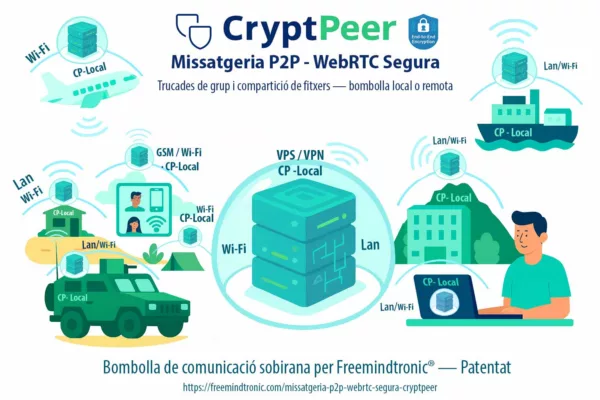
Hall 4 — Stand C286 — Cyber Pole

View Freemindtronic’s official Eurosatory 2026 exhibitor profile

Freemindtronic

Freemindtronic is a research and development company specializing in patented technologies for cybersecurity, security, traceability and dual-use counter-espionage.

The company develops sovereign technologies intended for civilian, industrial, governmental and defense environments.

20 Years of Innovation and R&D

Eurosatory 2026 is expected to be the most ambitious edition ever organized, bringing together global defence, security and resilience stakeholders across more than 185,000 m² of exhibition space.

Over two decades, this journey has resulted in:

  • 42 international patents granted
  • 24 international awards and distinctions
  • Technologies deployed in cybersecurity, cyber safety, traceability and counter-espionage

In 2026, PassCypher received the award for Best Cybersecurity Solution.

Freemindtronic Eurosatory 2026 Technologies

DataShielder

Data protection and encryption technologies.
DataShielder NFC HSM
DataShielder HSM PGP

PassCypher

Award-winning cybersecurity solutions.
PassCypher NFC HSM
PassCypher HSM PGP

EviKey NFC

Contactless trusted authentication technologies.
EviKey NFC Rugged USB Sticks

CryptPeer

Secure peer-to-peer communications.
CryptPeer web site clic here

CryptPeer Defense

Sovereign communications and trust architecture for defense environments.

[/row]

CryptPeer Defense & EviSKMS

CryptPeer Defense integrates EviSKMS, Freemindtronic’s sovereign trust technology designed to support resilient communications, secure identities and autonomous trust services.

Designed for connected, disconnected, hybrid and degraded environments, EviSKMS enables segmented-key management without dependency on centralized infrastructure.
The architecture is intended for defence, critical infrastructure, industrial resilience and autonomous operational environments.
It addresses emerging challenges related to operational resilience, digital sovereignty, secure communications and future autonomous systems.

Visitors interested in evaluating CryptPeer technologies can access a dedicated online environment and discover sovereign communication services designed for trusted operational environments.

EviSKMS combines:

  • Segmented Key Management
  • PKI Compatibility
  • HSM Compatibility
  • TPM Compatibility
  • Sovereign Trust Architecture
  • Offline Operational Capability

From Human DNA to Sovereign Digital Trust

Research initiated in 2022 around Human DNA as a trust material led to the EviDNA program and the exploration of new approaches to digital trust.

In 2024, Freemindtronic demonstrated operational cryptographic workflows using Human DNA Material as a trust foundation.

These works progressively evolved toward broader concepts of:

  • Identity
  • Lineage
  • Inheritance
  • Evolution
  • Continuity

Today these concepts contribute to the development of future sovereign trust architectures designed for resilience, autonomy and trusted digital interactions.

The next evolution of these research works will be discussed during Eurosatory 2026.
Interview Eurosatory 2026

Jacques Gascuel will be interviewed by Aude Leroy during Eurosatory 2026.

The interview will explore the evolution of Freemindtronic’s research from the EviDNA program and Human DNA-based cryptographic trust experiments presented at Eurosatory 2024 to a new generation of sovereign trust technologies that have not yet been publicly disclosed.

This new interview continues the discussion initiated with Aude Leroy at Eurosatory 2024 and highlights the evolution of concepts originally presented around digital identity, cryptographic trust and segmented-key architectures.

Moreover, some of these advances will be discussed publicly for the first time during Eurosatory 2026.
Eurosatory 2024 Interview with Aude Leroy

Watch the official Eurosatory 2024 interview conducted by defence and security journalist Aude Leroy.

During this interview, Jacques Gascuel presented DataShielder Defense, segmented-key technologies, counter-espionage innovations and the EviDNA program, including the use of Human DNA as a cryptographic trust material and the concept of Digital Human DNA.

This interview provides the historical foundation for the technologies and research developments that will be presented at Eurosatory 2026.
Meet Freemindtronic at Eurosatory 2026

Discover CryptPeer Defense live demonstrations and sovereign communication services at Hall 4 – Stand C286.
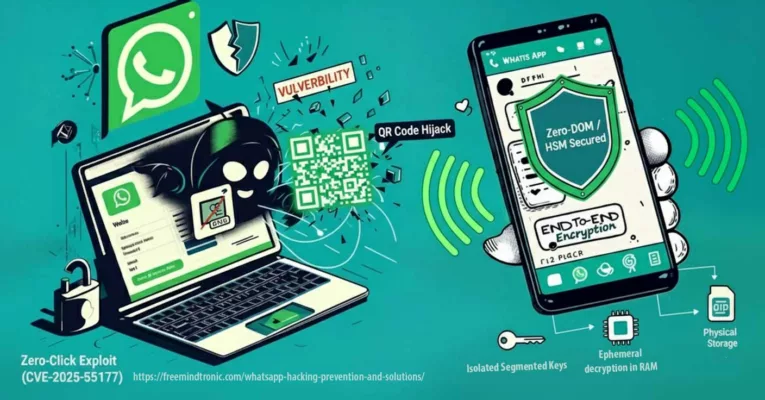
Hall 4 — Stand C286
AMG PRO — Cyber Pole

Official Eurosatory Exhibitor Profile
Contact CryptPeer Team
Test CryptPeer Online

Cyberattaque HubEE : Rupture silencieuse de la confiance numérique

Cyberattaque HubEE : rupture silencieuse de la confiance numérique. Cette attaque, qui a permis l’exfiltration de 160 000 documents sensibles entre le 4 et le 9 janvier 2026, ne relève pas d’un incident isolé. Au contraire, elle révèle une fragilité structurelle au cœur de l’architecture étatique, là où la compromission ne ressemble plus à un piratage classique. Parce que l’intrusion exploite les mécanismes légitimes du système, elle expose un glissement profond : la sécurité ne dépend plus seulement du code, mais du modèle de confiance qui organise les flux administratifs.

Résumé express — Cyberattaque HubEE

Qu’est‑ce que HubEE ?

HubEE est le Hub d’Échange de l’État, la plateforme centrale qui assure la transmission des documents administratifs entre les administrations françaises et les téléservices publics.

Selon la DINUM, HubEE est un tiers de transmission reliant :

  • les Services Instructeurs (mairies, conseils départementaux, ministères, opérateurs sociaux) ;
  • les Opérateurs de Services en Ligne comme la DILA (Service‑public.fr), la DGS ou la CNAF.

Concrètement, HubEE reçoit les documents envoyés par les usagers via les téléservices, les décrypte puis les redistribue aux administrations concernées. Il fonctionne comme la poste électronique de l’État.

Parce qu’il centralise les flux documentaires, HubEE constitue un point unique de défaillance : une intrusion dans cette plateforme expose potentiellement l’ensemble des administrations connectées.

⚡ La découverte

La Cyberattaque HubEE a été détectée le 9 janvier 2026, après cinq jours d’intrusion discrète. Les attaquants ont exfiltré 160 000 documents sensibles issus d’environ 70 000 dossiers administratifs, sans perturber le fonctionnement du service. L’État a confirmé l’incident le 16 janvier, tout en minimisant la portée structurelle de la compromission.

✦ Impact immédiat

  • Exfiltration de documents d’identité, justificatifs de revenus et pièces sociales
  • Compromission possible d’identifiants prestataires
  • Risque d’usurpation d’identité, fraude sociale et revente ciblée
  • Absence de notification individuelle claire pour les usagers concernés

⚠ Message stratégique

L’incident révèle une rupture profonde : l’attaque n’exploite pas une faille logicielle isolée, mais l’architecture même du système. En effet, HubEE repose sur un modèle centralisé où la confiance est héritée, non vérifiée. Dès lors, un attaquant qui obtient un accès légitime peut agir dans le flux, sans alerte, tandis que le chiffrement en transit ne protège pas les documents une fois arrivés dans l’infrastructure.

⎔ Contre‑mesure souveraine

La réduction du risque passe par trois leviers complémentaires :

  • DataShielder HSM PGP — chiffrement hors‑ligne maîtrisé par l’usager, empêchant toute lecture par un intermédiaire
  • CryptPeer / EviLink — communication distribuée sans serveur, supprimant le point unique de défaillance
  • PassCypher HSM PGP Free — authentification passwordless et OTP hors‑ligne, éliminant l’héritage de privilèges
Envie d’aller plus loin ?
Le Résumé enrichi replace l’incident dans une dynamique plus large : celle d’un modèle étatique où la centralisation, la sous‑traitance et la confiance implicite créent une surface d’attaque systémique.

Paramètres de lecture

Résumé express : ≈ 1 min
Résumé avancé : ≈ 4 min
Chronique complète : ≈ 32 min
Date de publication : 2026-01-17
Dernière mise à jour : 2026-01-18
Niveau de complexité : Souverain & géopolitique
Densité technique : ≈ 72 %
Langues disponibles : FR · EN · ES · CAT
Focal thématique : HubEE, service-public.fr, données personnelles, architecture étatique
Type éditorial : Enquête — Freemindtronic Digital Security Series

Niveau d’enjeu : 8.7 / 10 — souveraineté & données

Note éditoriale —Ce dossier s’inscrit dans la rubrique Sécurité Digitale. Il prolonge les analyses consacrées aux architectures souveraines, aux failles structurelles des services publics numériques et aux dérives du modèle « centralisé donc fiable ». Cette enquête examine la Cyberattaque HubEE, la fragilité des chaînes de sous‑traitance et les limites d’un système où la confiance repose davantage sur l’infrastructure que sur la vérification cryptographique. Ce contenu s’inscrit dans la continuité des travaux publiés dans la rubrique Digital Security. Il suit la Déclaration de transparence IA de Freemindtronic Andorra — FM-AI-2025-11-SMD5

Références officielles

Les éléments techniques, juridiques et méthodologiques évoqués dans ce dossier s’appuient sur des sources institutionnelles reconnues, garantissant la vérifiabilité et la neutralité des informations présentées.

Illustration de l’exfiltration des données lors de la cyberattaque HubEE : serveur compromis, documents extraits

2026 Digital Security

EviDNA DNA Cryptography | Jacques Gascuel Memory

EviDNA DNA cryptography: Freemindtronic complementary reference memory — EviDNA, Digital DNA, cryptographic genome, cybersecurity and [...]

2022 2026 Digital Security

EviDNA cryptographie ADN | mémoire Jacques Gascuel

EviDNA cryptographie ADN : mémoire complémentaire de référence Freemindtronic — EviDNA, ADN Digital, génome cryptographique, [...]

2022 2026 Digital Security

Predictive Artificial Intelligence Architectures: Freemindtronic EviSKMS R&D Memorandum

Predictive Artificial Intelligence Architectures: Freemindtronic reference memorandum on Artificial Intelligence, World Models, LAMP-C, Cybersecurity and [...]

2022 2026 Digital Security

Architectures intelligence artificielle prédictive : mémoire EviSKMS R&D Freemindtronic

Architectures intelligence artificielle prédictive : mémoire de référence Freemindtronic sur l’IA, les modèles du monde, [...]

2025 2026 Digital Security Technical News

Quantum computer 6100 qubits ⮞ Historic 2025 breakthrough

A 6,100-qubit neutral-atom array marks a major scaling milestone in quantum computing, raising new strategic [...]

2025 2026 Digital Security

Vulnérabilité WhatsApp zero-click — Actions, contremesures et sécurité E2EE souveraine

Vulnérabilité WhatsApp zero-click — la faille critique CVE-2025-55177, associée à Apple CVE-2025-43300, permet l’exécution de [...]

2025 2026 Digital Security

WhatsApp zero-click vulnerability and runtime compromise

WhatsApp zero-click vulnerability — the critical flaw CVE-2025-55177, chained with Apple CVE-2025-43300, enables remote code [...]

2026 Cyber Doctrine Digital Security

Whisper Leak side-channel and LLM token leakage

Whisper Leak side-channel: token-length leakage, semantic inference, and the structural limits of HTTPS in large [...]

2023 2026 Digital Security Phishing

BITB Attacks: How to Avoid Phishing by iFrame

Browser-in-the-Browser (BITB) attacks: interface forgery through redirection iframes and the structural limits of browser trust. [...]

2026 Digital Security

Zero-knowledge vulnérable : attaques par downgrade contre Bitwarden, LastPass et Dashlane

Zero-knowledge vulnérable : les attaques par downgrade contre Bitwarden, LastPass et Dashlane révèlent comment la [...]

2026 Digital Security

Zero-Knowledge Downgrade Attacks — Structural Risks

Zero-Knowledge Downgrade Attacks: downgrade paths against Bitwarden, LastPass, and Dashlane show how cryptographic backward compatibility [...]

2025 Digital Security

Clickjacking des extensions DOM : DEF CON 33 révèle 11 gestionnaires vulnérables

Clickjacking d’extensions DOM : DEF CON 33 révèle une faille critique et les contre-mesures Zero-DOM

2025 Cyberculture Digital Security

Browser Fingerprinting Tracking: Metadata Surveillance in 2026

Browser Fingerprinting Tracking today represents one of the true cores of metadata intelligence. Far beyond [...]

2026 Digital Security

Browser Fingerprinting : le renseignement par métadonnées en 2026

Le browser fingerprinting constitue aujourd’hui l’un des instruments centraux du renseignement par métadonnées appliqué aux [...]

2023 2026 Digital Security

CVE-2023-32784 : Pourquoi PassCypher protège vos secrets

PassCypher HSM protège les secrets numériques. Il protège vos secrets numériques hors du périmètre du [...]

2023 2026 Digital Security

CVE-2023-32784 Protection with PassCypher NFC HSM

CVE-2023-32784 Protection with PassCypher NFC HSM safeguards your digital secrets. It protects your secrets beyond [...]

2026 Digital Security

Cyber espionnage zero day : marché, limites et doctrine souveraine

Cyber espionnage zero day : la fin des spywares visibles marque l’entrée dans une économie [...]

2026 Digital Security

Cyberattaque HubEE : Rupture silencieuse de la confiance numérique

Cyberattaque HubEE : rupture silencieuse de la confiance numérique. Cette attaque, qui a permis l’exfiltration [...]

2025 Digital Security

Persistent OAuth Flaw: How Tycoon 2FA Hijacks Cloud Access

Persistent OAuth Flaw — Tycoon 2FA Exploited — When a single consent becomes unlimited cloud [...]

2025 Digital Security

Tycoon 2FA failles OAuth persistantes dans le cloud | PassCypher HSM PGP

Faille OAuth persistante — Tycoon 2FA exploitée — Quand une simple autorisation devient un accès [...]

2025 Digital Security

OpenAI fuite Mixpanel : métadonnées exposées, phishing et sécurité souveraine

OpenAI fuite Mixpanel rappelle que même les géants de l’IA restent vulnérables dès qu’ils confient [...]

2025 Digital Security

OpenAI Mixpanel Breach Metadata – phishing risks and sovereign security with PassCypher

AI Mixpanel breach metadata is a blunt reminder of a simple rule: the moment sensitive [...]

2026 Crypto Currency Cryptocurrency Digital Security

Ledger Security Breaches from 2017 to 2026: How to Protect Yourself from Hackers

Ledger Security Breaches have become a major indicator of vulnerabilities in the global crypto ecosystem. [...]

2026 Digital Security

Failles de sécurité Ledger : Analyse 2017-2026 & Protections

Les failles de sécurité Ledger sont au cœur des préoccupations des investisseurs depuis 2017. Cette [...]

2025 Digital Security

Bot Telegram Usersbox : l’illusion du contrôle russe

Le bot Telegram Usersbox n’était pas un simple outil d’OSINT « pratique » pour curieux [...]

2025 Digital Security

Espionnage invisible WhatsApp : quand le piratage ne laisse aucune trace

Espionnage invisible WhatsApp n’est plus une hypothèse marginale, mais une réalité technique rendue possible par [...]

2025 Digital Security

Fuite données ministère interieur : messageries compromises et ligne rouge souveraine

Fuite données ministère intérieur. L’information n’est pas arrivée par une fuite anonyme ni par un [...]

2026 Digital Security

Silent Whisper espionnage WhatsApp Signal : une illusion persistante

Silent Whisper espionnage WhatsApp Signal est présenté comme une méthode gratuite permettant d’espionner des communications [...]

2026 Awards Cyberculture Digital Security Distinction Excellence EviOTP NFC HSM Technology EviPass EviPass NFC HSM technology EviPass Technology finalists PassCypher PassCypher

Quantum-Resistant Passwordless Manager — PassCypher finalist, Intersec Awards 2026 (FIDO-free, RAM-only)

Quantum-Resistant Passwordless Manager 2026 (QRPM) — Best Cybersecurity Solution Finalist by PassCypher sets a new [...]

2025 Cyberculture Cybersecurity Digital Security EviLink

CryptPeer messagerie P2P WebRTC : appels directs chiffrés de bout en bout

La messagerie P2P WebRTC sécurisée constitue le fondement technique et souverain de la communication directe [...]

2025 CyptPeer Digital Security EviLink

Missatgeria P2P WebRTC segura — comunicació directa amb CryptPeer

Missatgeria P2P WebRTC segura al navegador és l’esquelet tècnic i sobirà de la comunicació directa [...]

2025 Digital Security

Russia Blocks WhatsApp: Max and the Sovereign Internet

Step by step, Russia blocks WhatsApp and now openly threatens to “completely block” the messaging [...]

2020 Digital Security

WhatsApp Gold arnaque mobile : typologie d’un faux APK espion

WhatsApp Gold arnaque mobile — clone frauduleux d’application mobile, ce stratagème repose sur une usurpation [...]

2025 Digital Security

Spyware ClayRat Android : faux WhatsApp espion mobile

Spyware ClayRat Android illustre la mutation du cyberespionnage : plus besoin de failles, il exploite [...]

2025 Digital Security

Android Spyware Threat Clayrat : 2025 Analysis and Exposure

Android Spyware Threat: ClayRat illustrates the new face of cyber-espionage — no exploits needed, just [...]

2023 Digital Security

WhatsApp Hacking: Prevention and Solutions

WhatsApp hacking zero-click exploit (CVE-2025-55177) chained with Apple CVE-2025-43300 enables remote code execution via crafted [...]

2025 Digital Security Technical News

Sovereign SSH Authentication with PassCypher HSM PGP — Zero Key in Clear

SSH Key PassCypher HSM PGP establishes a sovereign SSH authentication chain for zero-trust infrastructures, where [...]

2025 Digital Security Tech Fixes Security Solutions Technical News

SSH Key PassCypher HSM PGP — Sécuriser l’accès multi-OS à un VPS

SSH Key PassCypher HSM PGP fournit une chaîne souveraine : génération locale de clés SSH [...]

2025 Digital Security Technical News

Générateur de mots de passe souverain – PassCypher Secure Passgen WP

Générateur de mots de passe souverain PassCypher Secure Passgen WP pour WordPress — le premier [...]

2025 Digital Security Technical News

Ordinateur quantique 6100 qubits ⮞ La percée historique 2025

Ordinateur quantique 6100 qubits marque un tournant dans l’histoire de l’informatique, soulevant des défis sans [...]

2025 Cyberculture Digital Security

Authentification multifacteur : anatomie, OTP, risques

Authentification Multifacteur : Anatomie souveraine Explorez les fondements de l’authentification numérique à travers une typologie [...]

2025 Digital Security

Clickjacking extensions DOM: Vulnerabilitat crítica a DEF CON 33

DOM extension clickjacking — el clickjacking d’extensions basat en DOM, mitjançant iframes invisibles, manipulacions del [...]

2025 Digital Security

DOM Extension Clickjacking — Risks, DEF CON 33 & Zero-DOM fixes

DOM extension clickjacking — a technical chronicle of DEF CON 33 demonstrations, their impact, and [...]

2025 Digital Security

Chrome V8 Zero-Day CVE-2025-10585 — Ton navigateur était déjà espionné ?

Chrome V8 zero-day CVE-2025-10585 — Votre navigateur n’était pas vulnérable. Vous étiez déjà espionné !

2025 Digital Security

Confidentialité métadonnées e-mail — Risques, lois européennes et contre-mesures souveraines

La confidentialité des métadonnées e-mail est au cœur de la souveraineté numérique en Europe : [...]

2025 Digital Security

Email Metadata Privacy: EU Laws & DataShielder

Email metadata privacy sits at the core of Europe’s digital sovereignty: understand the risks, the [...]

2025 Digital Security

Chrome V8 confusió RCE — Actualitza i postura Zero-DOM

Chrome V8 confusió RCE: aquesta edició exposa l’impacte global i les mesures immediates per reduir [...]

2025 Digital Security

Chrome V8 confusion RCE — Your browser was already spying

Chrome v8 confusion RCE: This edition addresses impacts and guidance relevant to major English-speaking markets [...]

2025 Digital Security

Passkeys Faille Interception WebAuthn | DEF CON 33 & PassCypher

Conseil RSSI / CISO – Protection universelle & souveraine EviBITB (Embedded Browser‑In‑The‑Browser Protection) est une [...]

2025 Cyberculture Digital Security

Reputation Cyberattacks in Hybrid Conflicts — Anatomy of an Invisible Cyberwar

Synchronized APT leaks erode trust in tech, alliances, and legitimacy through narrative attacks timed with [...]

2025 Digital Security

APT28 spear-phishing: Outlook backdoor NotDoor and evolving European cyber threats

Russian cyberattack on Microsoft by Midnight Blizzard (APT29) highlights the strategic risks to digital sovereignty. [...]

2024 Cyberculture Digital Security

Russian Cyberattack Microsoft: An Unprecedented Threat

Russian cyberattack on Microsoft by Midnight Blizzard (APT29) highlights the strategic risks to digital sovereignty. [...]

2024 Digital Security

Midnight Blizzard Cyberattack Against Microsoft and HPE: What are the consequences?

Midnight Blizzard Cyberattack against Microsoft and HPE: A detailed analysis of the facts, the impacts [...]

2025 Digital Security

eSIM Sovereignty Failure: Certified Mobile Identity at Risk

  Runtime Threats in Certified eSIMs: Four Strategic Blind Spots While geopolitical campaigns exploit the [...]

2025 Digital Security

APT29 Exploits App Passwords to Bypass 2FA

A silent cyberweapon undermining digital trust Two-factor authentication (2FA) was supposed to be the cybersecurity [...]

2015 Digital Security

Darknet Credentials Breach 2025 – 16+ Billion Identities Stolen

Underground Market: The New Gold Rush for Stolen Identities The massive leak of over 16 [...]

2025 Digital Security

Signal Clone Breached: Critical Flaws in TeleMessage

TeleMessage: A Breach That Exposed Cloud Trust and National Security Risks TeleMessage, marketed as a [...]

2025 Digital Security

APT29 Spear-Phishing Europe: Stealthy Russian Espionage

APT29 SpearPhishing Europe: A Stealthy LongTerm Threat APT29 spearphishing Europe campaigns highlight a persistent and [...]

2025 Digital Security

APT36 SpearPhishing India: Targeted Cyberespionage | Security

Understanding Targeted Attacks of APT36 SpearPhishing India APT36 cyberespionage campaigns against India represent a focused [...]

2025 Digital Security

Microsoft Outlook Zero-Click Vulnerability: Secure Your Data Now

Microsoft Outlook Zero-Click Vulnerability: How to Protect Your Data Now A critical Zero-Click vulnerability (CVE-2025-21298) [...]

2025 Digital Security

Microsoft Vulnerabilities 2025: 159 Flaws Fixed in Record Update

Microsoft: 159 Vulnerabilities Fixed in 2025 Microsoft has released a record-breaking security update in January [...]

2025 Digital Security

APT44 QR Code Phishing: New Cyber Espionage Tactics

APT44 Sandworm: The Elite Russian Cyber Espionage Unit Unmasking Sandworm’s sophisticated cyber espionage strategies and [...]

2025 Digital Security

BadPilot Cyber Attacks: Russia’s Threat to Critical Infrastructures

BadPilot Cyber Attacks: Sandworm’s New Weaponized Subgroup Understanding the rise of BadPilot and its impact [...]

2024 Digital Security

Salt Typhoon & Flax Typhoon: Cyber Espionage Threats Targeting Government Agencies

Salt Typhoon – The Cyber Threat Targeting Government Agencies Salt Typhoon and Flax Typhoon represent [...]

2024 Digital Security

BitLocker Security: Safeguarding Against Cyberattacks

Introduction to BitLocker Security If you use a Windows computer for data storage or processing, [...]

2024 Digital Security

Cyberattack Exploits Backdoors: What You Need to Know

Cyberattack Exploits Backdoors: What You Need to Know In October 2024, a cyberattack exploited backdoors [...]

2021 Cyberculture Digital Security Phishing

Phishing Cyber victims caught between the hammer and the anvil

Phishing is a fraudulent technique that aims to deceive internet users and to steal their [...]

2024 Digital Security

Google Sheets Malware: The Voldemort Threat

Sheets Malware: A Growing Cybersecurity Concern Google Sheets, a widely used collaboration tool, has shockingly [...]

2024 Articles Digital Security News

Russian Espionage Hacking Tools Revealed

Russian Espionage Hacking Tools: Discovery and Initial Findings Russian espionage hacking tools were uncovered by [...]

2024 Digital Security Spying Technical News

Side-Channel Attacks via HDMI and AI: An Emerging Threat

Understanding the Impact and Evolution of Side-Channel Attacks in Modern Cybersecurity Side-channel attacks, also known [...]

Digital Security Spying Technical News

Are fingerprint systems really secure? How to protect your data and identity against BrutePrint

Fingerprint Biometrics: An In-Depth Exploration of Security Mechanisms and Vulnerabilities It is a widely recognized [...]

2024 Digital Security Technical News

Apple M chip vulnerability: A Breach in Data Security

Apple M chip vulnerability: uncovering a breach in data security Researchers at the Massachusetts Institute [...]

Digital Security Technical News

Brute Force Attacks: What They Are and How to Protect Yourself

Brute-force Attacks: A Comprehensive Guide to Understand and Prevent Them Brute Force: danger and protection [...]

2024 Digital Security

OpenVPN Security Vulnerabilities Pose Global Security Risks

Critical OpenVPN Vulnerabilities Pose Global Security Risks OpenVPN security vulnerabilities have come to the forefront, [...]

2024 Digital Security

Google Workspace Vulnerability Exposes User Accounts to Hackers

How Hackers Exploited the Google Workspace Vulnerability Hackers found a way to bypass the email [...]

2023 Digital Security

Predator Files: The Spyware Scandal That Shook the World

Predator Files: How a Spyware Consortium Targeted Civil Society, Politicians and Officials Cytrox: The maker [...]

2023 Digital Security

5Ghoul: 5G NR Attacks on Mobile Devices

5Ghoul: How Contactless Encryption Can Secure Your 5G Communications from Modem Attacks 5Ghoul is a [...]

2024 Digital Security

Leidos Holdings Data Breach: A Significant Threat to National Security

A Major Intrusion Unveiled In July 2024, the Leidos Holdings data breach came to light, [...]

2024 Digital Security

RockYou2024: 10 Billion Reasons to Use Free PassCypher

RockYou2024: A Cybersecurity Earthquake The RockYou2024 data leak has shaken the very foundations of global [...]

2024 Digital Security

Europol Data Breach: A Detailed Analysis

May 2024: Europol Security Breach Highlights Vulnerabilities In May 2024, Europol, the European law enforcement [...]

2024 Digital Security

Dropbox Security Breach 2024: Phishing, Exploited Vulnerabilities

Phishing Tactics: The Bait and Switch in the Aftermath of the Dropbox Security Breach The [...]

Digital Security EviToken Technology Technical News

EviCore NFC HSM Credit Cards Manager | Secure Your Standard and Contactless Credit Cards

EviCore NFC HSM Credit Cards Manager is a powerful solution designed to secure and manage [...]

2024 Digital Security

Kapeka Malware: Comprehensive Analysis of the Russian Cyber Espionage Tool

Kapeka Malware: The New Russian Intelligence Threat   In the complex world of cybersecurity, a [...]

2024 Cyberculture Digital Security News Training

Andorra National Cyberattack Simulation: A Global First in Cyber Defense

Andorra Cybersecurity Simulation: A Vanguard of Digital Defense Andorra-la-Vieille, April 15, 2024 – Andorra is [...]

Articles Digital Security EviVault Technology NFC HSM technology Technical News

EviVault NFC HSM vs Flipper Zero: The duel of an NFC HSM and a Pentester

EviVault NFC HSM vs Flipper Zero: The duel of an NFC HSM and a Pentester [...]

Articles Cryptocurrency Digital Security Technical News

Securing IEO STO ICO IDO and INO: The Challenges and Solutions

Securing IEO STO ICO IDO and INO: How to Protect Your Crypto Investments Cryptocurrencies are [...]

2023 Articles Digital Security Technical News

Remote activation of phones by the police: an analysis of its technical, legal and social aspects

What is the new bill on justice and why is it raising concerns about privacy? [...]

Articles Cyberculture Digital Security Technical News

Protect Meta Account Identity Theft with EviPass and EviOTP

Protecting Your Meta Account from Identity Theft Meta is a family of products that includes [...]

2024 Digital Security

Cybersecurity Breach at IMF: A Detailed Investigation

Cybersecurity Breach at IMF: A Detailed Investigation Cybersecurity breaches are a growing concern worldwide. The [...]

2023 Articles Cyberculture Digital Security Technical News

Strong Passwords in the Quantum Computing Era

How to create strong passwords in the era of quantum computing? Quantum computing is a [...]

2024 Digital Security

PrintListener: How to Betray Fingerprints

PrintListener: How this Technology can Betray your Fingerprints and How to Protect yourself PrintListener revolutionizes [...]

Les chroniques affichées ci-dessus ↑ appartiennent à la section Sécurité Numérique.
Elles prolongent l’analyse des architectures centralisées, des risques systémiques liés aux plateformes d’intermédiation étatiques, et des conséquences citoyennes des fuites de données administratives.
Cette sélection complète la présente chronique dédiée à la Cyberattaque HubEE (2026) et aux failles structurelles d’un modèle fondé sur la concentration des flux, la dépendance aux prestataires tiers, et l’absence de chiffrement souverain.

Chapitre 1 — Une confirmation tardive, un récit maîtrisé

La Cyberattaque HubEE a été détectée le 9 janvier 2026, mais l’État n’a communiqué publiquement que le 16 janvier.
Cette temporalité, bien que conforme aux obligations minimales prévues par le cadre de notification des violations de données défini par la CNIL, révèle une stratégie de communication prudente.

En effet, la DINUM a choisi de présenter l’incident comme un événement circonscrit, alors que l’exfiltration de 160 000 documents démontre une compromission bien plus profonde.
Ainsi, la première semaine a servi à contenir le récit autant qu’à contenir l’attaque.

Dès l’annonce officielle, le discours a insisté sur deux éléments : l’absence d’impact sur Service‑public.fr et la maîtrise rapide de l’incident.
Cependant, cette formulation crée une ambiguïté, car elle distingue la plateforme visible du public de l’infrastructure réelle qui traite les documents — une distinction pourtant documentée dans les architectures d’intermédiation de l’État.

Par conséquent, la communication institutionnelle a minimisé la portée systémique de l’intrusion, tout en évitant de préciser la nature exacte des données compromises, contrairement aux recommandations de transparence formulées par la CNIL en cas de fuite de données sensibles.

Cette gestion du calendrier, combinée à un vocabulaire soigneusement choisi, montre que la communication a été calibrée pour rassurer plutôt que pour exposer la réalité structurelle de la compromission.
Dès lors, le récit officiel s’est construit autour d’une idée simple : l’incident est maîtrisé, même si les causes profondes restent floues.

Chapitre 2 — HubEE : un maillon invisible devenu point de rupture

HubEE fonctionne comme un hub d’échange documentaire entre les administrations françaises.
Bien qu’invisible pour les citoyens, il constitue un maillon central du parcours administratif.
Ainsi, lorsqu’un usager transmet un justificatif via Service‑public.fr, HubEE assure la circulation du document vers les organismes concernés, notamment la CNAF.
Cette position stratégique transforme HubEE en point de passage obligé, et donc en cible privilégiée.

Parce que la plateforme centralise les flux, elle concentre également les risques.
Dès lors, une intrusion dans HubEE ne touche pas un service isolé, mais l’ensemble des administrations connectées.
Cette architecture, conçue pour simplifier les échanges, crée paradoxalement un point unique de défaillance.
Ainsi, l’attaque ne compromet pas seulement un système : elle fragilise un écosystème entier.

En outre, la plupart des usagers ignorent l’existence même de HubEE.
Cette invisibilité complique la perception du risque, car elle masque la réalité des flux documentaires.
Par conséquent, l’incident révèle un paradoxe : plus une infrastructure est invisible, plus son impact est massif lorsqu’elle cède.

Chapitre 3 — Une intrusion qui révèle une faille d’architecture

L’intrusion s’est déroulée entre le 4 et le 9 janvier 2026, sans perturber le fonctionnement du service.
Cette discrétion indique que les attaquants ont utilisé un accès légitime ou un mécanisme interne, plutôt qu’une exploitation bruyante.
Ainsi, la Cyberattaque HubEE ne résulte pas d’un piratage classique, mais d’un détournement de confiance.

Parce que HubEE déchiffre les documents pour les redistribuer, l’attaquant a pu accéder à des données en clair.
Dès lors, le chiffrement en transit ne suffit plus : la faille réside dans l’absence de chiffrement de bout en bout.
Cette architecture, héritée d’un modèle centralisé, expose les documents dès qu’ils atteignent l’infrastructure.

L’incident montre que la sécurité d’un système ne dépend pas uniquement de ses correctifs techniques, mais de la manière dont il organise la confiance.
Ainsi, une architecture qui accorde trop de privilèges à un point central devient vulnérable, même si elle applique toutes les bonnes pratiques apparentes.

Chapitre 6 — Les contradictions du discours officiel

Dès les premières déclarations, plusieurs contradictions ont émergé dans le discours institutionnel.
Alors que la DINUM affirmait que l’incident était « maîtrisé », elle reconnaissait simultanément que l’exfiltration avait duré cinq jours sans être détectée.
Ainsi, la communication oscillait entre volonté de rassurer et nécessité de reconnaître l’ampleur de la compromission.

De plus, l’État a insisté sur le fait que Service‑public.fr n’était pas touché.
Cependant, cette précision détourne l’attention du véritable problème : ce n’est pas la façade visible qui a été compromise, mais l’infrastructure qui traite les documents.
Par conséquent, la distinction entre la plateforme et son moteur interne a créé une confusion qui a minimisé la perception du risque.

Enfin, les autorités ont évoqué une « intrusion maîtrisée » sans expliquer comment un attaquant a pu agir pendant plusieurs jours dans un système censé être surveillé.
Cette formulation, volontairement vague, laisse entendre que la détection n’a pas fonctionné comme prévu.
Ainsi, les contradictions du discours officiel révèlent une tension entre transparence et préservation de l’image de l’État numérique.

Chapitre 4 — Le sous‑traitant fantôme : l’angle mort de la communication

Dès les premières communications, un élément a attiré l’attention : la mention d’un sous‑traitant impliqué dans la compromission.
Cependant, ni son nom, ni son rôle précis, ni la nature de son accès n’ont été rendus publics.
Cette absence d’information crée un angle mort majeur, car elle empêche d’évaluer la chaîne de confiance réelle derrière HubEE.

En effet, lorsqu’un prestataire détient des accès techniques ou opérationnels, il devient un maillon critique de la sécurité.
Ainsi, si ses identifiants sont compromis, l’attaquant hérite automatiquement de ses privilèges.
Dès lors, la Cyberattaque HubEE révèle un problème structurel : la délégation de confiance à des acteurs invisibles, sans contrôle cryptographique indépendant.

Cette opacité complique également la compréhension du périmètre exact de l’intrusion.
Parce que le prestataire n’est pas identifié, il est impossible de savoir s’il intervenait sur l’infrastructure, sur la maintenance, sur les flux documentaires ou sur la supervision.
Par conséquent, l’incident met en lumière une fragilité récurrente des services publics numériques : la dépendance à des tiers dont la sécurité conditionne celle de l’État.


Résumé enrichi — Quand la Cyberattaque HubEE révèle une rupture de confiance

Du constat factuel à la dynamique structurelle

Ce résumé enrichi complète le premier niveau de lecture. Il ne se limite pas à décrire l’exfiltration des 160 000 documents.
Au contraire, il replace la Cyberattaque HubEE dans une dynamique plus profonde : celle d’un modèle administratif centralisé où la confiance repose sur l’infrastructure, tandis que la vérification cryptographique reste absente.
Ainsi, l’incident ne constitue pas une anomalie, mais le symptôme d’un système qui accorde trop de privilèges à ses propres mécanismes internes.

Le modèle historique de l’État numérique : centralisation et héritage

Historiquement, les plateformes administratives ont été conçues autour d’un principe simple : un hub central, plusieurs administrations connectées, un flux unifié.
Ce modèle, efficace en apparence, crée cependant une corrélation dangereuse : un accès légitime équivaut à une légitimité totale.
Dès lors, la sécurité dépend moins du chiffrement que de la capacité à protéger un point unique de confiance.

L’héritage de confiance comme vecteur d’attaque

Dans ce contexte, un attaquant n’a plus besoin de casser un système.
Il lui suffit d’hériter d’un accès déjà autorisé — par exemple via un compte prestataire compromis ou un jeton valide.
Parce que HubEE considère cet accès comme légitime, l’attaquant peut alors agir dans le flux, sans provoquer d’alerte.
Le chiffrement en transit fonctionne, mais il protège uniquement le transport, pas l’environnement déjà compromis.

De la vulnérabilité technique à la bascule stratégique

C’est ici que se situe la véritable rupture.
Contrairement aux attaques classiques, l’intrusion HubEE ne repose pas sur une faille logicielle isolée.
Elle exploite la logique même du système : centralisation, héritage de privilèges, absence de cloisonnement et confiance implicite.
Par conséquent, la détection devient secondaire, puisque l’attaque n’enfreint aucune règle apparente.

Quand le risque quitte le code pour l’architecture de confiance

Cette invisibilité opérationnelle remet en cause l’idée selon laquelle la sécurité d’un service public peut être évaluée uniquement à travers ses correctifs techniques.
Lorsque l’attaque exploite la structure même de la confiance, la surface de risque se déplace : elle ne réside plus dans le code, mais dans la manière dont l’État organise, délègue et centralise ses flux documentaires.

Ce qu’il faut retenir

  • Le chiffrement protège les flux, pas les documents une fois arrivés dans HubEE.
  • Un accès légitime n’est pas synonyme d’utilisateur légitime.
  • La centralisation amplifie mécaniquement l’impact d’une intrusion.
  • L’attaque devient invisible lorsqu’elle exploite les mécanismes normaux du système.

Chapitre 7 — Les risques concrets pour les citoyens

L’exfiltration de 160 000 documents expose les citoyens à des risques immédiats et différés.
Selon les analyses publiées par la CNIL, les fuites de pièces d’identité, de justificatifs de revenus ou de documents sociaux constituent l’un des vecteurs les plus critiques d’usurpation et de fraude.

Parce que les pièces compromises incluent des justificatifs d’identité, de revenus et de situation familiale, elles peuvent alimenter des fraudes ciblées.
Ainsi, les victimes potentielles ne sont pas seulement les usagers concernés, mais aussi les organismes sociaux qui devront gérer les conséquences, comme l’ont déjà souligné plusieurs autorités publiques dans des cas similaires.

Le premier risque est l’usurpation d’identité.
Avec un justificatif de domicile, une pièce d’identité et un document social, un attaquant peut constituer un dossier complet pour ouvrir des comptes, contracter des crédits ou détourner des prestations — un scénario explicitement décrit dans les recommandations de la CNIL sur les violations de données sensibles.

Le second risque concerne la fraude sociale.
Les documents exfiltrés peuvent permettre de simuler des situations familiales ou financières, ce qui fragilise les dispositifs d’aide.
La ANSSI rappelle que les données administratives constituent un matériau privilégié pour les attaques d’ingénierie sociale, notamment lorsqu’elles sont revendues sur des marchés spécialisés et utilisées pour des campagnes de phishing ciblé.

Enfin, l’absence de notification individuelle claire complique la capacité des citoyens à se protéger.
Selon la CNIL, la transparence envers les personnes concernées est un élément essentiel de la limitation des risques, car elle leur permet de surveiller leurs comptes, d’anticiper les tentatives d’usurpation et de prendre des mesures préventives.

Ainsi, l’impact réel de la Cyberattaque HubEE pourrait se révéler progressivement, au fil des mois, comme cela a été observé dans d’autres incidents impliquant des données administratives sensibles.

Chapitre 8 — Les responsabilités politiques et techniques

La Cyberattaque HubEE met en lumière une responsabilité partagée entre les acteurs politiques, les équipes techniques et les prestataires.
Parce que HubEE constitue un maillon central de l’État numérique, sa sécurité relève autant de la gouvernance que de la technique.
Ainsi, l’incident révèle une chaîne de responsabilités qui dépasse largement la seule DINUM.

Sur le plan politique, la centralisation des services administratifs a été encouragée pour simplifier les démarches.
Cependant, cette stratégie n’a pas été accompagnée d’une réflexion équivalente sur la segmentation cryptographique ou la souveraineté des flux.
Dès lors, l’État a construit une architecture efficace, mais vulnérable par conception.

Sur le plan technique, la dépendance à des prestataires extérieurs crée une dilution de la responsabilité.
Lorsque plusieurs acteurs interviennent sur une même infrastructure, la sécurité dépend du maillon le plus faible.
Ainsi, l’absence d’identification publique du sous‑traitant empêche d’évaluer la robustesse de la chaîne.

Enfin, la gouvernance de la cybersécurité repose encore trop souvent sur des audits ponctuels, alors que les menaces évoluent en continu.
Par conséquent, l’incident HubEE montre que la sécurité doit devenir un processus permanent, et non une conformité administrative.

Chapitre 9 — Les questions que l’enquête met sur la table

L’enquête ouverte après la Cyberattaque HubEE soulève plusieurs questions essentielles.
Certaines concernent la technique, d’autres la gouvernance, et d’autres encore la transparence.
Ainsi, l’incident agit comme un révélateur des zones d’ombre du modèle administratif actuel.

La première question porte sur l’accès initial : comment un attaquant a‑t‑il pu obtenir un accès légitime ou un jeton valide ?
Cette interrogation conditionne toute la compréhension de l’intrusion.
Si l’accès provient d’un prestataire, alors la chaîne de sous‑traitance doit être réévaluée.

La deuxième question concerne la détection.
Pourquoi l’exfiltration massive de documents n’a‑t‑elle pas déclenché d’alerte ?
Cette absence de signal montre que les mécanismes de surveillance ne sont pas adaptés aux attaques qui exploitent les privilèges internes.

La troisième question touche à la transparence.
Pourquoi les usagers n’ont‑ils pas été informés individuellement ?
Cette omission complique la capacité des citoyens à se protéger, alors que le RGPD impose une notification lorsque le risque est élevé.

Enfin, une question plus large se pose : l’architecture actuelle peut‑elle encore garantir la confiance ?
L’incident montre que la réponse dépend moins du code que du modèle de confiance qui structure les échanges.

Chapitre 5 — Une architecture qui amplifie l’impact

L’architecture de HubEE repose sur un principe simple : centraliser les échanges documentaires pour fluidifier les démarches administratives.
Cependant, cette centralisation crée un effet mécanique : l’impact d’une intrusion augmente proportionnellement au nombre d’administrations connectées.
Ainsi, une faille dans HubEE ne touche pas un service isolé, mais l’ensemble des organismes qui s’appuient sur cette plateforme.

Parce que HubEE reçoit, déchiffre et redistribue les documents, il devient un point de passage incontournable.
Dès lors, l’attaquant qui accède à cette zone peut observer ou exfiltrer des données provenant de multiples sources.
Cette configuration transforme une faille locale en incident national, ce qui explique l’ampleur des 160 000 documents compromis.

En outre, l’absence de cloisonnement strict entre les flux accentue le risque.
Lorsque les documents transitent dans un même espace logique, une compromission permet d’accéder à des données hétérogènes : pièces d’identité, justificatifs de revenus, attestations sociales, documents familiaux.
Ainsi, l’architecture amplifie non seulement le volume, mais aussi la diversité des données exposées.

Cette situation montre que la sécurité ne peut plus reposer sur la seule protection d’un point central.
Au contraire, elle doit s’appuyer sur une segmentation cryptographique, où chaque document reste protégé indépendamment de l’infrastructure qui le transporte.

Chapitre 10 — Comment l’attaque a pu réussir, et par qui

Même si l’enquête judiciaire n’a pas encore identifié les auteurs, plusieurs éléments permettent de comprendre comment l’attaque a pu réussir.
Parce que l’intrusion s’est déroulée sans bruit, elle repose probablement sur un accès légitime ou sur un mécanisme interne détourné.
Ainsi, l’attaquant n’a pas eu besoin de casser le système : il lui a suffi d’en hériter.

Trois hypothèses se dégagent.
La première concerne un compte prestataire compromis.
Si un sous‑traitant disposait d’un accès technique, un simple vol d’identifiants pouvait suffire.
La deuxième hypothèse repose sur un jeton d’accès valide, obtenu via phishing ou compromission locale.
La troisième évoque une intrusion interne, plus rare mais cohérente avec la discrétion de l’attaque.

Dans tous les cas, l’architecture centralisée de HubEE a facilité la progression de l’attaquant.
Parce que les documents sont déchiffrés dans l’infrastructure, l’accès à cette zone permet d’observer ou d’exfiltrer des données en clair.
Ainsi, l’attaque ne révèle pas seulement une faille opérationnelle, mais une faiblesse structurelle.

Enfin, la durée de l’intrusion montre que les mécanismes de détection n’ont pas fonctionné comme prévu.
Cette situation suggère que l’attaquant connaissait bien l’environnement, ce qui renforce l’hypothèse d’un accès hérité plutôt que d’un piratage externe.

Et si la cible avait utilisé PassCypher NFC HSM / HSM PGP ?

Si les accès prestataires ou administratifs avaient été protégés par PassCypher NFC HSM ou HSM PGP, l’attaque HubEE aurait été structurellement impossible, même avec un accès légitime compromis.

  • Aucun identifiant exploitable : PassCypher ne stocke ni mots de passe, ni secrets persistants, ni tokens réutilisables.
  • OTP hors-ligne : chaque accès repose sur un code à usage unique généré dans un HSM NFC, impossible à intercepter.
  • Aucun accès persistant : l’attaquant ne peut pas maintenir une session ou réutiliser un secret.
  • Modèle de confiance inversé : l’identité n’est plus validée par le serveur, mais par le HSM de l’utilisateur.

Dans ce scénario, l’attaque HubEE n’aurait pas pu obtenir d’accès durable, ni contourner les contrôles, ni exploiter un identifiant interne.

Chapitre 11 — Les alternatives : sortir du modèle vulnérable

La Cyberattaque HubEE montre que le modèle actuel, fondé sur la centralisation et l’héritage de privilèges, atteint ses limites.
Pour restaurer la confiance, il ne suffit plus de renforcer les contrôles : il faut repenser l’architecture.
Ainsi, la souveraineté numérique passe par une transformation profonde des mécanismes de confiance.

La première alternative consiste à adopter une segmentation cryptographique.
Avec des solutions comme DataShielder HSM PGP, chaque document reste chiffré de bout en bout, indépendamment de l’infrastructure.
Dès lors, même une intrusion dans un hub ne permet plus de lire les données.

La deuxième alternative repose sur des communications distribuées.
Avec CryptPeer / EviLink, les échanges ne transitent plus par un point central, ce qui élimine le risque de compromission massive. Ainsi, la surface d’attaque se réduit mécaniquement.

La troisième alternative concerne l’authentification.
Avec PassCypher HSM PGP Free, les accès ne reposent plus sur des identifiants persistants, mais sur des OTP hors‑ligne impossibles à intercepter.
Par conséquent, l’héritage de privilèges disparaît.

Ces approches montrent qu’il est possible de construire un modèle où la confiance ne dépend plus d’un hub central, mais d’une cryptographie maîtrisée par l’usager.
Ainsi, la souveraineté numérique devient une réalité opérationnelle, et non un slogan.

Et si les documents avaient été chiffrés avec DataShielder NFC HSM / HSM PGP ?

Si les documents transmis via HubEE avaient été chiffrés en amont avec DataShielder NFC HSM ou HSM PGP, l’exfiltration de 160 000 fichiers n’aurait eu aucune valeur exploitable.

  • Chiffrement E2E hors-ligne : les documents sont chiffrés avant l’envoi, dans un HSM NFC.
  • Aucune clé côté serveur : HubEE ne peut ni lire ni déchiffrer les documents.
  • Exfiltration = blobs chiffrés : même en cas de fuite massive, les données restent cryptographiquement inutilisables.
  • Résilience aux attaques internes : même un agent interne ne peut rien exploiter sans le HSM du détenteur.

Dans ce scénario, l’attaque HubEE aurait été un incident technique, pas une catastrophe nationale.

Synthèse : ce que révèlent ces scénarios souverains

Les scénarios PassCypher, DataShielder et CryptPeer démontrent que l’ampleur de la cyberattaque HubEE n’est pas liée à la sophistication de l’attaque, mais au modèle de confiance centralisé sur lequel repose l’architecture actuelle.

Avec une approche souveraine, qu’elle soit déployée indépendamment ou en écosystème, l’impact aurait été radicalement différent :

  • les accès n’auraient pas été exploitables grâce à l’authentification hors‑ligne et non réutilisable (PassCypher) ;
  • les documents exfiltrés seraient restés illisibles, chiffrés en amont dans le terminal (DataShielder) ;
  • les flux n’auraient jamais été interceptables, car ils n’auraient pas transité en clair par un hub central (CryptPeer) ;
  • HubEE n’aurait plus constitué un point unique de défaillance ;
  • l’architecture étatique aurait été résiliente par conception, et non par réaction.

Qu’elle soit appliquée seule ou combinée, chacune de ces solutions aurait réduit l’incident à un événement mineur — voire l’aurait rendu totalement inopérant. L’attaque HubEE n’aurait pas pu produire les effets systémiques observés.

Contre‑mesures souveraines

La Cyberattaque HubEE montre que la sécurité ne peut plus dépendre d’une infrastructure centralisée où les accès, les documents et les flux convergent vers un même point de défaillance. Les contre‑mesures souveraines doivent agir à la source : sur la cryptographie, l’authentification et la distribution des échanges. Elles réduisent mécaniquement l’impact d’une intrusion, même lorsque l’attaquant obtient un accès légitime.

1. DataShielder HSM PGP — Chiffrement hors‑ligne maîtrisé par l’usager

Avec DataShielder HSM PGP, chaque document est chiffré de bout en bout avant son envoi, directement dans le terminal de l’usager. Même si un attaquant accède à un hub ou à un prestataire, il ne peut rien lire. Cette approche supprime la dépendance à la confiance implicite dans les serveurs.

2. CryptPeer / EviLink — Communications distribuées via un relais aveugle

CryptPeer élimine le point unique de défaillance. Les échanges ne transitent plus en clair par une plateforme centrale, mais par un canal pair‑à‑pair éphémère où le serveur relais ne voit que des blocs AES‑256 déjà chiffrés. Une intrusion dans une infrastructure ne permet plus d’observer ni d’intercepter les flux.

3. PassCypher HSM PGP Free — Authentification sans identifiants persistants

PassCypher remplace les identifiants classiques par des OTP hors‑ligne impossibles à intercepter ou à réutiliser. Un attaquant ne peut plus hériter d’un accès prestataire ou d’un jeton valide. Cette approche supprime l’héritage de privilèges, cœur du problème HubEE.

En combinant ces trois leviers — ou même en les déployant séparément — il devient possible de construire un modèle où la confiance ne repose plus sur l’infrastructure, mais sur la cryptographie maîtrisée par l’usager. Une attaque comparable à HubEE serait alors réduite à un incident mineur, voire rendue impossible.

Il convient également de rappeler que ces technologies souveraines ne sont pas théoriques.
Les versions régaliennes de DataShielder et PassCypher ont été officiellement présentées lors des éditions Eurosatory 2022 et Eurosatory 2024, démontrant leur maturité opérationnelle dans des environnements de défense et de sécurité.
De la même manière, la version régalienne de CryptPeer — incluant l’auto‑hébergement, l’auto‑portabilité et un service complet de client messagerie — sera présentée par AMG PRO partenaire de Freemindtronic à Eurosatory 2026.
Ces présentations successives confirment que ces solutions s’inscrivent dans un écosystème souverain déjà reconnu par les acteurs institutionnels et industriels.

Modèle centralisé vs modèle souverain

Critère Modèle centralisé (HubEE) Modèle souverain (Freemindtronic)
Architecture Point unique de défaillance Distribution des flux
Chiffrement En transit uniquement E2E hors‑ligne (HSM PGP)
Accès Identifiants persistants OTP hors‑ligne
Résilience Impact massif en cas d’intrusion Impact localisé, cloisonné
Confiance Héritée Vérifiable cryptographiquement

HubEE vs Architecture distribuée

Aspect HubEE Architecture distribuée
Visibilité Infrastructures invisibles pour l’usager Flux transparents et segmentés
Détection Difficile si accès légitime Détection locale par nœud
Propagation Propagation systémique Propagation limitée
Exfiltration Massive Fragmentée

Chiffrement en transit vs chiffrement E2E

Critère Chiffrement en transit Chiffrement E2E
Protection Uniquement pendant le transport Du producteur au destinataire
Lecture par l’infrastructure Oui Impossible
Résilience Faible Très élevée
Modèle de confiance Basé sur l’infrastructure Basé sur la cryptographie

Cas d’usage souverain

Pour illustrer la transition vers un modèle souverain, voici trois scénarios concrets où les solutions Freemindtronic éliminent les failles révélées par la Cyberattaque HubEE.

1. Transmission d’un justificatif administratif

L’usager chiffre son document avec DataShielder HSM PGP avant l’envoi.
Ainsi, même si un hub ou un prestataire est compromis, le document reste illisible.
L’administration destinataire le déchiffre localement, sans intermédiaire.

2. Échange sécurisé entre deux administrations

CryptPeer crée un canal pair‑à‑pair éphémère entre les deux organismes.
Le flux ne transite plus par un serveur central, ce qui supprime le risque d’exfiltration massive.

3. Accès prestataire sans identifiants persistants

Avec PassCypher, le prestataire ne possède plus de mot de passe ou de jeton durable.
Chaque accès repose sur un OTP hors‑ligne, utilisable une seule fois.
Ainsi, même si un attaquant vole un appareil, il ne peut pas se connecter.

Signaux faibles

Plusieurs éléments périphériques, bien que peu commentés, éclairent la dynamique réelle de la Cyberattaque HubEE.
Ces signaux faibles révèlent des incohérences, des omissions et des zones d’ombre qui méritent une attention particulière.

  • Absence de notification individuelle — alors que le RGPD l’exige en cas de risque élevé.
  • Silence sur le prestataire — aucun nom, aucun périmètre, aucune responsabilité publique.
  • Rétablissement rapide — un retour à la normale en 48 h, inhabituel pour une intrusion de cette ampleur.
  • Communication centrée sur Service‑public.fr — alors que le problème se situe dans HubEE.
  • Durée de l’intrusion — cinq jours sans détection, signe d’un accès hérité plutôt que d’un piratage externe.

Pris isolément, ces éléments semblent anodins.
Ensemble, ils dessinent un paysage où la transparence reste partielle et où la gouvernance de la cybersécurité doit évoluer.

FAQ

Les citoyens concernés seront‑ils contactés ?

À ce jour, aucune notification individuelle n’a été envoyée. Pourtant, le RGPD impose cette démarche lorsque le risque est élevé.
L’absence de notification empêche les usagers de surveiller leurs comptes, de bloquer les démarches frauduleuses ou de protéger leurs proches.

Les documents exfiltrés sont‑ils exploitables ?

Oui. Les pièces d’identité, justificatifs de revenus, attestations familiales et documents sociaux permettent de constituer des dossiers complets pour des fraudes ciblées : crédits, prestations sociales, abonnements, usurpation d’identité ou phishing personnalisé.

Pourquoi l’attaque n’a‑t‑elle pas été détectée plus tôt ?

Parce qu’elle exploite un accès légitime ou un mécanisme interne. Ce type d’attaque contourne les alertes classiques, qui surveillent surtout les comportements anormaux ou les intrusions externes.
Dans un modèle centralisé, un accès interne suffit pour exfiltrer des volumes massifs sans déclencher d’alarme.

Le chiffrement en transit protège‑t‑il les documents ?

Non. Une fois arrivés dans HubEE, les documents sont automatiquement déchiffrés pour être traités et redistribués.
Le chiffrement en transit protège uniquement le transport, pas le stockage ni la manipulation interne.
C’est précisément ce point qui rend l’architecture vulnérable.

Le modèle actuel peut‑il être sécurisé ?

Oui, mais seulement en repensant la confiance. Cela implique :

  • une segmentation cryptographique empêchant la lecture des documents par l’infrastructure ;
  • une distribution des flux pour éviter le point unique de défaillance ;
  • une authentification hors‑ligne pour neutraliser les accès internes compromis ;
  • un chiffrement de bout en bout contrôlé par l’usager, et non par la plateforme.

Les données exfiltrées peuvent‑elles réapparaître plus tard ?

Oui. Les données administratives volées circulent souvent sur des marchés spécialisés pendant des mois, voire des années.
Elles peuvent être revendues, croisées avec d’autres fuites et utilisées pour des fraudes différées.
Les risques ne disparaissent jamais spontanément.

HubEE a‑t‑il été conçu pour résister à ce type d’attaque ?

Non. HubEE repose sur une architecture d’intermédiation centralisée, pensée pour la fluidité administrative, pas pour la résilience face à des attaques internes ou des compromissions de prestataires tiers.

Une architecture souveraine aurait‑elle empêché l’incident ?

Oui. Une architecture souveraine fondée sur le chiffrement hors‑ligne, la décentralisation des clés et l’absence de confiance dans l’infrastructure rend l’exfiltration massive impossible, même en cas d’accès interne compromis.

Ce que nous n’avons pas couvert

Certaines zones restent volontairement en suspens, car elles dépendent d’informations non publiques ou d’investigations judiciaires en cours.
Ainsi, ce dossier n’aborde pas :

  • l’identité du prestataire impliqué ;
  • les détails techniques de l’accès initial ;
  • les logs internes de HubEE ;
  • les responsabilités individuelles ;
  • les conclusions de l’enquête judiciaire.

Ces éléments seront intégrés dès qu’ils deviendront accessibles.

Perspective stratégique

La Cyberattaque HubEE marque un tournant.
Elle montre que la sécurité ne peut plus reposer sur la centralisation, la sous‑traitance opaque et l’héritage de privilèges.
Ainsi, la souveraineté numérique exige une transformation profonde du modèle de confiance.

L’avenir repose sur trois piliers : la cryptographie maîtrisée par l’usager, la distribution des flux et l’authentification sans identifiants persistants.
Ces approches réduisent mécaniquement l’impact d’une intrusion, même lorsque l’attaquant obtient un accès légitime.

En adoptant ces principes, l’État peut construire un modèle où la confiance ne dépend plus d’un hub central, mais d’une architecture résiliente, vérifiable et souveraine.
Ainsi, la sécurité devient un attribut structurel, et non un correctif appliqué après coup.

Glossaire

Architecture centralisée
Concept clé
Modèle où un point unique concentre les flux, les accès et la confiance. Il simplifie les échanges mais crée un point de défaillance critique.
Architecture distribuée
Alternative souveraine
Modèle où les flux sont répartis entre plusieurs nœuds indépendants. Il réduit l’impact d’une intrusion et supprime le point unique de défaillance.
Chiffrement en transit
Limite structurelle
Chiffrement appliqué uniquement pendant le transport. Les données sont déchiffrées dès qu’elles atteignent l’infrastructure, comme HubEE.
Chiffrement de bout en bout (E2E)
Protection forte
Chiffrement appliqué du producteur au destinataire, sans déchiffrement intermédiaire. L’infrastructure ne peut jamais lire les données.
Héritage de privilèges
Failles HubEE
Mécanisme où un accès légitime donne automatiquement accès à des ressources internes. Une compromission d’identifiants suffit à tout ouvrir.
Point unique de défaillance
Risque systémique
Élément central dont la compromission entraîne une panne ou une fuite massive. HubEE en est un exemple typique.
Jeton d’accès
Vecteur d’intrusion
Identifiant temporaire permettant d’accéder à un service. S’il est volé, l’attaquant hérite des privilèges associés.
OTP hors‑ligne
Souveraineté
Code à usage unique généré localement, sans serveur. Impossible à intercepter ou à réutiliser.
Exfiltration
Attaque
Extraction discrète de données depuis un système compromis, souvent sans perturber son fonctionnement.
Surface d’attaque
Analyse
Ensemble des points par lesquels un attaquant peut tenter d’accéder à un système. La centralisation l’augmente mécaniquement.

Russia Blocks WhatsApp: Max and the Sovereign Internet

Movie-style poster for the English chronicle “Russia Blocks WhatsApp: Max and the Sovereign Internet”, with WhatsApp fading into the Max superapp over a split Russian digital map.

Step by step, Russia blocks WhatsApp and now openly threatens to “completely block” the messaging app, accused of enabling terrorist plots, sabotage and large-scale fraud. Behind this offensive, the story goes far beyond a legal dispute between Roskomnadzor and Meta. Moscow actively tries to replace a global end-to-end encrypted messenger with a domestic ecosystem that authorities can fully monitor, centred on the Max superapp and the architecture of the Russian sovereign Internet.

Executive Summary — What “Russia blocks WhatsApp” really means

Quick read ≈ 4 min — Russia’s communications regulator Roskomnadzor now states that it may move towards a full ban on WhatsApp if the messenger does not comply with Russian laws against crime, terrorism and “extremism”.

Context — From tolerance to programmed rupture

For years, Moscow tolerated WhatsApp even after it labelled Meta (Facebook, Instagram) an “extremist organisation”. The app had become indispensable to the daily lives of tens of millions of Russians. However, as the Russian sovereign Internet takes shape, this compromise becomes less and less sustainable. The progressive blocking of calls, followed by the threat of a full ban, signals a shift towards an assumed incompatibility between global end-to-end encryption and Russia’s surveillance strategy.

Legal foundation — A framework designed for access to communications

At the same time, the laws on data localisation, the Yarovaya package and the Sovereign Internet law create a legal framework tailored for state access to communications. These texts require telecom operators and messaging services to hand over content, metadata and decryption capabilities to security services. By design, WhatsApp cannot decrypt users’ messages. Therefore, to appear “compliant” with Russian law, the app would have to weaken its security model (backdoors, client-side scanning) or effectively leave the Russian market.

Strategic principle — Replacing WhatsApp with the Max superapp

In parallel, Russia promotes a national alternative, Max, developed by VK and marketed as the “national messenger”. VK positions Max as a superapp that combines chat, payments and e-government services. The app does not offer verifiable end-to-end encryption. Consequently, the more difficult and risky WhatsApp becomes to use, the more Russians drift towards Max, where security services enjoy maximum visibility over data flows.

Sovereign stakes — From counter-terrorism to social control

Official Russian discourse now frames WhatsApp as a major vector for fraud, sabotage and terrorism. Yet Russian statistics still show that classic phone calls remain the leading fraud channel. Moreover, in a system where “extremism” covers opposition movements, NGOs and the LGBT community, asking WhatsApp to “exclude criminal activities” effectively means building a political police inside the messenger. The sequence “Russia threatens to completely block WhatsApp” therefore reveals a deeper strategic choice: replacing global encrypted services with controlled national solutions, and redefining digital sovereignty around surveillance rather than around encryption.

Reading Parameters

Executive summary: ≈ 4 min
Core analysis: ≈ 10–12 min
Full chronicle: ≈ 25–30 min
Publication date: 2025-11-29
Last update: 2025-11-29
Complexity level: Sovereign & Geopolitical
Technical density: ≈ 70%
Languages available: FR · EN
Main focus: Russia blocks WhatsApp, Roskomnadzor, Max, sovereign Internet, end-to-end encryption
Editorial type: Chronicle — Freemindtronic Cyberculture Series
Strategic impact: 8.4 / 10 — sovereignty & encrypted communications

Editorial note — This chronicle belongs to the Freemindtronic Cyberculture collection. It analyses the sequence “Russia blocks WhatsApp” through the lens of sovereign communication architectures and state doctrines for controlling the Internet. It compares pressure on WhatsApp, the rise of the Max superapp and the Russian sovereign Internet with alternative architectures based on local encryption and hardware devices for protecting secrets.
In the Freemindtronic doctrine, sovereignty does not mean simply the ability to intercept. It means the capacity to design systems that do not need backdoors. While Russia seeks to regain control by weakening global encrypted messengers in favour of a national superapp such as Max, solutions like DataShielder HSM PGP and DataShielder NFC HSM illustrate a 100% serverless approach (local encryption, offline HSM). In parallel, CryptPeer adds a peer-to-peer layer with a self-hostable, self-portable relay server that only handles already encrypted streams and holds no decryption keys. In every case, the data remains unusable, even if the messaging infrastructure is seized or blocked.

Table of Contents

Key Insights — Main fault lines

  • The sequence “Russia blocks WhatsApp” results from a gradual strategy: Yarovaya laws, sovereign Internet, Meta as “extremist”, then increasing pressure on encrypted messengers.
  • Russia does not primarily reproach WhatsApp for failing to fight crime. Instead, the state sees the app as structurally incompatible with full state surveillance.
  • The Max superapp plays the role of domestic replacement for WhatsApp, without verifiable end-to-end encryption, deeply integrated with payments and e-government services and supervised by the security apparatus.
  • Official fraud statistics still show that traditional phone calls remain the main vector. This point relativises the narrative that presents WhatsApp as the primary problem.
  • Serverless or keyless architectures — local HSMs (DataShielder NFC HSM, DataShielder HSM PGP) and self-hostable relay servers with no keys (CryptPeer) — offer an alternative where no state can demand a single exploitable central backdoor.

Context — How “Russia blocks WhatsApp” went from scenario to real threat

Section summary — In 2022, Russia labelled Meta an “extremist organisation” but spared WhatsApp. In 2025, restrictions on calls and the tightening of the sovereign Internet changed the equation. Roskomnadzor now openly mentions a full WhatsApp ban. This evolution is no accident. It closes a phase of constrained tolerance and opens a phase of programmed rupture.

2022 — Meta labelled “extremist”, WhatsApp spared

In March 2022, shortly after the full-scale invasion of Ukraine, a Russian court declared Meta an “extremist organisation”. Authorities blocked Facebook and Instagram in Russia. However, one detail immediately attracted attention. The ruling explicitly stated that it did not apply to WhatsApp, which remained the main messaging app of the Meta group in Russia.

A messenger embedded in everyday life

At that time, WhatsApp permeated Russian society. Families, small businesses and local administrations relied on it. Schools, universities and some public services also used it to coordinate day-to-day information. A brutal ban would have disrupted the daily lives of millions of people. At that stage, no credible domestic alternative could fully replace the app.

The rise of the Russian sovereign Internet

Gradually, however, the technical and political context shifted. On one side, the architecture of the Russian sovereign Internet (Runet) took shape. Telecom operators deployed Deep Packet Inspection equipment and centralised routing capabilities. They also implemented technical mechanisms able to isolate the Runet from the wider Internet when the state decides to do so. On the other side, political discourse hardened around “information warfare”. Authorities increasingly invoked “extremism” and the fight against allegedly hostile foreign platforms.

2025 — From call restrictions to an explicit “Russia blocks WhatsApp” threat

On 13 August 2025, Russia crossed a new threshold in this gradual strategy. Roskomnadzor announced restrictions on audio calls via WhatsApp and Telegram. Officials justified the decision by referring to the fight against fraud and terrorism. Text messages remained technically possible. Nevertheless, in many regions, users already experienced a degraded service and unreliable voice calls.

A few months later, Roskomnadzor publicly mentioned the option of a complete ban on WhatsApp in Russia if the app did not adapt to Russian law. The regulator framed the situation as a binary choice. Either WhatsApp complies with Russian requirements on data and decryption, or it accepts disconnection from the Runet.

A political turn, not a simple technical incident

In other words, the phrase “Russia blocks WhatsApp” no longer describes a distant scenario. It now points to a political horizon that Russian authorities assume and openly discuss. In this context, it becomes important to analyse the legal foundation that makes this scenario plausible. That foundation also reveals the deeper logic behind the confrontation with WhatsApp and the trajectory chosen by the Russian state.

Section summary — Three pillars make WhatsApp’s position increasingly untenable: data localisation, the Yarovaya package and the sovereign Internet law. Together, they aim at a Runet where no mass communication service escapes state interception.

To understand why Russia can threaten a complete WhatsApp ban, we need to look at the legal architecture built over the past decade. This architecture rests on three complementary pillars.

Data localisation — Keeping personal data “within reach”

First, the data localisation law requires that Russian citizens’ personal data stay on servers located inside Russia. Services that refuse localisation face fines and, ultimately, blocking. Roskomnadzor maintains a list of offenders and orchestrates technical sanctions.

For a global messaging service like WhatsApp, this requirement already creates a serious constraint. The infrastructure of the app is distributed and designed for an Internet without hard borders. Forcing a strict separation between “Russian data” and “non-Russian data” means challenging the very design of the platform.

Yarovaya package — Mass storage and decryption obligations

Next comes the Yarovaya package, adopted in 2016. It requires telecom operators and “organisers of information distribution” to:
  • store the content of communications for several months,
  • retain metadata for a longer period,
  • and, crucially, provide security services with the means to decrypt communications, including handing over encryption keys.

In plain language, any messenger used at scale in Russia must at least in theory deliver the content of conversations in cleartext when authorities request it. This requirement collides directly with genuine end-to-end encryption, where the provider holds no decryption keys.

Sovereign Internet — DPI and central control over the Runet

Finally, the Sovereign Internet law completes the framework:

  • ISPs must install Deep Packet Inspection (DPI) equipment under Roskomnadzor’s control;
  • the state can redirect, filter, throttle or cut specific services;
  • the Russian Internet segment (Runet) can be isolated from the global network in case of crisis or political decision.

Taken together, these three pillars (“data localisation”, “Yarovaya”, “sovereign Internet”) converge towards a model where, on paper, no mass communication service remains out of reach. This applies to hosting, to encryption and to network routing.

Within such a normative universe, a global messenger with end-to-end encryption like WhatsApp becomes a legal and technical anomaly. This anomaly largely explains why the sequence “Russia blocks WhatsApp” does not simply reflect a passing mood. Instead, it expresses a deep conflict between two philosophies of encryption.

WhatsApp — End-to-end encryption at the heart of the “Russia blocks WhatsApp” conflict

Section summary — WhatsApp encrypts messages end to end. Meta cannot decrypt content, even under state pressure. To become “compliant” with Russian law, the messenger would have to abandon or severely weaken its security model, or withdraw from the Russian market. This tension lies at the heart of the phrase “Russia blocks WhatsApp”.

A technical model built around end-to-end encryption

Once we understand the legal framework, we can return to WhatsApp’s technical model. The messenger relies on end-to-end encryption (E2EE). Concretely:

  • the app encrypts messages on the sender’s device;
  • only the recipient’s device can decrypt them;
  • Meta has no direct access to cleartext content, only to metadata.

A Russian demand incompatible with WhatsApp’s design

We can now compare this model with Russian legal requirements. In an E2EE system, laws that demand providers to submit keys or plaintext content cannot be satisfied without a deep redesign of the service. The tension does not simply come from political refusal. It arises from a design incompatibility between the messenger and the Russian legal environment.

Three theoretical outcomes for WhatsApp in Russia

To become compliant with Russia, WhatsApp only sees three realistic options:

  1. Introduce a backdoor or client-side scanning. In this scenario, the app would scan messages on the device before encryption, detect prohibited content or behaviour and send reports to servers that authorities can query.
  2. Abandon end-to-end encryption for all or part of Russian users. The service would then revert to a model where servers can read messages and hand them over to security services.
  3. Refuse and accept a full ban, thereby becoming a niche app mainly used via VPNs and technical workarounds.

Two irreconcilable models of sovereignty over communications

So far, Meta publicly defends E2EE as essential for protecting private communications. As a result, the phrase “Russia blocks WhatsApp” functions less as a rhetorical threat and more as a collision point between two security models. One model treats encryption as a strong shield, including against states. The other rejects the idea that a mass-market service might escape state surveillance.

From this point on, it becomes useful to place this impasse within a clear timeline. That timeline retraces Russia’s previous attempts to control encrypted messengers.

Programmed escalation — Telegram, Meta, then WhatsApp

Section summary — The threat of a full WhatsApp ban does not come out of nowhere. It follows a sequence: failed attempt to block Telegram, Meta labelled “extremist”, deployment of the sovereign Internet, restrictions on WhatsApp/Telegram calls, then the prospect of a complete cut-off.

To gauge the significance of the current threat, we must look back at previous episodes and see how they prepare the ground.

Attempted Telegram ban (2018–2020)

In 2018, Russian authorities tried to block Telegram after the company refused to hand over encryption keys. Roskomnadzor ordered the blocking of millions of IP addresses, including infrastructure that belonged to Amazon and Google. Collateral damage proved massive, while Telegram remained largely accessible through mirrors and circumvention tools. In 2020, the regulator officially abandoned the ban.

This failed attempt revealed two important lessons. First, without a fully operational sovereign Internet, blocking a popular messenger remains technically difficult and politically costly. Second, regulatory pressure alone does not suffice when the state lacks a credible alternative platform to propose.

Meta as “extremist”, WhatsApp tolerated (2022)

In 2022, Russia took a new step by declaring Meta an “extremist organisation”. Authorities blocked Facebook and Instagram. Yet the court ruling explicitly spared WhatsApp. This choice reflected a form of pragmatic realism: target social networks that the Kremlin viewed as politically sensitive, while preserving the messenger that much of the population relied on.

Sovereign Internet, legal hardening and call restrictions (2024–2025)

Between 2024 and 2025, the landscape changed again. DPI equipment became widespread. The notion of “extremism” broadened. New provisions criminalised even the online search for content branded “extremist”. In parallel, lawmakers increasingly targeted the use of VPNs to access such content.

On 13 August 2025, Roskomnadzor announced targeted restrictions on audio calls via WhatsApp and Telegram, once again justified by “anti-fraud” and “anti-terrorism” arguments. In practice, voice communications deteriorated to the point of becoming unusable in many areas, while text messages continued to function.

A few months later, the threat of a full WhatsApp ban in Russia entered the public debate. Consequently, the sequence “Russia blocks WhatsApp” does not fall from the sky. It extends a gradual escalation, technically prepared and politically deliberate.

This escalation only makes sense because, in parallel, a domestic alternative was already under construction: the Max superapp, designed to replace WhatsApp within the Russian sovereign Internet ecosystem.

Max — Domestic superapp and WhatsApp replacement

Section summary — Max, developed by VK, is more than a messenger. It acts as a superapp that aggregates chat, payments, e-government and digital identity. It does not offer verifiable end-to-end encryption and positions itself as the “sovereign” replacement for WhatsApp in an increasingly closed Runet.

An “all-in-one” superapp at the heart of the Runet

As Russia turns up the pressure on WhatsApp, another key piece already sits on the board. This is the Max superapp, developed by VK Group and promoted as the “national messenger”.

VK presents Max as an “all-in-one” application:

  • one-to-one and group messaging;
  • payments, digital wallet and transfers;
  • access to selected government services (Gosuslugi);
  • planned integration with digital identity and electronic signatures.

Limited encryption and structural compatibility with the sovereign Internet

Two features weigh heavily in the balance. The first concerns encryption.

Public information and independent analyses indicate that Max does not provide verifiable end-to-end encryption. At best, the app encrypts traffic in transit. In practice, the operator can still read messages and deliver them to authorities when required. This design makes the superapp structurally compatible with the requirements of the Russian sovereign Internet.

Mandatory pre-installation and growing dependency

The second feature concerns distribution. From 1 September 2025, Russian regulations require Max to be pre-installed on all smartphones and tablets sold in the country. At the same time, several administrations already encourage or impose its use for communication with parents, schools and public services. Step by step, Max becomes a compulsory gateway to digital everyday life.

From WhatsApp to Max — An assumed substitution strategy

In this context, the phrase “Russia blocks WhatsApp” does not simply describe a punitive measure. It forms part of a broader substitution strategy.

The more painful or risky the use of WhatsApp becomes, the more Max imposes itself as the default channel. It turns into the unavoidable hub to communicate, pay and interact with the state. As a result, the potential WhatsApp ban and the rise of Max reinforce each other.

This dynamic forces analysts to examine Moscow’s narrative that justifies this shift — fraud, terrorism, extremism. Understanding that discourse helps to see how the sequence “Russia blocks WhatsApp” also serves a wider project of social control.

Fraud, terrorism, extremism — Official narrative vs reality

Section summary — Moscow justifies pressure on WhatsApp by invoking the fight against fraud and terrorism. However, official figures still show that classic phone calls remain the main fraud channel. Above all, Russia’s definition of “criminal” behaviour is extremely broad, covering opposition movements, NGOs and the LGBT community.

An official storyline centred on fraud and terrorism

In its press releases, Roskomnadzor claims that WhatsApp and Telegram have become central tools for:

  • mass fraud and financial scams;
  • recruitment for terrorism and sabotage;
  • coordination of criminal actions and “extremism”.

At first glance, this narrative appears consistent with public-security concerns. However, official data paint a more nuanced picture.

The Central Bank of Russia tells a different story

Reports from the Central Bank of Russia highlight another reality. They show that:

  • traditional phone calls still represent the main fraud channel;
  • encrypted messengers remain only one vector among many;
  • restrictions on WhatsApp/Telegram calls mainly triggered a rebound in classic voice traffic rather than eliminating fraud.

In other words, the “fraud” angle operates as a legitimising narrative at least as much as a technical justification. This gap opens the way to a second, more political shift.

An ever-expanding definition of “criminal behaviour”

At the same time, constant references to “criminal activities” and “extremism” play a structuring role. By 2025, these categories in Russia cover:

  • organisations linked to Alexei Navalny, labelled “extremist” and then “terrorist”;
  • the international LGBT movement, classified as an extremist organisation;
  • numerous NGOs, independent media and human-rights organisations;
  • many anti-war expressions and criticisms of the army.

Gradually, the boundary between actual criminality and political dissent becomes blurred. The language of criminal law then reshapes public space instead of merely addressing precise offences.

From anti-fraud measures to an embedded political police

Within this context, demanding that WhatsApp “exclude criminal activity” means several concrete things:

  • proactively censoring conversations on sensitive topics;
  • identifying people who participate in these exchanges;
  • and sending data to the relevant security agencies.

An end-to-end encrypted messenger cannot deliver this programme without sacrificing its security model. Adding such functions would effectively turn the app into a tool for political surveillance.

Therefore, the sequence “Russia threatens to completely block WhatsApp” acts as a revealing moment. The state asks a global tool to become an embedded political-police device, which WhatsApp neither can nor wants to be. This observation leads directly to Roskomnadzor’s pivotal role as legal enforcer, technical orchestrator and official narrator of the confrontation.

Roskomnadzor — Technical and political hub of the Runet

Section summary — Roskomnadzor does not behave like a simple administrative watchdog. Instead, it conducts the Russian sovereign Internet. It manages censorship, steers DPI equipment, oversees data localisation and coordinates the replacement of global services with domestic solutions.

A regulator at the core of the sovereign Internet

To understand Roskomnadzor’s role, we must look at its operational responsibilities. The agency cumulates several key functions within the Russian sovereign Internet:

  • it maintains the central blocklist of sites and online services subject to restriction;
  • it monitors compliance with data localisation obligations;
  • it supervises the roll-out of DPI equipment at ISPs;
  • it coordinates throttling or cut-off operations on foreign services (social networks, VPNs, video platforms, analytics tools, etc.).

In other words, Roskomnadzor does not merely issue rules. It also orchestrates their technical enforcement within the Runet’s infrastructure.

Technical arm of a progressive Runet lockdown

In the official narrative, Roskomnadzor acts to “protect citizens” and ensure “infrastructure stability”. In practice, however, it has become the technical arm of a policy aimed at progressively locking down the Runet. Its statements on WhatsApp therefore carry significance far beyond the messaging app itself. They signal the overall direction of Russian digital policy.

The threat of a full ban as strategic signalling

The threat of a full WhatsApp ban illustrates this signalling role particularly well. It fits into a coherent pattern of actions and messages:

  • pressure on foreign services that the state labels as “non-cooperative”;
  • active promotion of the Max superapp as a “patriotic” alternative;
  • constant reminders of data-sharing, localisation and decryption obligations.

Each statement by Roskomnadzor therefore goes beyond a warning to a single platform. It contributes to redefining what remains tolerated within the Russian digital space.

A triptych that redefines freedom of communication

The triptych “Russia blocks WhatsApp”, “Max as national superapp” and “sovereign Internet” sketches a new model. Under this model, freedom of communication becomes conditional on alignment with the surveillance architecture. Mass-market messengers appear legitimate only if they fully integrate into this control framework.

The next step consists in projecting this model into the future through several realistic scenarios. These scenarios help evaluate how far Runet lockdown and the marginalisation of global encrypted services might go.

Prospective scenarios — What future for the Russian Internet?

Section summary — Three trajectories stand out: a de facto progressive ban, an opaque deal with client-side surveillance, or an assumed rupture with a full ban. In each case, the Runet becomes more closed, more monitored and more dependent on domestic solutions such as Max.

Starting from the current situation, we can outline several realistic trajectories for the relationship between Russia, WhatsApp and the sovereign Internet.

Scenario 1 — Progressive de facto ban

In the first scenario, the state does not announce a brutal “ban”. Instead, authorities organise a slow erosion of WhatsApp usage.

  • call restrictions remain in place for the long term;
  • file transfers are throttled or intermittently disrupted;
  • new accounts sometimes struggle to register;
  • official discourse describes the service as “unreliable” or “dangerous”.

In such a scenario, WhatsApp does not fully disappear from the Runet, but its use concentrates among:

  • more tech-savvy users, able to manage VPNs and circumvention tools;
  • cross-border communications with the diaspora and foreign partners.

Consequently, “Russia blocks WhatsApp” becomes a day-to-day reality without a single spectacular decision. At the same time, Max automatically gathers mass-market users.

Scenario 2 — Opaque deal with client-side surveillance

The second scenario revolves around a discreet compromise. WhatsApp remains accessible in Russia, but only at the price of client-side scanning or specific integrations.

For example, authorities could demand:

  • automatic analysis of selected content on the device before encryption;
  • mandatory reporting of patterns associated with “extremism” or fraud;
  • enhanced logging of metadata for domestic security agencies.

This trajectory would not formally break end-to-end encryption, yet it would seriously weaken its substance. Security would then depend less on cryptography and more on the integrity of control mechanisms imposed by the Russian state.

Scenario 3 — Assumed rupture and a full WhatsApp ban in Russia

The third scenario involves an openly total rupture with WhatsApp.

  • the state blocks the messenger at network level;
  • using VPNs to access it becomes criminalised or treated as suspicious behaviour;
  • Max becomes the near-exclusive entry point for everyday communication, e-government and part of the payment ecosystem.

In this configuration, the Runet looks increasingly like a state intranet. Data flows are filtered, global services are replaced by local equivalents, and the remaining pockets of real encryption move to marginal, high-risk niches.

Whatever the scenario, one open question remains. How can encryption sovereignty survive when the messaging infrastructure lies under the control of a state that rejects the very idea of opacity? At this point, sovereign architectures outside mainstream platforms become crucial.

Weak signals — Balkanisation and control-oriented superapps

Weak-signals block

1. Accelerated Balkanisation of the Internet — Russia’s trajectory reinforces a vision of the Internet split into spheres (Russia, China, Western bloc, etc.), each with its own platforms, “sovereign clouds” and surveillance rules. The sequence “Russia blocks WhatsApp” now serves as a textbook case of this Balkanisation.

2. Superapps as state-control vectors — After WeChat in China, Max in Russia illustrates a model where a single app concentrates messaging, payments, e-government and identity. The more central the superapp becomes, the broader the surface for state control grows.

3. Permanent security narrative — Anti-fraud, child protection, counter-terrorism: these themes, legitimate in themselves, increasingly act as rhetorical levers to challenge end-to-end encryption and to normalise backdoors.

4. Fault lines around encryption — The encryption issue no longer concerns authoritarian regimes only. Several democracies now debate “lawful access” and “exceptional access” backdoors. These debates provide rhetorical ammunition to states that want to go significantly further.

5. Strategic role of off-platform solutions — As global messengers become trapped between states with conflicting demands, off-jurisdiction solutions based on local encryption gain importance: serverless models (DataShielder NFC HSM, DataShielder HSM PGP) and models with a self-hostable relay server that never holds keys (CryptPeer). In both cases, the server cannot decrypt messages, which radically changes the balance of power.

In the background, these weak signals suggest that answering the formula “Russia blocks WhatsApp” cannot remain a narrow debate about messengers. It must address the design of encryption architectures at the level of states, organisations and individuals.

Sovereign use case — Protecting messages beyond any future “Russia blocks WhatsApp” scenario

Section summary — When the messaging infrastructure is controlled by a state, confidentiality depends on that state’s goodwill. Serverless architectures using HSMs and segmented keys (DataShielder), or relay-server architectures with no keys (CryptPeer), offer an alternative: no central key to hand over and no database to seize.

A textbook case: when the state controls the messenger and can block WhatsApp

Ultimately, the sequence “Russia blocks WhatsApp” raises a broader question. What happens when a state demands that a messaging provider hand over content, metadata or encryption keys? As long as security depends on a central platform, that platform becomes the obvious pressure point. It concentrates technical, legal and economic leverage.

In a centralised model:

  • even encrypted messaging relies on servers and infrastructure that a state can compel;
  • the provider may face pressure to add exceptions, backdoors or client-side scanning mechanisms;
  • users do not control where their data resides or how it flows across borders.

In short, the promise of encryption remains fragile if the root of trust stays concentrated in a single actor.

Reducing trust in platforms with segmented-key HSMs

Architectures like DataShielder and CryptPeer start from a different premise. They aim to minimise the trust placed in platforms and networks, and to move the root of security as close as possible to the user.

  • DataShielder NFC HSM and DataShielder HSM PGP: there is no decryption server and no central database. The system can operate 100% offline, without cloud or account. A hardware HSM (NFC HSM or HSM PGP) performs encryption. Keys (AES-256, RSA-4096 depending on the use case) are generated and stored locally. A system of segmented keys splits trust between the Main Operator and module holders.
  • CryptPeer: end-to-end encryption occurs at the peers. A self-hostable, self-portable relay server only receives already encrypted data. It holds no encryption or decryption keys. The server simply forwards packets and cannot read content or reconstruct secrets shared between peers.

Encryption encapsulation — One encrypted message inside another

Even when users continue to rely on a mainstream messenger such as WhatsApp or Telegram, they can shift the balance by using encryption encapsulation.

Concretely:

  • the user encrypts sensitive content locally inside an NFC HSM (for example, DataShielder NFC HSM);
  • what travels through WhatsApp appears only as an opaque encrypted block;
  • even if the messenger or network becomes compromised, the attacker sees nothing more than “encryption inside encryption”.

From a state’s perspective, demanding keys from the messenger provider then becomes ineffective. Critical keys are not held by that provider. They reside in sovereign hardware HSMs or cryptographic pairs managed at peer level, as with CryptPeer. Meanwhile, the relay server only sees encrypted data it cannot open.

Encryption sovereignty beyond WhatsApp and Max

In a world where “Russia blocks WhatsApp” may become a precedent, these architectures serve as demonstrators. They show that it is possible to:

  • keep using mainstream messengers for ergonomics;
  • make data structurally unusable without the HSM or peer key, even in case of seizure or blocking;
  • remain compliant with export-control frameworks for dual-use encryption goods, such as the one that applies to DataShielder in Europe.

In other words, real sovereignty does not boil down to a choice between WhatsApp and Max. It lies in the ability to design systems where neither Moscow nor any other state can demand an exploitable central backdoor. This boundary separates nominal security from true operational encryption sovereignty.

To be linked with other Freemindtronic chronicles and publications

FAQ — Russia blocks WhatsApp, Max and the sovereign Internet

Frequently asked questions about “Russia blocks WhatsApp”

A clash between end-to-end encryption and the sovereign Internet

The threat of a complete WhatsApp ban does not operate as a simple one-off political gesture. Instead, it stems from a structural clash between, on one side, a end-to-end encrypted messenger that Meta cannot decrypt and, on the other, a Russian legal framework (data localisation, Yarovaya law, sovereign Internet) that expects communication services to hand over content and decryption capabilities to authorities.
As long as WhatsApp maintains its E2EE security model, it remains structurally non-compliant with Moscow’s expectations. This position makes the threat of a ban logical within the doctrine of the Russian sovereign Internet.

Partial restrictions today, threat of a full ban tomorrow

At this stage, Russia already restricts audio calls on WhatsApp (and on Telegram), which seriously degrades everyday use of the messenger. Text messages remain accessible for most users, but the threat of a “complete ban” now appears explicitly in Roskomnadzor’s statements.
In practice, Russia is moving towards a scenario where:

  • “normal” WhatsApp use becomes increasingly difficult;
  • key features such as calls and large file transfers are targeted first;
  • remaining use concentrates among people able to handle VPNs and workarounds, with growing legal risks.

Max, domestic superapp and pivot of Russia’s sovereign Internet

Max, developed by VK, is promoted as the national messenger. It does much more than simply replicate WhatsApp:

  • it combines messaging, payments, digital wallet and access to some government services;
  • it is pre-installed on smartphones sold in Russia and pushed by public bodies;
  • it does not provide verifiable end-to-end encryption, which makes it compatible with the sovereign Internet framework.

By progressively making WhatsApp more difficult to use, the state creates a trap effect. Citizens who want to keep communicating and interacting with public services are strongly incentivised to move to Max, where state visibility is maximal.

VPNs, circumvention and the rising risk of criminalisation

Technically, any WhatsApp ban can be partly bypassed using VPNs, proxies and anti-censorship tools. However, Russian authorities now deploy DPI capabilities that allow them to detect and disrupt some VPN traffic. In addition:

  • accessing banned content and using blocked services can be treated as suspicious behaviour;
  • recent laws already target the search for “extremist” content online;
  • legal and technical pressure is likely to increase against VPN providers themselves.

Therefore, circumvention remains technically possible, but it becomes increasingly risky and uncertain from a legal and operational standpoint, especially in an environment where “extremism” receives a very broad definition.

From simple regulation to the power to cut, filter and isolate

Most states regulate the Internet: data protection, crime fighting, platform oversight. The Russian sovereign Internet goes further by combining:

  • forced localisation of data and large-scale storage of communications;
  • deployment of Deep Packet Inspection equipment at ISPs, under Roskomnadzor’s control;
  • the legal and technical capacity to isolate the Runet from the global Internet upon political decision.

This evolution moves from regulation to a real-time intervention capability on traffic, services and architectures. It offers enough leverage to de facto invalidate security models such as large-scale end-to-end encryption.

Local encryption, HSMs and keyless relay servers

When the messaging infrastructure is controlled by the state, confidentiality cannot rely solely on a provider’s goodwill. Two major families of architectures stand out:

  • No decryption server models such as DataShielder NFC HSM and DataShielder HSM PGP: a hardware HSM performs encryption, without cloud or central database. Keys are generated and stored locally, using segmented keys, which makes it impossible to hand over a single “master key” to any state.
  • Keyless relay server models such as CryptPeer: peers encrypt directly between themselves. A self-hostable, self-portable relay server only forwards already encrypted traffic, without holding any encryption or decryption keys. Even if the server is seized, contents remain unusable.

These designs do not remove the need to comply with local laws, but they show that engineers can build systems where no central entity holds all keys. This choice drastically limits the impact of political pressure on a single provider.

A global fault line around encryption

No. While the “Russia blocks WhatsApp” sequence looks particularly stark, the encryption debate already extends far beyond authoritarian regimes. In several democracies, policymakers periodically advocate “lawful access” backdoors or “exceptional access” to encrypted messaging for counter-terrorism or child protection.
The Russian case acts as a magnifying mirror. It shows how far a state can go when it controls a sovereign Internet, domestic superapps and a permanent security narrative. It also reminds us that, once societies accept the principle of a backdoor, the boundary between legitimate and political uses becomes extremely difficult to define.

What we did not cover

This chronicle focuses on the “Russia blocks WhatsApp” sequence, the legal and technical architecture of the Russian sovereign Internet, the rise of Max and sovereign encryption architectures.

It deliberately leaves aside several dimensions that could justify dedicated chronicles:

  • a detailed map of the global superapp ecosystem and their governance models (WeChat, Max, future superapps in other geopolitical zones);
  • a fine-grained comparison of legal frameworks on encryption (Europe, United States, Russia, China) and their possible convergence around the idea of “lawful” backdoors;
  • an operational analysis of Russian DPI capabilities (equipment types, vendors, crisis-time scenarios);
  • a deeper exploration of overlay-encryption strategies (DataShielder, CryptPeer, other serverless or keyless models) tailored to an increasingly fragmented Internet.

These topics can be developed in future Cyberculture chronicles, with a specific focus on operational encryption sovereignty in a Balkanised Internet.

Official sources and references

  • “Yarovaya” laws — Federal Laws No. 374-FZ and 375-FZ of 06.07.2016, official text (Russian) on the Russian legal portal: http://pravo.gov.ru; English overview: https://en.wikipedia.org/wiki/Yarovaya_law
  • Federal Law No. 90-FZ on the “sovereign Internet” (amending the communications and information laws) — official text available via the legal portal: http://pravo.gov.ru; comparative analyses in NGO reports (Access Now, Human Rights Watch).
  • Roskomnadzor releases on WhatsApp, Telegram and Max (call restrictions, potential full ban, promotion of Max as national messenger): https://rkn.gov.ru
  • Central Bank of Russia — data on fraud and financial losses linked to social-engineering attacks and communication channels (official reports and statistical bulletins): https://www.cbr.ru
  • Court decision classifying Meta as an “extremist organisation” and explicitly excluding WhatsApp from the ban — documents and releases from the Russian Prosecutor General’s Office: https://genproc.gov.ru, with additional context from international press coverage.
  • Analyses of the Max superapp and its role within the Russian sovereign Internet — Russian specialised media and digital-sovereignty observatories (e.g. reports by journalists and NGOs, financial press analysis).

Russie bloque WhatsApp : Max et l’Internet souverain

illustrant Russie bloque WhatsApp avec le Kremlin, l’icône WhatsApp barrée, la superapp Max et un réseau d’Internet souverain russe, pour une chronologie géopolitique du blocage complet de WhatsApp

La Russie bloque WhatsApp par étapes et menace désormais de « bloquer complètement » la messagerie, accusée de servir à organiser des actes terroristes, des sabotages et des fraudes massives. Derrière cette offensive, il ne s’agit pas seulement d’un conflit juridique entre Roskomnadzor et Meta : Moscou cherche à remplacer une messagerie globale chiffrée par un écosystème domestique intégralement surveillable, centré sur la superapp Max et l’architecture de l’Internet souverain russe.

Résumé express — Ce qu’il faut retenir de « Russie bloque WhatsApp

Lecture rapide ≈ 4 min — Le régulateur russe Roskomnadzor a déclaré qu’il pourrait aller jusqu’à un blocage complet de WhatsApp si la messagerie ne se conforme pas aux lois russes de lutte contre la criminalité, le terrorisme et l’« extrémisme ».

Contexte — De la tolérance à la rupture programmée

Pendant des années, Moscou a toléré WhatsApp malgré la classification de Meta (Facebook, Instagram) comme « organisation extrémiste ». L’application était devenue indispensable aux communications quotidiennes de dizaines de millions de Russes. Cependant, à mesure que l’Internet souverain russe se met en place, ce compromis devient de moins en moins tenable. Le blocage progressif des appels, puis la menace de blocage total, marquent le passage à une incompatibilité assumée entre chiffrement de bout en bout global et exigences de surveillance russes.

Fondement — Un droit pensé pour l’accès aux communications

En parallèle, la loi de localisation des données, le paquet Iarovaïa et la loi sur l’Internet souverain imposent que les opérateurs et les services de messagerie soient capables de remettre contenus, métadonnées et moyens de déchiffrement aux services de sécurité. Or, par conception, WhatsApp ne peut pas déchiffrer les messages de ses utilisateurs. Pour être « conforme » au droit russe, l’application devrait affaiblir son modèle de sécurité (backdoor, scanning côté client) ou accepter de quitter de facto le marché russe.

Principe — Remplacer WhatsApp par la superapp Max

Dans le même temps, la Russie pousse une alternative nationale, Max, développée par VK et présentée comme la messagerie nationale. Max ne propose pas de chiffrement de bout en bout vérifiable. Elle est conçue comme une superapp intégrant messagerie, paiements et e-administration.
Plus Moscou rend l’usage de WhatsApp difficile et risqué, plus elle pousse les Russes vers Max, où les services de sécurité disposent d’une visibilité maximale sur les flux.

Enjeu souverain — Du terrorisme au contrôle social

Officiellement, WhatsApp serait un vecteur majeur de fraude, de sabotage et de terrorisme. Pourtant, les données russes montrent que les appels téléphoniques classiques restent le canal principal de fraude. Surtout, dans un système où l’« extrémisme » englobe l’opposition, les ONG et le mouvement LGBT, exiger de WhatsApp qu’elle « exclue les activités criminelles » revient à réclamer une police politique intégrée à la messagerie. Ainsi, la séquence « Russie menace de bloquer complètement WhatsApp » devient le révélateur d’un choix stratégique : remplacer les services globaux chiffrés par des solutions nationales contrôlées, et redéfinir la souveraineté numérique autour de la surveillance plutôt que du chiffrement.

Paramètres de lecture

Résumé express : ≈ 4 min
Analyse centrale : ≈ 10–12 min
Chronique complète : ≈ 25–30 min
Date de publication : 2025-11-29
Dernière mise à jour : 2025-11-29
Niveau de complexité : Souverain & Géopolitique
Densité technique : ≈ 70 %
Langues disponibles :  FR · EN
Focal thématique : Russie bloque WhatsApp, Roskomnadzor, Max, Internet souverain, chiffrement E2E
Type éditorial : Chronique — Freemindtronic Cyberculture Series
Niveau d’enjeu : 8.4 / 10 — souveraineté & communications chiffrées

Note éditoriale — Cette chronique s’inscrit dans la collection Freemindtronic Cyberculture. Elle analyse la séquence « Russie bloque WhatsApp » à travers le prisme des architectures souveraines de communication et des doctrines de contrôle de l’Internet. Elle met en regard la pression sur WhatsApp, la montée de la superapp Max et l’Internet souverain russe avec des architectures alternatives fondées sur le chiffrement local et des dispositifs matériels de protection des secrets.
Dans la doctrine Freemindtronic, la souveraineté ne se mesure pas à la seule capacité à intercepter, mais à la capacité à concevoir des systèmes qui n’ont pas besoin de backdoors. Là où la Russie cherche à reprendre la main en affaiblissant les messageries globales chiffrées au profit d’une superapp nationale comme Max, des solutions comme DataShielder HSM PGP et DataShielder NFC HSM illustrent une approche 100 % hors serveur (chiffrement local, HSM hors ligne). De son côté, CryptPeer ajoute une couche pair à pair avec un serveur relais auto-hébergeable et auto-portable qui ne voit que des flux déjà chiffrés et ne détient aucune clé de déchiffrement. Dans tous les cas, les données demeurent inexploitables même en cas de saisie ou de blocage de la messagerie.

Sommaire

Points saillants — Lignes de force

  • La séquence « Russie bloque WhatsApp » est l’aboutissement d’une stratégie graduelle : lois Iarovaïa, Internet souverain, mise au ban de Meta, puis pression sur les messageries chiffrées.
  • La Russie reproche moins à WhatsApp de ne pas filtrer la criminalité que de ne pas être structurellement compatible avec une surveillance étatique intégrale.
  • La superapp Max joue le rôle de remplacement domestique de WhatsApp, sans chiffrement de bout en bout vérifiable, intégrée aux paiements et à l’e-administration, sous le regard du FSB.
  • Les chiffres officiels de fraude montrent que les appels téléphoniques classiques restent le vecteur principal, ce qui relativise le narratif centré sur WhatsApp comme problème numéro un.
  • Les architectures sans clé de déchiffrement côté serveur — HSM locaux hors serveur (DataShielder NFC HSM, DataShielder HSM PGP) et serveur relais auto-hébergeable sans clé (CryptPeer) — offrent une alternative où aucun État ne peut exiger une backdoor centrale exploitable.

Contexte — De Meta « extrémiste » à la menace de blocage total de WhatsApp

Résumé de section — En 2022, la Russie classe Meta comme « organisation extrémiste » mais épargne WhatsApp.
En 2025, le blocage des appels et le durcissement de l’Internet souverain changent l’équation.
Roskomnadzor évoque désormais la possibilité d’un blocage complet de WhatsApp.
Cette évolution ne relève pas du hasard.
Elle clôt une phase de tolérance contrainte et ouvre une phase de rupture programmée.

2022 — Meta classée « extrémiste », WhatsApp épargnée

En mars 2022, au début de l’invasion de l’Ukraine, un tribunal russe déclare Meta « organisation extrémiste ».
Facebook et Instagram sont alors bloqués en Russie.
Pourtant, un point attire immédiatement l’attention : la décision précise qu’elle ne s’applique pas à WhatsApp.
L’application reste la principale messagerie du groupe Meta en Russie.

Une messagerie devenue centrale dans la vie quotidienne

À ce moment-là, WhatsApp est omniprésente dans la société russe.
Elle sert aux familles, aux petites entreprises et aux administrations locales.
Écoles, universités et certains services publics l’utilisent aussi pour coordonner l’information courante.
Bloquer brutalement la messagerie provoquerait une rupture massive dans le quotidien de millions de personnes.
À ce stade, aucune alternative nationale crédible n’est encore prête à prendre pleinement le relais.

Montée en puissance de l’Internet souverain russe

Progressivement, cependant, le contexte technique et politique change.
D’une part, l’architecture de l’Internet souverain russe se met en place.
Les opérateurs déploient des équipements de Deep Packet Inspection et des capacités de routage centralisé.
Ils mettent aussi en place des mécanismes techniques permettant d’isoler le Runet du reste de l’Internet.
D’autre part, le discours politique se durcit autour de la « guerre de l’information ».
Les autorités invoquent l’« extrémisme » et la lutte contre des plateformes étrangères jugées hostiles.

2025 — Du blocage des appels à la menace de coupure

Le 13 août 2025, la Russie franchit un seuil dans cette stratégie graduelle.
Les appels audio et vidéo sur WhatsApp et Telegram sont bloqués.
Officiellement, la mesure vise la lutte contre la fraude et le terrorisme.
Les messages textuels restent possibles, mais l’usage est déjà dégradé dans de nombreuses régions.
Trois mois plus tard, Roskomnadzor évoque publiquement la possibilité d’un blocage complet de WhatsApp.
Le régulateur explique que la messagerie doit se conformer au droit russe ou accepter ce scénario.

Un tournant politique plus qu’un simple incident technique

Autrement dit, la formule « Russie bloque WhatsApp » ne relève plus d’un simple scénario prospectif.
Elle décrit désormais un horizon politique assumé par les autorités russes.
Dans ce contexte, il devient nécessaire d’examiner le socle juridique qui rend ce scénario plausible.
Ce socle éclaire aussi la logique profonde de la confrontation avec WhatsApp.
Il permet de comprendre la trajectoire choisie par le pouvoir russe.

Cadre juridique — Localisation des données, loi Iarovaïa et Internet souverain

Résumé de section — Trois briques normatives rendent la position de WhatsApp intenable : la localisation des données, le paquet Iarovaïa et l’Internet souverain. Ensemble, elles visent un Runet où aucune communication de masse ne devrait échapper à la capacité d’interception de l’État.

Pour comprendre pourquoi la Russie peut menacer de blocage complet de WhatsApp, il faut maintenant examiner l’architecture juridique construite depuis une décennie. Celle-ci repose sur trois piliers complémentaires.

Localisation des données — Garder les PII « à portée de main »

Tout d’abord, la loi de localisation des données impose que les données personnelles de citoyens russes soient stockées sur des serveurs situés en Russie. Un service qui refuse de localiser ses données s’expose à des amendes, voire à un blocage total. Roskomnadzor tient la liste des contrevenants et orchestre les sanctions techniques.

Pour une messagerie globale comme WhatsApp, cette exigence est déjà problématique. Son infrastructure est répartie, mutualisée, conçue pour un Internet sans frontières nettes. Forcer une stricte segmentation « données russes / données non russes » revient à remettre en cause le modèle même de la plateforme.

Paquet Iarovaïa — Stockage massif et obligation de déchiffrement

Ensuite, le paquet Iarovaïa, voté en 2016, va beaucoup plus loin. Il impose aux opérateurs et aux « organisateurs de diffusion d’information » de :

  • stocker le contenu des communications pendant plusieurs mois,
  • conserver les métadonnées pendant une période plus longue encore,
  • et surtout, fournir aux services de sécurité les moyens de déchiffrer les communications, y compris la remise des clés de chiffrement.

En clair, une messagerie utilisée massivement en Russie doit être capable, au moins en théorie, de remettre le contenu des conversations en clair aux autorités qui en font la demande. Cette exigence n’est pas compatible, par construction, avec un chiffrement de bout en bout où le fournisseur ne détient aucune clé de déchiffrement.

Internet souverain — DPI et contrôle central du Runet

Enfin, la loi sur l’Internet souverain complète le dispositif :

  • les fournisseurs d’accès doivent installer des équipements de Deep Packet Inspection (DPI) contrôlés par Roskomnadzor ;
  • l’État peut rediriger, filtrer, ralentir ou couper des services ciblés ;
  • le segment russe de l’Internet (Runet) peut être isolé du reste du réseau mondial en cas de crise ou de décision politique.

Ainsi, ce triptyque (« localisation des données », « Iarovaïa », « Internet souverain ») converge vers un modèle où, sur le papier, aucun service de communication de masse ne devrait être hors de portée : ni du point de vue de l’hébergement, ni du point de vue du chiffrement, ni du point de vue de l’acheminement réseau.

Dans un tel univers normatif, une messagerie globale chiffrée de bout en bout comme WhatsApp devient une anomalie juridique et technique. Cette anomalie explique en grande partie pourquoi la séquence « Russie bloque WhatsApp » n’est pas une simple crise d’humeur, mais l’expression d’un conflit structurel entre deux philosophies du chiffrement.

WhatsApp — Chiffrement de bout en bout et impasse technique pour le FSB

Résumé de section — WhatsApp chiffre les messages de bout en bout.
Meta ne peut pas déchiffrer leur contenu, même si l’État le demande.
Pour devenir « conforme » aux lois russes, la messagerie devrait renoncer à son modèle de sécurité.
Elle devrait accepter un affaiblissement majeur ou quitter purement et simplement le marché russe.
C’est le cœur de la tension derrière l’expression « Russie bloque WhatsApp ».

Un modèle technique fondé sur le chiffrement de bout en bout

D’abord, une fois ce cadre juridique posé, il faut revenir au modèle technique de WhatsApp.
La messagerie repose sur un chiffrement de bout en bout (E2E).
Concrètement :

  • les messages sont chiffrés sur le terminal de l’expéditeur ;
  • ils ne peuvent être déchiffrés que sur le terminal du destinataire ;
  • Meta n’a pas accès au contenu en clair, seulement aux métadonnées.

Une demande russe incompatible avec la conception de WhatsApp

Ensuite, il faut confronter ce modèle aux exigences des lois russes.
Dans un tel modèle, les lois russes exigent la remise des clés ou du contenu en clair.
Une telle demande est techniquement impossible sans modifier la conception même du service.
La tension ne vient donc pas d’un simple refus politique.
Elle résulte surtout d’une incompatibilité de design entre messagerie et cadre légal russe.

Trois issues théoriques pour WhatsApp en Russie

Pour se mettre en conformité avec la Russie, WhatsApp n’a que trois options théoriques :

  1. Introduire une backdoor ou de l’analyse côté client : scanner les messages sur le téléphone avant chiffrement.
    Le système détecterait certains contenus ou comportements interdits et enverrait des rapports aux autorités.
  2. Abandonner le chiffrement de bout en bout pour tout ou partie des utilisateurs russes.
    Le serveur pourrait alors lire les messages et les remettre aux services de sécurité.
  3. Refuser et accepter un blocage complet, avec un service réduit à une application de niche.
    Dans ce cas, WhatsApp resterait accessible surtout via VPN et autres contournements techniques.

Deux modèles irréconciliables de souveraineté sur les communications

Pour l’instant, Meta continue de défendre publiquement le chiffrement E2E.
Selon l’entreprise, ce chiffrement reste indispensable à la protection des communications privées.
Dès lors, la formule « Russie bloque WhatsApp » décrit moins une simple provocation.
Elle marque surtout un point de collision entre deux modèles de sécurité des communications.
Le premier modèle pense le chiffrement comme une protection forte contre tous les États.
Le second modèle refuse qu’un service de masse puisse échapper à la surveillance étatique.

À partir de là, il devient nécessaire de replacer cette impasse dans une chronologie claire.
Cette chronologie retrace les principales tentatives russes de contrôle des messageries chiffrées.

Escalade programmée — Telegram, Meta, puis WhatsApp

Résumé de section — La menace de blocage total ne tombe pas du ciel. Elle s’inscrit dans une séquence : tentative de blocage de Telegram, classification de Meta comme « extrémiste », déploiement de l’Internet souverain, blocage des appels WhatsApp/Telegram, puis menace de coupure complète.

Pour mesurer la portée de la menace actuelle, il faut remonter le fil des épisodes précédents.

Tentative de blocage de Telegram (2018–2020)

En 2018, la Russie tente de bloquer Telegram pour refus de fournir les clés de chiffrement. Roskomnadzor bloque des millions d’adresses IP, y compris celles d’Amazon et de Google. Les dégâts collatéraux sont considérables. Malgré tout, Telegram reste largement accessible via des contournements. En 2020, le régulateur renonce officiellement au blocage.

Cette tentative ratée montre deux choses. D’abord, sans Internet souverain pleinement opérationnel, bloquer une messagerie populaire est techniquement difficile et politiquement coûteux. Ensuite, la simple pression réglementaire ne suffit pas si l’État ne dispose pas d’une alternative crédible à proposer.

Meta « extrémiste », WhatsApp tolérée (2022)

En 2022, la Russie franchit un nouveau cap en classant Meta comme « organisation extrémiste ». Facebook et Instagram sont bloqués. Cependant, la décision précise que l’interdiction ne concerne pas WhatsApp. Ce choix traduit une forme de réalisme pragmatique : frapper les réseaux sociaux considérés comme politisés, tout en ménageant la messagerie utilisée par la population.

Internet souverain, durcissement légal et blocage des appels (2024–2025)

Entre 2024 et 2025, la situation évolue à nouveau. Les équipements de DPI sont généralisés, la notion d’« extrémisme » s’étend, et de nouvelles dispositions pénalisent déjà la recherche en ligne de contenus qualifiés d’« extrémistes », tandis qu’un projet de loi vise explicitement les accès à ces contenus via des VPN.

Le 13 août 2025, Roskomnadzor annonce des restrictions ciblées sur les appels audio et vidéo via WhatsApp et Telegram. Officiellement, il s’agit d’une mesure « anti-fraude » et « anti-terroriste ». Dans la pratique, la qualité des communications vocales se dégrade au point de devenir inutilisable dans de nombreuses régions.

Quelques mois plus tard, la menace de blocage complet de WhatsApp en Russie est brandie publiquement. Ainsi, la séquence « Russie bloque WhatsApp » ne tombe pas du ciel : elle prolonge une escalade graduelle, techniquement préparée et politiquement assumée.

Cette escalade n’a de sens que parce qu’une alternative domestique a été préparée en parallèle : la superapp Max, appelée à remplacer WhatsApp dans l’écosystème de l’Internet souverain russe.

Max — Superapp domestique et remplacement de WhatsApp

Résumé de section — Max, développée par VK, n’est pas qu’une messagerie.
C’est une superapp qui agrège chat, paiements, e-administration et identité numérique.
Elle ne propose pas de chiffrement de bout en bout vérifiable.
Elle se place comme remplaçante « souveraine » de WhatsApp dans un Runet de plus en plus fermé.

Une superapp « tout-en-un » au cœur du Runet

Au moment où la Russie durcit le ton contre WhatsApp, une autre pièce essentielle est déjà en place.
Il s’agit de la superapp Max, développée par le groupe VK et promue comme « messenger national ».

Concrètement, Max se présente comme une application « tout-en-un » :

  • messagerie individuelle et de groupe ;
  • paiements, portefeuille numérique et transferts ;
  • accès à certains services administratifs (Gosuslugi) ;
  • intégration annoncée avec l’identité numérique et la signature électronique.

Un chiffrement limité et compatible avec l’Internet souverain

Par ailleurs, deux caractéristiques pèsent lourd dans la balance.
La première concerne le chiffrement.

Max ne propose pas de chiffrement de bout en bout vérifiable.
Les informations publiques et les analyses indépendantes indiquent que les échanges sont au mieux chiffrés en transit.
Ils restent toutefois lisibles par l’opérateur.
Ils demeurent aussi accessibles aux autorités sur demande.
Cette conception rend la superapp structurellement compatible avec les exigences de l’Internet souverain russe.

Préinstallation obligatoire et dépendance progressive

La deuxième caractéristique tient à son mode de diffusion.
À partir du 1er septembre 2025, la préinstallation de Max devient obligatoire sur tous les smartphones et tablettes vendus en Russie.
Dans le même temps, certaines administrations imposent déjà son usage.
Elles l’utilisent pour les communications avec les parents, les écoles ou les services publics.
Progressivement, Max devient donc un passage obligé de la vie quotidienne numérique.

De WhatsApp à Max : une stratégie assumée de substitution

Dans ce contexte, la formule « Russie bloque WhatsApp » ne décrit pas un simple blocage punitif.
Elle s’inscrit plutôt dans une stratégie de substitution.

En pratique, plus WhatsApp est pénible ou risqué à utiliser, plus Max s’impose.
Elle devient le point de passage obligé pour communiquer, payer et interagir avec l’État.
Le blocage potentiel de WhatsApp et l’essor de Max se renforcent ainsi mutuellement.
Cette dynamique oblige à s’interroger sur le narratif invoqué par Moscou pour justifier cette bascule : fraude, terrorisme, extrémisme.

Il convient donc d’examiner ce discours plus en détail dans la section suivante.
Ce sera la clé pour comprendre comment la séquence « Russie bloque WhatsApp » sert aussi un projet plus large de contrôle social.

Fraude, terrorisme, extrémisme — Narratif officiel vs réalité

Résumé de section — Moscou justifie la pression sur WhatsApp par la lutte contre la fraude et le terrorisme.
Pourtant, les chiffres officiels montrent que les appels téléphoniques classiques restent le premier vecteur de fraude.
Surtout, la définition russe de ce qui est « criminel » est extrêmement large.
Elle inclut l’opposition, les ONG et le mouvement LGBT.

Un récit officiel centré sur la fraude et le terrorisme

Dans ses communiqués, Roskomnadzor affirme que WhatsApp et Telegram sont devenus des outils centraux.
Selon le régulateur, ces messageries serviraient notamment à :

  • fraudes de masse et escroqueries financières ;
  • recrutement pour le terrorisme et le sabotage ;
  • coordination d’actions criminelles et d’« extrémisme ».

À première vue, l’argumentaire semble cohérent avec une logique de sécurité publique.
En réalité, les données officielles dessinent un paysage beaucoup plus nuancé.

Les chiffres de la Banque de Russie racontent une autre histoire

Les rapports de la Banque centrale de Russie dressent un constat différent.
Ils indiquent que :

  • les appels téléphoniques classiques demeurent le canal principal de fraude ;
  • les messageries chiffrées ne constituent qu’un vecteur parmi d’autres ;
  • le blocage des appels sur WhatsApp et Telegram a surtout entraîné une reprise du trafic voix traditionnel, sans faire disparaître la fraude elle-même.

Autrement dit, la dimension « fraude » sert autant de narratif de légitimation que de justification technique.
Ce décalage ouvre sur un second glissement, plus politique encore.

Une définition extensible de ce qui est « criminel »

En parallèle, la référence permanente aux « activités criminelles » et à l’« extrémisme » joue un rôle structurant.
En 2025, ces catégories incluent en Russie :

  • les structures liées à Alexeï Navalny, qualifiées d’« extrémistes » puis de « terroristes » ;
  • le mouvement LGBT international, classé comme organisation extrémiste ;
  • de nombreuses ONG, médias indépendants et organisations de défense des droits ;
  • des formes d’expression anti-guerre ou critiques de l’armée.

Progressivement, la frontière entre criminalité réelle et dissidence politique devient floue.
Le vocabulaire pénal sert alors à encadrer l’espace public et non plus seulement à poursuivre des infractions.

De la lutte contre la fraude à la police politique embarquée

Dans ce cadre, exiger que WhatsApp « exclue les activités criminelles » signifie, concrètement, plusieurs choses.
Il s’agit de :

  • censurer proactivement les conversations sur ces sujets ;
  • identifier les personnes qui participent à ces échanges ;
  • et orienter les données vers les services compétents.

Or, une messagerie chiffrée de bout en bout ne peut pas réaliser ce programme sans renoncer à son modèle de sécurité.
Introduire ces fonctions reviendrait à transformer l’application en outil de surveillance politique.

C’est précisément ce qui fait de la séquence « Russie menace de bloquer complètement WhatsApp » un révélateur.
L’État exige d’un outil global qu’il devienne une police politique embarquée, ce que WhatsApp ne peut ni ne veut être.
Ce constat renvoie directement au rôle pivot de Roskomnadzor.
L’organisme agit à la fois comme gendarme juridique, chef d’orchestre technique et narrateur officiel de cette confrontation.

Roskomnadzor — Pivot technique et politique du Runet

Résumé de section — Roskomnadzor n’est pas un simple gendarme administratif.
C’est le chef d’orchestre de l’Internet souverain russe.
Il gère la censure, pilote les équipements de DPI, supervise la localisation des données.
Il coordonne aussi la substitution progressive des services globaux par des solutions nationales.

Un régulateur au cœur de l’Internet souverain russe

Pour bien comprendre son rôle, il faut partir de ses fonctions opérationnelles.
Roskomnadzor cumule plusieurs responsabilités clés au sein de l’Internet souverain russe :

  • il administre la liste noire des sites et services bloqués ;
  • il contrôle l’application de la localisation des données ;
  • il supervise le déploiement des équipements de DPI chez les FAI ;
  • il coordonne les opérations de throttling ou de coupure de services étrangers (réseaux sociaux, VPN, plateformes vidéo, outils de mesure, etc.).

Autrement dit, il ne se contente pas d’édicter des règles.
Il orchestre aussi leur mise en œuvre technique sur l’infrastructure du Runet.

Un bras technique de la fermeture progressive du Runet

Dans le récit officiel, Roskomnadzor agit pour « protéger les citoyens ».
Il serait également chargé de garantir la « stabilité de l’infrastructure ».
Dans les faits, il est devenu le bras technique d’une politique de fermeture progressive du Runet.
À ce titre, ses communiqués sur WhatsApp ont une portée qui dépasse largement la messagerie elle-même.
Ils signalent l’orientation générale de la politique numérique russe.

La menace de blocage complet comme signal stratégique

La menace de blocage complet contre WhatsApp en est un bon exemple.
Elle s’inscrit dans un ensemble cohérent de signaux, parmi lesquels :

  • pression sur les services étrangers jugés « non coopératifs » ;
  • promotion active de la superapp Max comme alternative « patriotique » ;
  • rappel régulier des obligations de partage de données, de localisation et de déchiffrement.

Ainsi, chaque prise de position de Roskomnadzor ne vise pas seulement une plateforme.
Elle contribue à redessiner le périmètre de ce qui est toléré ou non dans l’espace numérique russe.

Un triptyque qui redéfinit la liberté de communication

Le triptyque « Russie bloque WhatsApp », « Max comme superapp nationale », « Internet souverain » décrit, en creux, un nouveau modèle.
Dans ce modèle, la liberté de communication est conditionnée à la conformité au dispositif de surveillance.
Autrement dit, une messagerie de masse n’est légitime que si elle s’insère dans cette architecture de contrôle.
C’est ce modèle qu’il faut maintenant projeter dans l’avenir à travers plusieurs scénarios possibles.
Ces scénarios permettront d’évaluer jusqu’où peut aller la fermeture du Runet et la marginalisation des services globaux chiffrés.

Scénarios prospectifs — Vers quel Internet russe ?

Résumé de section — Trois trajectoires se dessinent : un blocage progressif de facto, un accord opaque avec surveillance côté terminal, ou une rupture assumée avec blocage complet. Dans tous les cas, le Runet devient plus fermé, plus surveillé et plus dépendant de solutions nationales comme Max.

À partir de la situation actuelle, plusieurs trajectoires réalistes peuvent être envisagées pour la relation entre la Russie, WhatsApp et l’Internet souverain.

Blocage progressif de facto

Premier scénario : il n’y a pas de « ban » brutal, mais une érosion continue de l’usage de WhatsApp.

  • les appels restent durablement bloqués ;
  • les pièces jointes sont ralenties ou intermittentes ;
  • certains nouveaux comptes peinent à s’enregistrer ;
  • le service est officiellement présenté comme « peu fiable » ou « dangereux ».

Dans ce cas, WhatsApp ne disparaît pas complètement du Runet, mais son usage se concentre sur :

  • les utilisateurs les plus technophiles, capables de manier VPN et contournements ;
  • les communications transfrontières, notamment avec la diaspora ou des partenaires étrangers.

Ainsi, « Russie bloque WhatsApp » devient une réalité de facto, sans nécessité d’un ban spectaculaire. Max, de son côté, gagne mécaniquement les usages de masse.

Accord opaque et surveillance côté terminal

Deuxième scénario : un compromis discret où WhatsApp resterait accessible, mais au prix d’un scanning côté client ou d’intégrations imposées.

Par exemple :

  • analyse automatique de certains contenus sur le terminal avant chiffrement ;
  • signalement obligatoire de pattern associés à l’« extrémisme » ou à la fraude ;
  • journalisation renforcée des métadonnées au profit des autorités.

Cette trajectoire ne casserait pas formellement le chiffrement de bout en bout, mais elle en viderait une large part de sa substance : la sécurité dépendrait moins de la cryptographie que de l’intégrité des mécanismes de contrôle imposés par l’État russe.

Rupture assumée et blocage complet

Troisième scénario : Moscou assume une rupture totale avec WhatsApp.

  • la messagerie est pleinement bloquée au niveau réseau ;
  • l’usage via VPN est criminalisé ou assimilé à un comportement suspect ;
  • Max devient la porte d’entrée quasi exclusive pour les communications quotidiennes, l’e-administration et une partie des paiements.

Dans cette configuration, le Runet ressemble de plus en plus à un intranet d’État : les flux sont filtrés, les services globaux remplacés par des équivalents locaux, et les rares poches de chiffrement réel sont reléguées à des niches à haut risque.

Quel que soit le scénario retenu, une question demeure : comment préserver une souveraineté du chiffrement lorsque l’infrastructure de messagerie est sous contrôle d’un État qui rejette l’idée même d’opacité ? C’est précisément là qu’entrent en jeu les architectures souveraines hors plateformes.

Signaux faibles — Balkanisation et superapps de contrôle

Bloc signaux faibles

1. Balkanisation accélérée de l’Internet — La trajectoire russe renforce l’image d’un Internet découpé en sphères (Russie, Chine, bloc occidental, etc.), chacune avec ses propres plateformes, clouds « souverains » et règles de surveillance. La séquence « Russie bloque WhatsApp » devient un cas d’école de cette balkanisation.

2. Superapps comme vecteurs de contrôle — Après WeChat en Chine, Max en Russie illustre un modèle où une seule application concentre messagerie, paiements, e-administration et identité. Plus la superapp est centrale, plus la surface de contrôle étatique est large.

3. Narratif sécuritaire permanent — Lutte contre la fraude, protection des enfants, anti-terrorisme : ces registres, légitimes en soi, deviennent des leviers rhétoriques pour remettre en cause le chiffrement de bout en bout et normaliser les backdoors.

4. Lignes de fracture autour du chiffrement — La question du chiffrement ne se limite plus aux régimes autoritaires. Certaines démocraties débattent de « portes dérobées légales ». Ces débats offrent des arguments aux États qui veulent aller beaucoup plus loin.

5. Rôle stratégique des solutions hors plateformes — À mesure que les grandes messageries globales sont prises entre États aux exigences contradictoires, les solutions hors juridiction fondées sur le chiffrement local gagnent en importance : modèles sans serveur (DataShielder NFC HSM, DataShielder HSM PGP) et modèles avec serveur relais auto-hébergeable qui ne détient aucune clé (CryptPeer). Dans les deux cas, le serveur ne peut pas déchiffrer les messages, ce qui change radicalement le rapport de force.

En filigrane, ces signaux faibles indiquent que la réponse à la formule « Russie bloque WhatsApp » ne peut pas se limiter à un débat sur les seules messageries. Elle doit porter sur la conception même des architectures de chiffrement à l’échelle des États, des organisations et des individus.

Cas d’usage souverain — Messagerie hors juridiction et chiffrement local

Résumé de section — Quand l’infrastructure de messagerie est contrôlée par un État, la confidentialité dépend de la bienveillance de cet État.
Les architectures sans serveur, avec HSM et clés segmentées (DataShielder), ou avec serveur relais auto-hébergeable sans clé (CryptPeer), proposent une alternative.
Il n’y a alors aucune clé centrale à livrer et aucune base à saisir.

Un cas d’école : quand l’État contrôle la messagerie

L’affaire « Russie bloque WhatsApp » pose finalement une question plus large.
Que se passe-t-il quand un État exige d’un fournisseur de messagerie de livrer contenus, métadonnées ou clés de chiffrement ?
Tant que la sécurité repose sur une plateforme centrale, cette plateforme devient le point de pression évident.
Elle concentre les leviers techniques, juridiques et économiques.

Dans un modèle centralisé :

  • la messagerie, même chiffrée, s’appuie sur des serveurs et des infrastructures qu’un État peut contraindre ;
  • l’éditeur peut être poussé à introduire des exceptions, des backdoors ou des mécanismes de scanning côté client ;
  • les utilisateurs ne contrôlent ni l’emplacement réel de leurs données, ni la manière dont elles circulent.

Autrement dit, la promesse de chiffrement reste fragile si la racine de confiance reste concentrée chez un acteur unique.

Limiter la confiance dans les plateformes grâce aux HSM à clés segmentées

Les architectures comme DataShielder et CryptPeer partent d’une autre hypothèse.
Elles visent à réduire au maximum la confiance accordée aux plateformes et aux réseaux.
Elles déplacent aussi la racine de sécurité au plus près des utilisateurs.

  • DataShielder NFC HSM et DataShielder HSM PGP :
    pas de serveur, pas de base de données centrale.
    Le système peut fonctionner 100 % hors ligne, sans cloud ni compte.
    Le chiffrement est réalisé dans un HSM matériel (NFC HSM ou HSM PGP).
    Les clés (AES-256, RSA-4096 selon les cas) sont générées et stockées localement.
    Un système de clés segmentées répartit enfin la confiance entre Main Operator et détenteurs de modules.
  • CryptPeer :
    le chiffrement de bout en bout est géré côté pairs.
    Un serveur relais auto-hébergeable et auto-portable ne reçoit que des données déjà chiffrées.
    Il ne possède aucune clé de chiffrement ou de déchiffrement.
    Le serveur ne fait qu’acheminer les paquets.
    Il ne peut ni lire le contenu, ni reconstituer les secrets partagés entre les pairs.

Encapsulation de chiffrement — Un message chiffré dans un autre

Même lorsqu’on continue à utiliser une messagerie comme WhatsApp ou Telegram, il est possible de changer la donne.
Pour cela, on pratique l’encapsulation de chiffrement.

Concrètement :

  • le contenu sensible est chiffré en local dans un HSM NFC (par exemple, DataShielder NFC HSM) ;
  • ce qui transite dans WhatsApp n’est plus qu’un bloc chiffré opaque ;
  • même si la messagerie ou l’infrastructure réseau sont compromises, l’attaquant ne récupère qu’un « chiffrement dans le chiffrement ».

Du point de vue d’un État, exiger des clés à l’éditeur de messagerie devient alors inopérant.
Les clés critiques ne sont pas chez ce fournisseur.
Elles résident dans des HSM matériels souverains ou dans des paires cryptographiques gérées au niveau des pairs, comme dans CryptPeer.
Pendant ce temps, le serveur relais ne voit que des données chiffrées qu’il ne peut pas ouvrir.

Souveraineté du chiffrement au-delà de WhatsApp et Max

Dans un monde où « Russie bloque WhatsApp » devient un précédent, ces architectures jouent un rôle de démonstrateur.
Elles montrent qu’il est possible de :

  • continuer à utiliser des messageries grand public pour l’ergonomie ;
  • rendre les données structurellement inexploitables sans le HSM ou sans la clé du pair, y compris en cas de saisie ou de blocage ;
  • rester conforme à des cadres de contrôle à l’export de biens de chiffrement à double usage, comme celui qui encadre la solution DataShielder en Europe.

Autrement dit, la souveraineté réelle ne se joue pas uniquement dans le choix entre WhatsApp et Max.
Elle se mesure à la capacité d’architecturer des systèmes où ni Moscou ni aucun autre État ne peuvent exiger une backdoor centrale exploitable.
C’est là que se situe la véritable frontière entre sécurité nominale et souveraineté opérationnelle du chiffrement.

À relier avec…

À relier avec d’autres chroniques et publications Freemindtronic

FAQ — Russie bloque WhatsApp, Max et Internet souverain

Questions fréquentes sur « Russie bloque WhatsApp »

Une incompatibilité entre chiffrement de bout en bout et Internet souverain

La menace de blocage complet de WhatsApp n’est pas un simple geste politique ponctuel. Elle découle d’un conflit structurel entre, d’un côté, une messagerie chiffrée de bout en bout que Meta ne peut pas déchiffrer, et de l’autre, un cadre légal russe (localisation des données, loi Iarovaïa, Internet souverain) qui exige que les services de communication puissent remettre contenus et moyens de déchiffrement aux autorités.
Tant que WhatsApp conserve son modèle de sécurité E2E, elle reste structurellement non conforme aux attentes de Moscou, ce qui rend la menace de blocage logique dans la doctrine de l’Internet souverain russe.

Blocage partiel aujourd’hui, menace de blocage total demain

À ce stade, la Russie a déjà bloqué les appels audio et vidéo sur WhatsApp (et sur Telegram), ce qui dégrade fortement l’usage de la messagerie dans la vie quotidienne.
Les messages textuels restent encore accessibles pour la majorité des utilisateurs, mais la menace de « blocage complet » est désormais explicite dans les déclarations de Roskomnadzor.
En pratique, on se dirige vers un scénario où :

  • l’usage « normal » de WhatsApp devient de plus en plus pénible ;
  • les fonctions clés (appels, fichiers) sont visées en priorité ;
  • les usages résiduels se concentrent chez les personnes capables de gérer VPN et contournements, avec des risques juridiques croissants.

Max, superapp domestique et pivot de l’Internet souverain russe

Max, développée par VK, est présentée comme la messagerie nationale. Ce n’est pas seulement un clone de WhatsApp :

  • elle combine messagerie, paiements, portefeuille numérique et accès à certains services administratifs ;
  • elle est préinstallée sur les smartphones vendus en Russie et promue par des administrations ;
  • elle ne propose pas de chiffrement de bout en bout vérifiable, ce qui la rend compatible avec les exigences de l’Internet souverain russe.

En rendant progressivement WhatsApp plus difficile à utiliser, l’État crée un effet de nasse : pour continuer à communiquer et interagir avec les services publics, les citoyens sont incités à basculer vers Max, où la visibilité de l’appareil d’État est maximale.

VPN, contournements et risque croissant de criminalisation

Techniquement, un blocage de WhatsApp peut être partiellement contourné via des VPN, des proxies ou des outils d’anti-censure. Cependant :

  • la Russie dispose d’un dispositif de DPI lui permettant de détecter et de perturber certains VPN ;
  • la consultation de contenus interdits et l’usage de services bloqués peuvent être assimilés à des comportements suspects, et des lois récentes visent déjà la recherche de contenus qualifiés d’« extrémistes » en ligne ;
  • la pression légale peut monter contre les fournisseurs de VPN eux-mêmes.

Autrement dit, le contournement reste possible sur le plan technique, mais il devient de plus en plus risqué et incertain sur le plan juridique et opérationnel, surtout dans un contexte où l’« extrémisme » est défini très largement.

Du simple encadrement à la capacité de couper, filtrer et isoler

La plupart des États régulent l’Internet : protection des données, lutte contre la criminalité, encadrement des plateformes. L’Internet souverain russe va plus loin en combinant :

  • la localisation forcée des données et le stockage massif des communications ;
  • l’installation d’équipements de Deep Packet Inspection chez les FAI, pilotés par Roskomnadzor ;
  • la capacité légale et technique d’isoler le Runet du reste du réseau mondial en cas de décision politique.

On passe ainsi d’une simple régulation à une capacité d’intervention en temps réel sur les flux, les services et les architectures, avec la possibilité d’invalider de facto des modèles de sécurité comme le chiffrement de bout en bout à grande échelle.

Chiffrement local, HSM et serveurs relais sans clé

Lorsque l’infrastructure de messagerie est contrôlée par un État, la confidentialité ne peut plus reposer uniquement sur la bonne volonté du fournisseur de service. Deux grandes familles d’architectures se dégagent :

  • Modèles sans serveur de déchiffrement comme DataShielder NFC HSM et DataShielder HSM PGP : le chiffrement est effectué dans un HSM matériel, sans cloud ni base centrale. Les clés sont générées et stockées localement, selon une logique de clés segmentées, ce qui rend impossible la remise d’une « clé maître » à un État.
  • Modèles avec serveur relais sans clé comme CryptPeer : les pairs chiffrent entre eux, et un serveur relais auto-hébergeable et auto-portable ne voit que des données déjà chiffrées, sans détenir aucune clé de chiffrement ou de déchiffrement. Même en cas de saisie du serveur, les contenus restent inexploitables.

Ces approches ne dispensent pas du respect des lois locales, mais elles montrent qu’il est possible de concevoir des systèmes où aucune entité centrale ne détient les clés, ce qui limite fortement les effets d’une pression politique sur un fournisseur unique.

Une ligne de fracture globale autour du chiffrement

Non. Si la séquence « Russie bloque WhatsApp » est particulièrement brutale, le débat sur le chiffrement dépasse largement les régimes autoritaires. Dans plusieurs démocraties, des responsables politiques évoquent régulièrement des backdoors « légales » ou des « accès exceptionnels » aux messageries chiffrées pour la lutte antiterroriste ou la protection des mineurs.
L’exemple russe agit comme un miroir grossissant : il montre jusqu’où peut aller un État lorsqu’il dispose d’un Internet souverain, de superapps nationales et d’un narratif sécuritaire permanent. Il rappelle aussi qu’une fois que l’on accepte le principe d’une porte dérobée, la frontière entre usage légitime et usage politique devient très difficile à tracer.

Ce que nous n’avons pas couvert

Cette chronique se concentre sur la séquence « Russie bloque WhatsApp », l’architecture juridique et technique de l’Internet souverain russe, la montée de Max et les architectures souveraines de chiffrement.

Elle laisse volontairement de côté plusieurs axes qui pourraient faire l’objet de chroniques dédiées :

  • une cartographie détaillée de l’écosystème des superapps et de leurs modèles de gouvernance (WeChat, Max, futures superapps dans d’autres zones géopolitiques) ;
  • une comparaison fine des cadres juridiques sur le chiffrement (Europe, États-Unis, Russie, Chine) et de leurs convergences possibles autour de l’idée de backdoors « légales » ;
  • une analyse opérationnelle des capacités de DPI russes (types d’équipements, fournisseurs, scénarios d’usage en temps de crise) ;
  • une exploration détaillée des stratégies de chiffrement de surcouche (DataShielder, CryptPeer, autres modèles sans serveur ou sans clé côté serveur) adaptées à des contextes de plus en plus fragmentés.

Ces dimensions pourront être développées dans de futures chroniques de la série Cyberculture, avec un focus spécifique sur la souveraineté opérationnelle du chiffrement dans un Internet balkanisé.

Sources officielles et références

  • Loi dite « Iarovaïa » — lois fédérales n° 374-FZ et 375-FZ du 06.07.2016, texte officiel (russe) disponible sur le portail juridique de l’État russe : http://pravo.gov.ru ; synthèse en anglais : https://en.wikipedia.org/wiki/Yarovaya_law
  • Loi fédérale n° 90-FZ sur l’« Internet souverain » (modification de la loi sur les communications et sur l’information) — texte officiel consultable via le portail juridique : http://pravo.gov.ru ; analyses comparatives : rapports d’ONG (Access Now, Human Rights Watch).
  • Communiqués de Roskomnadzor relatifs à WhatsApp, Telegram et Max (blocage des appels, menace de blocage complet, promotion de Max comme messagerie nationale) : https://rkn.gov.ru
  • Banque de Russie — données sur la fraude et les pertes financières liées à l’ingénierie sociale et aux canaux de communication (rapports officiels et bulletins statistiques) : https://www.cbr.ru
  • Décision de justice classant Meta comme « organisation extrémiste » et exclusion explicite de WhatsApp du champ d’interdiction — documents et communiqués accessibles via le Parquet général de Russie : https://genproc.gov.ru, complétés par les résumés de la presse internationale.
  • Analyses de la superapp Max et de son rôle dans l’Internet souverain russe — presse russe spécialisée et observatoires de la souveraineté numérique (par exemple : Reporters sans frontières, Financial Times, etc.).

Quantum computer 6100 qubits ⮞ Historic 2025 breakthrough

Science-fiction movie style poster showing a quantum computer cryostat with 6,100 qubits. A researcher is observing the device. The title warns of a "MAJOR BREAKTHROUGH & CYBERSECURITY RISKS" related to the trapped neutral atoms. Blue laser beams (optical tweezers) are visible, highlighting the zone-based architecture.

A 6,100-qubit neutral-atom array marks a major scaling milestone in quantum computing, raising new strategic questions for encryption, post-quantum migration, and digital sovereignty.

Executive Summary — Quantum Computer 6,100 Qubits

⮞ Reading Note

This express summary takes ≈ 4 minutes to read. It delivers the essentials: discovery, immediate impact, strategic message, and sovereign levers.

⚡ The Discovery

In September 2025, a team from Caltech (United States) set a world record by creating a 6,100-qubit atomic array using neutral atoms in optical tweezers. The breakthrough was published in Nature (UK) and detailed in an arXiv e-print, which highlights key metrics: ~12.6 seconds of coherence, 99.98952% imaging survival, and a zone-based scaling strategy.

This leap far surpasses earlier prototypes (50–500 qubits) from global leaders in quantum computing.

⚠ Strategic Message

Crossing the threshold of several thousand highly coherent neutral-atom qubits does not mean that RSA or ECC are broken today. However, it shortens the strategic planning horizon for post-quantum migration, cryptographic inventory, and long-term confidentiality protection.

⎔ Sovereign Countermeasure

Sovereign solutions such as DataShielder and PassCypher help reduce exposure by isolating secrets, segmenting keys, limiting browser-side leakage, and preparing for hybrid post-quantum migration.

Two more minutes? Continue to the Advanced Summary: key figures, attack vectors, and Zero-DOM levers.
Diagram showing the trapping of a neutral atom using optical tweezers with laser beam, lenses L1 and L2, mirror, and objective lens — key setup for quantum computing with neutral atom qubits.
✪ Illustration of a neutral atom trapped by focused laser beams using optical tweezers. The setup includes laser source, lenses L1 and L2, mirror, and objective lens — foundational for scalable quantum computers based on trapped atoms.

Reading Parameters

Express summary reading time: ≈ 4 minutes
Advanced summary reading time: ≈ 6 minutes
Full chronicle reading time: ≈ 36 minutes
Last updated: 2025-10-02
Complexity level: Advanced / Expert
Technical density: ≈ 73%
Languages: CAT · EN · ES · FR
Linguistic specificity: Sovereign lexicon — high technical density
Accessibility: Screen-reader optimized — semantic anchors included
Editorial type: Strategic Chronicle — Digital Security · Technical News · Quantum Computing · Cyberculture
About the author: Jacques Gascuel, inventor and founder of Freemindtronic®, embedded cybersecurity and post-quantum cryptography expert. A pioneer of sovereign solutions based on NFC, Zero-DOM, and hardware encryption, his work focuses on system resilience against quantum threats and multi-factor authentication without cloud dependency.

Editorial Note — This chronicle is living: it will evolve with new attacks, standards, and technical demonstrations related to quantum computing. Check back regularly.

TL;DR —

  • Unprecedented scaling leap: with 6,100 qubits, the quantum computer crosses a technological threshold that disrupts classical forecasts.
  • Strategic cryptographic pressure: RSA and ECC remain structurally vulnerable under future fault-tolerant quantum execution, making post-quantum migration urgent.
  • Shor and Grover algorithms: not yet operational at cryptographic scale, but increasingly relevant for long-term security planning.
  • Sovereign response: Zero-DOM isolation, NFC/PGP HSMs, and solutions like DataShielder or PassCypher strengthen digital resilience.
  • Accelerated geopolitical race: States and corporations compete for quantum supremacy, with major implications for sovereignty and global cybersecurity.

Advanced Summary — Quantum Computer 6,100 Qubits

⮞ Reading Note

This advanced summary takes ≈ 6 minutes to read. It extends the express summary with historical context, cryptographic threats, and sovereign levers.

Inflection Point: Crossing the 500-Qubit Threshold

Major shift: For the first time, an announcement does not just pass 1,000 qubits but leaps directly to 6,100.
Why systemic: Cryptographic infrastructures (RSA/ECC) relied on the assumption that such thresholds would not be reached for several decades.

⮞ Doctrinal Insight: Raw scale alone is not enough — sovereignty depends on qubits that are usable and error-tolerant.
Vector Scope Mitigation
Shor’s Algorithm Future RSA/ECC exposure Adopt post-quantum cryptography (PQC)
Grover’s Algorithm Halves symmetric strength Double AES key lengths
Quantum Annealing Optimization & AI acceleration Isolate sovereign models

These insights now set the stage for the full Chronicle. It will explore in depth:

  • The historic race: IBM, Google, Microsoft, Atos, IonQ, neutral atoms
  • Attack scenarios: future RSA/ECC exposure, degraded symmetric systems, and Harvest Now / Decrypt Later risks
  • Geopolitical competition and sovereignty
  • Sovereign countermeasures: Zero-DOM, NFC/PGP HSMs, DataShielder

→ Access the full Chronicle

2025 2026 Digital Security Technical News

Quantum computer 6100 qubits ⮞ Historic 2025 breakthrough

2026 Cyber Doctrine Digital Security

Whisper Leak side-channel and LLM token leakage

2023 2026 Digital Security Phishing

BITB Attacks: How to Avoid Phishing by iFrame

2026 Crypto Currency Cryptocurrency Digital Security

Ledger Security Breaches from 2017 to 2026: How to Protect Yourself from Hackers

2026 Awards Cyberculture Digital Security Distinction Excellence EviOTP NFC HSM Technology EviPass EviPass NFC HSM technology EviPass Technology finalists PassCypher PassCypher

Quantum-Resistant Passwordless Manager — PassCypher finalist, Intersec Awards 2026 (FIDO-free, RAM-only)

2025 Cyberculture Cybersecurity Digital Security EviLink

CryptPeer messagerie P2P WebRTC : appels directs chiffrés de bout en bout

2025 Digital Security Tech Fixes Security Solutions Technical News

SSH Key PassCypher HSM PGP — Sécuriser l’accès multi-OS à un VPS

2025 Cyberculture Digital Security

Authentification multifacteur : anatomie, OTP, risques

2024 Cyberculture Digital Security

Russian Cyberattack Microsoft: An Unprecedented Threat

2021 Cyberculture Digital Security Phishing

Phishing Cyber victims caught between the hammer and the anvil

2024 Articles Digital Security News

Russian Espionage Hacking Tools Revealed

2024 Digital Security Spying Technical News

Side-Channel Attacks via HDMI and AI: An Emerging Threat

2024 Digital Security Technical News

Apple M chip vulnerability: A Breach in Data Security

2024 Cyberculture Digital Security News Training

Andorra National Cyberattack Simulation: A Global First in Cyber Defense

Articles Digital Security EviVault Technology NFC HSM technology Technical News

EviVault NFC HSM vs Flipper Zero: The duel of an NFC HSM and a Pentester

Articles Cryptocurrency Digital Security Technical News

Securing IEO STO ICO IDO and INO: The Challenges and Solutions

Articles Cyberculture Digital Security Technical News

Protect Meta Account Identity Theft with EviPass and EviOTP

2023 Articles Cyberculture Digital Security Technical News

Strong Passwords in the Quantum Computing Era

In sovereign cybersecurity ↑ This chronicle belongs to the Digital Security section for its zero-trust countermeasures, and to Technical News for its scientific contribution: segmented architectures, AES-256 CBC, volatile memory, and key self-destruction.

Caltech’s 6,100-Qubit Breakthrough — Team, Context & Architecture

In September 2025, researchers at the California Institute of Technology (Caltech) unveiled the first-ever 6,100-qubit neutral atom array. This achievement, peer-reviewed in Nature and detailed in an arXiv preprint, marks a quantum leap in scale, coherence, and imaging fidelity. The project was led by the Endres Lab and described by Manetsch, Nomura, Bataille, Leung, Lv, and Endres. Their architecture relies on neutral atoms confined by optical tweezers — now considered one of the most scalable pathways toward fault-tolerant quantum computing.

⮞ Key Metrics: 6,100 atoms trapped across ≈12,000 sites, coherence ≈12.6 s, imaging fidelity >99.99%, and a zone-based architecture for scalable error correction.

Lead Contributors

  • Hannah J. Manetsch — Lead experimentalist in neutral atom physics. Designed and executed the large-scale trapping protocol for cesium atoms, ensuring stability across 12,000 sites. First author of the Nature publication.
  • Gyohei Nomura — Specialist in optical tweezer instrumentation and control systems. Engineered the laser array configuration and dynamic readdressing logic for atom placement and transport.
  • Élie Bataille — Expert in coherence characterization and quantum metrology. Led the measurement of hyperfine qubit lifetimes (~12.6 s) and validated long-duration stability under operational load.
  • Kon H. Leung — Architect of the zone-based computing model. Developed benchmarking protocols and error-correction simulations for scalable quantum operations across modular regions.
  • Xudong Lv — Imaging and dynamics specialist. Designed high-fidelity imaging systems (>99.99%) and analyzed atom mobility during pick-up/drop-off operations with randomized benchmarking.
  • Manuel Endres — Principal Investigator and head of the Endres Lab at Caltech. Directed the overall research strategy, secured funding, and coordinated the integration of experimental and theoretical advances toward fault-tolerant quantum computing.

Technical Milestones

Visualization of 6,100 cesium atoms trapped by optical tweezers — Caltech quantum breakthrough 2025
  • Scale: 6,100 atoms across ≈12,000 sites — highest controlled density to date
  • Coherence: ~12.6 seconds for hyperfine qubits in optical tweezer networks
  • Imaging: 99.98952% survival, >99.99% fidelity — enabling error-corrected systems
  • Mobility: Atom transport over 610 μm with ~99.95% fidelity (interleaved benchmarking)
  • Architecture: Zone-based model for sorting, transport, and parallel error correction

Architecture & Technology

The Caltech system uses neutral atoms trapped by optical tweezers — finely focused laser beams that isolate and manipulate atoms with high precision. Thousands of traps can be reconfigured dynamically, enabling modular growth and stability. This supports the zone-based scaling strategy outlined in the technical note.

Doctrinal Insight: The shift from “more qubits” to “usable qubits” reframes sovereignty — it’s not just about scale, but about coherence, control, and error correction.

Primary Sources

Further Reading

Historic Race — Toward the 6,100-Qubit Quantum Computer

The path to 6,100 qubits did not emerge overnight. It is the result of a global technological race spanning more than a decade, with key milestones achieved by major players in quantum science and engineering.

  • 2019 — Google claims quantum supremacy with its 53-qubit superconducting processor, Sycamore, solving a task faster than classical computers.
  • 2020 — IBM unveils its roadmap toward 1,000 qubits, emphasizing modular superconducting architectures.
  • 2021 — IonQ expands trapped-ion systems to beyond 30 qubits, focusing on error correction and commercial applications.
  • 2022 — Atos positions itself with quantum simulators, bridging hardware gaps with HPC integration.
  • 2023 — Microsoft doubles down on topological qubits research, although practical results remain pending.
  • 2024 — IBM demonstrates prototypes approaching 500 qubits, with increasing coherence but mounting error rates.
  • 2025 — Caltech leaps far ahead by creating the first 6,100-qubit neutral atom array, eclipsing competitors’ forecasts by decades.

Key inflection: While IBM, Google, and Microsoft pursued superconducting or topological pathways, Caltech’s neutral atom approach demonstrated a major scaling milestone. However, raw qubit count alone does not equal cryptographic capability. The breakthrough accelerates the urgency of post-quantum cryptography planning without proving immediate RSA or ECC compromise.

Editorial insight: The quantum race is no longer about “who will reach 1,000 qubits first” but “who will achieve usable thousands of qubits for real-world impact.”

Quantum Performance by Nation: Sovereign Architectures & Strategic Reach (2025)

Strategic Overview

This section maps the global quantum computing landscape, highlighting each country’s dominant architecture, qubit capacity, and strategic posture. It helps benchmark sovereign capabilities and anticipate cryptographic rupture timelines.

Comparative Table

🇺🇳 Country Lead Institution / Program Architecture Type Qubit Count (2025) Strategic Notes
🇺🇸 United States Caltech, IBM, Google, Microsoft, IonQ Neutral atoms, superconducting, topological, trapped ions 6,100 (Caltech), 1,121 (IBM), 100+ (Google) Zone-based scaling, Majorana prototype, supremacy benchmarks
🇫🇷 France Atos / Eviden Hybrid HPC, emulated ~50 simulated QLM integration, sovereign HPC-quantum convergence
🇨🇳 China USTC / Zuchongzhi Superconducting ~105 qubits Claims 1M× speed over Sycamore, national roadmap
🇷🇺 Russia Russian Quantum Center Superconducting / ion hybrid ~50 qubits Focus on secure comms, national sovereignty
🇰🇷 South Korea Quantum Korea Superconducting + photonic ~30 qubits Photonic emphasis, national R&D strategy
🇯🇵 Japan RIKEN / NTT / Fujitsu Superconducting / photonic ~64 qubits Hybrid annealing + gate-based systems
🇨🇦 Canada D-Wave Systems Quantum annealing >5,000 qubits Optimization-focused, not universal gate-based
🇩🇪 Germany Fraunhofer / IQM Superconducting / ion ~30 qubits EU-funded scaling, industrial integration
🇬🇧 United Kingdom Oxford Quantum Circuits Superconducting / photonic ~32 qubits Modular cloud-accessible systems
🇮🇳 India MeitY / IISc Superconducting (early stage) <20 qubits National mission launched, early prototypes
🇮🇱 Israel Quantum Machines / Bar-Ilan Control systems / hybrid Control layer focus Specializes in orchestration and quantum-classical integration

Encryption Threats — RSA, AES, ECC, PQC

The arrival of a 6,100-qubit neutral-atom array poses a strategic challenge to today’s cryptographic planning. It does not break RSA, ECC, TLS, PGP, or PKI infrastructures today. However, it reinforces the need to prepare for future fault-tolerant quantum execution, Shor’s algorithm, Grover’s algorithm, and Harvest Now / Decrypt Later exposure.

Cryptosystem Current Assumption Quantum Threat Timeline
RSA (2048–4096) Backbone of web & PKI security Structurally vulnerable to Shor’s algorithm under future fault-tolerant execution Strategic risk — migration planning required now, but no immediate operational break
ECC (Curve25519, P-256) Core of TLS, blockchain, mobile security Structurally vulnerable to Shor’s algorithm under sufficiently capable universal quantum systems High long-term exposure risk, especially under Harvest Now / Decrypt Later scenarios
AES-128 Standard symmetric encryption Halved security under Grover’s algorithm Still usable if upgraded to AES-256
AES-256 High-grade symmetric security Quantum-resistant when key size doubled Safe for now
Post-Quantum Cryptography (PQC) Lattice-based, hash-based, code-based Designed to resist Shor & Grover Phased migration required according to NIST, NSA CNSA 2.0, NCSC and sector-specific timelines

Key point: Symmetric encryption such as AES-256 remains comparatively resilient, while asymmetric systems such as RSA and ECC are structurally exposed to future fault-tolerant quantum execution. The issue is not immediate collapse, but long-term exposure and migration lead time.

Doctrinal warning: The threat is not only about when quantum computers may break encryption. It is also about data already being harvested today for future decryption. PQC migration, crypto-agility, and cryptographic inventory are now operational priorities.

Strategic clarification — 6,100 qubits do not equal cryptographic collapse

The Caltech 6,100-qubit result is a major neutral-atom scaling milestone, but it is not equivalent to an operational machine capable of breaking RSA-2048, ECC, TLS, PGP, or PKI infrastructures today.

Cryptographic attacks require more than raw qubit count. They require fault-tolerant universal quantum computation, stable logical qubits, sustained error correction, and the ability to execute Shor’s algorithm at cryptographic scale.

The strategic significance of this milestone is therefore not immediate decryption. It is the shortening of the planning horizon for post-quantum migration, Harvest Now / Decrypt Later exposure, cryptographic inventory, and sovereign key protection.

Quantum Attack Vectors

The emergence of a 6,100-qubit quantum computer redefines the landscape of cyber attacks. Threat actors — state-sponsored or criminal — can now exploit new attack vectors that bypass today’s strongest cryptography.

⚡ Shor’s Algorithm

  • Target: RSA, ECC, Diffie-Hellman
  • Impact: Future collapse of RSA/ECC if sufficiently large fault-tolerant universal quantum systems become operational
  • Scenario: TLS sessions, VPNs, blockchain signatures exposed

⚡ Grover’s Algorithm

  • Target: Symmetric algorithms (AES, SHA)
  • Impact: Security levels halved
  • Scenario: AES-128 downgraded, brute-force viable with scaled quantum hardware

⚡ Harvest Now / Decrypt Later (HNDL)

  • Target: Encrypted archives, communications, medical & financial data
  • Impact: Today’s encrypted traffic may be stored until broken
  • Scenario: Nation-states archiving sensitive data for post-quantum decryption

⚡ Hybrid Quantum-Classical Attacks

  • Target: Blockchain consensus, authentication protocols
  • Impact: Amplified by combining quantum speed-up with classical attack chains
  • Scenario: Faster key recovery, bypass of multi-factor authentication
Strategic Insight: The true danger lies in stealth harvesting today, while awaiting decryption capabilities tomorrow. Every encrypted record is a target-in-waiting.

Sovereign Countermeasures Against the 6,100-Qubit Quantum Milestone

The historic 6,100-qubit neutral-atom milestone forces a strategic rethink of digital security. Organisations should not interpret this result as an immediate cryptographic collapse, but as a signal to reduce exposure while preparing for post-quantum cryptography. This doctrine rests on three pillars: Zero-DOM isolation, NFC/PGP hardware security modules, and offline secret managers.

⮞ Executive Summary — The 6,100-qubit milestone demonstrates why it is urgent to reduce key exposure, remove cryptographic operations from browser-interpretable environments, externalise secrets into hardware, and adopt phased PQC migration plans.

1) Zero-DOM Isolation — Protecting Keys From Quantum Computer Exploits

Firstly, Zero-DOM isolation ensures that cryptographic operations remain outside the browser’s interpretable environment. Consequently, adversaries cannot rely on web-layer vulnerabilities to exfiltrate secrets before any future quantum capability becomes operational. By creating a minimal, auditable runtime, this countermeasure reduces exposure to XSS, token theft, and injection attacks.

2) Hardware Anchoring — NFC and PGP HSMs Against 6,100-Qubit Quantum Attacks

Secondly, sovereign defence requires hardware anchoring of keys. With NFC/PGP HSMs, master secrets never leave secure hardware. As a result, even if a quantum computer 6100 qubits compromises the operating system, the keys remain inaccessible. Key segmentation further ensures that no single device contains the entire cryptographic secret.

3) Offline Secret Managers — DataShielder & PassCypher in the Quantum Era

Finally, offline secret managers such as DataShielder and PassCypher eliminate persistent storage of keys. Instead, keys are materialised in volatile memory only during use, then destroyed. Consequently, the threat posed by quantum computers of thousands of qubits is mitigated by denying them access to long-lived archives.

Strategic Insight: By combining Zero-DOM, NFC/PGP HSMs, segmented keys, and offline secret managers, sovereign actors can reduce exposure while preparing for future fault-tolerant quantum threats.

Use Cases — DataShielder & PassCypher Facing the 6,100-Qubit Quantum Computer

After presenting the principles of sovereign countermeasures, it is essential to illustrate their concrete application.
Two solutions developed by Freemindtronic, DataShielder and PassCypher, demonstrate how to anticipate today the threats posed by a quantum computer with 6,100 qubits.

⮞ In summary — DataShielder and PassCypher embody the sovereign approach: off-OS execution, hardware encryption, cloud independence, and resilience against post-quantum cryptographic disruption.

DataShielder: Securing Sensitive Communications

DataShielder relies on a hybrid hardware/software HSM, available in two versions:

  • NFC HSM version: the AES-256 key is stored on a physical NFC device, used via a mobile NFC application. It is loaded into volatile memory only during use, then self-destructed. No persistent trace remains in the host environment.
  • Browser PGP HSM version: based on a pair of autonomous symmetric segments of 256 bits each:
    • The first segment is stored in the browser’s local storage,
    • The second segment is kept on a physical NFC device.

    These segments are useless in isolation.
    The browser extension must know the exact location of both segments to trigger the sovereign concatenation algorithm, dynamically reconstructing a usable AES-256 CBC key.
    This key is loaded into volatile memory for the operation, then self-destructed immediately after use.
    This mechanism guarantees that the full key never exists in persistent memory, neither in the browser nor in the OS.

PassCypher: Sovereign Secret Manager

PassCypher also implements these two approaches:

  • NFC HSM version: allows users to add more than 9 cumulative key segments, each linked to a trust criterion. Reconstructing the AES-256 key requires the simultaneous presence of all segments, ensuring total hardware segmentation.
  • Browser PGP HSM version: identical to DataShielder’s, with two autonomous 256-bit segments dynamically concatenated to generate a temporary AES-256 CBC key, loaded into volatile memory then self-destructed after use.

These mechanisms are protected by two complementary international patents:
– 📄 WO2018154258 – Segmented key authentication system
– 📄 WO2017129887 – Embedded electronic security system

Together, they ensure sovereign protection of secrets — off-cloud, off-OS, and resilient against post-quantum cryptographic disruption.

Anticipating Quantum Threats

By combining these two approaches, Freemindtronic illustrates a clear and immediately operational strategy: on one hand, physically isolating secrets to prevent exfiltration; on the other, avoiding their software exposure by eliminating interpretable environments, while ensuring immediate resilience against future threats.

In this technological shift, where the prospect of a quantum computer reaching 6,100 qubits accelerates the urgency of migrating to post-quantum cryptography, these solutions emerge as strategic safeguards — sovereign, modular, and auditable.

⮞ Additional reference — A brute-force simulation using EviPass technology showed it would take 766 trillion years to crack a randomly generated 20-character password.
This figure exceeds the estimated age of the universe, highlighting the robustness of secrets stored in EviTag NFC HSM or EviCard NFC HSM devices.
This demonstration is detailed in the chronicle 766 trillion years to find a 20-character password, and reinforces the doctrine of segmentation, volatile memory, and key self-destruction.

After exploring these use cases, it is important to focus on the weak signals surrounding the quantum race.
They reveal less visible but equally decisive issues linked to geopolitics, standardisation, and industrial espionage.

Weak Signals — Quantum Geopolitics

The quantum computer 6100 qubits breakthrough is not only a scientific milestone. It also generates geopolitical ripples that reshape strategic balances. For decades, the United States, China, and Europe have invested in quantum technologies. However, the scale of this announcement forces all actors to reconsider their timelines, alliances, and doctrines of technological sovereignty.

United States: Through Caltech and major industry players (IBM, Google, Microsoft, IonQ), the U.S. maintains technological leadership. Yet, the very fact that an academic institution, rather than a corporate lab, reached 6,100 qubits first reveals a weak signal: innovation does not always follow the expected industrial path. Consequently, Washington will likely amplify funding to ensure that such breakthroughs remain aligned with national security interests.

China: Beijing has long framed quantum computing as part of its Made in China 2025 strategy. A 6,100-qubit quantum computer in the U.S. accelerates the perceived gap, but also legitimises China’s own programs. Therefore, one can expect intensified investments, not only in hardware but also in quantum-safe infrastructures and military applications. In fact, Chinese state media have already begun positioning sovereignty over data as a counterbalance to American advances.

Europe: The European Union, while a pioneer in cryptography, risks strategic dependency if it remains fragmented. Initiatives such as EuroQCI and national PQC roadmaps show awareness, but they remain reactive. As a result, the European sovereignty narrative will need to integrate both quantum R&D and deployment of sovereign countermeasures such as Zero-DOM, DataShielder, and PassCypher.

Editorial insight: Weak signals in quantum geopolitics do not lie in official announcements, but in subtle shifts: academic breakthroughs overtaking corporate roadmaps, sovereign doctrines emerging around digital autonomy, and the acceleration of post-quantum migration under the pressure of a quantum computer reaching 6,100 qubits.

Strategic Outlook — Quantum Computer 6,100 Qubits

The announcement of a 6,100-qubit neutral-atom array redefines more than technology. It resets strategic horizons across security, economy, and sovereignty. It does not prove that cryptographic quantum attacks are operational today, but it reinforces the need to accelerate post-quantum migration, cryptographic inventory, and sovereign exposure reduction. As a result, decision-makers now face three plausible trajectories.

1) Scenario of Rupture — Accelerated Loss of Trust in Classical Asymmetric Cryptography

In this scenario, the 6,100-qubit milestone accelerates confidence loss in RSA and ECC timelines, even before a practical cryptanalytic machine is publicly demonstrated. Entire infrastructures — from banking networks to PKIs and blockchain systems — may face accelerated migration pressure. Governments may impose emergency standards, while adversaries continue exploiting archives harvested years earlier. Although radical, this scenario illustrates the strategic disruption caused by quantum acceleration.

2) Scenario of Adaptation — Accelerated Migration to PQC

Here, the immediate shock is contained by swift deployment of post-quantum cryptography (PQC). Organisations prioritise hybrid models, combining classical and PQC algorithms. Consequently, long-lived assets (archives, digital signatures, PKI roots) are migrated first, while symmetric encryption is reinforced with AES-256. This scenario aligns with NIST’s ongoing standardisation and offers a pragmatic path toward resilience.

3) Scenario of Sovereignty — Digital Autonomy as Strategic Priority

Finally, a sovereign perspective emerges: the quantum computer 6100 qubits becomes a catalyst for autonomy. Nations and organisations not only deploy PQC but also invest in sovereign infrastructures — including Zero-DOM, DataShielder, and PassCypher. In this outlook, quantum risk becomes an opportunity to reinforce digital independence and redefine trust architectures at a geopolitical level.

Editorial perspective: The strategic outlook depends less on the raw number of qubits than on the capacity to adapt. Whether through rupture, adaptation, or sovereignty, the era of the 6,100-qubit quantum computer has already begun — and the time to act is now.

What We Didn’t Cover — Editorial Gaps & Future Updates

Every chronicle has its limits. This one focused on the quantum computer 6100 qubits milestone, its cryptographic impact, and the sovereign countermeasures required. However, there are many dimensions that deserve dedicated analysis and will be addressed in upcoming updates.

  • Standardisation processes: NIST PQC algorithms, European ETSI initiatives, and ISO workstreams shaping the global transition.
  • Industrial deployment: How banks, telecom operators, and cloud providers are experimenting with hybrid post-quantum infrastructures.
  • Ethical and social impacts: From data sovereignty debates to the role of academia in securing open innovation in the quantum era.
  • Emerging weak signals: New patents, military investments, and private sector roadmaps beyond Caltech’s 6,100-qubit breakthrough.

In fact, this chronicle is deliberately living. As standards evolve and as new demonstrations emerge, we will enrich this narrative with fresh data, updated insights, and additional case studies. Therefore, readers are invited to revisit this page regularly and follow the dedicated Digital Security and Technical News sections for further developments.

Editorial note: By acknowledging what we did not cover, we reaffirm the principle of transparency that underpins sovereign digital science: no analysis is ever complete, and every milestone invites the next.

Glossary — Quantum Computer 6,100 Qubits

This glossary explains the key terms used in this chronicle on the quantum computer 6100 qubits breakthrough. Each entry is simplified without losing scientific precision, to make the narrative more accessible.

  • Qubit: The quantum equivalent of a classical bit. Unlike bits, which can be 0 or 1, qubits can exist in superposition, enabling parallel computation.
  • Neutral Atom Array: A grid of atoms trapped and manipulated using optical tweezers. Caltech’s 6,100-qubit quantum machine is based on this architecture.
  • Optical Tweezers: Highly focused laser beams used to trap, move, and arrange individual atoms with extreme precision.
  • Coherence Time: The duration during which a qubit maintains its quantum state before decoherence. For Caltech’s array, ≈12.6 seconds.
  • Imaging Survival: The probability that an atom remains intact after quantum state measurement. Caltech achieved 99.98952% survival.
  • Shor’s Algorithm: A quantum algorithm that factors large numbers efficiently, breaking RSA and ECC encryption once enough qubits are available.
  • Grover’s Algorithm: A quantum algorithm that accelerates brute-force search, effectively halving the security of symmetric ciphers such as AES.
  • Harvest Now, Decrypt Later (HNDL): A strategy where encrypted data is intercepted and stored today, awaiting future decryption by large-scale quantum computers.
  • Zero-DOM Isolation: A sovereign architecture that executes cryptographic operations outside the browser/DOM, preventing key exposure in interpretable environments.
  • NFC/PGP HSM: Hardware Security Modules that store cryptographic keys offline, activated via NFC or PGP protocols for secure signing and decryption.
  • PQC (Post-Quantum Cryptography): Cryptographic algorithms designed to resist attacks from quantum computers with thousands of qubits.
  • Sovereignty: In cybersecurity, the ability of a nation, organisation, or individual to secure digital assets without dependency on foreign infrastructure or cloud services.
Note: This glossary will be updated as quantum research evolves, particularly as the quantum computer scaling beyond 6,100 qubits introduces new terms and concepts into the strategic lexicon.

FAQ — Quantum Computer 6,100 Qubits

This FAQ compiles common questions raised on expert forums, Reddit, Hacker News, and professional networks after the announcement of the quantum computer 6100 qubits. It addresses technical doubts, strategic implications, and everyday concerns.

No. The 6,100-qubit neutral-atom array does not break RSA today. Shor’s algorithm requires a sufficiently large fault-tolerant universal quantum computer, stable logical qubits, and sustained error correction. The milestone is strategically important because it shortens the planning horizon for PQC migration.
Financial systems still rely on classical crypto. In the short term, AES-256 remains secure. However, RSA-based infrastructures could become vulnerable. Banks are expected to migrate to post-quantum cryptography within the next few years.
It is real as a scaling milestone, but it should not be confused with an operational cryptanalytic machine. The result shows major progress in neutral-atom arrays, while error correction, logical qubits, and cryptographic-scale algorithm execution remain decisive bottlenecks.
Yes. Shor’s algorithm breaks ECC even faster. Blockchains relying on ECDSA (Bitcoin, Ethereum) are particularly exposed.
Blockchain wallets relying on ECC are structurally exposed to future Shor-capable quantum systems. The 6,100-qubit milestone does not mean wallets can be hijacked today, but it reinforces the need for post-quantum signature planning and key exposure reduction.
If private keys rely on ECC, they can be forged. A quantum computer with 6100 qubits could, in theory, hijack crypto wallets. Post-quantum signature schemes are urgently needed.
Yes. Intelligence agencies and cybercriminals already store encrypted data today. Once quantum machines are stable, they can retroactively decrypt it. This makes archives, medical records, and diplomatic cables high-value targets.
NIST has already selected PQC algorithms. Deployment is the bottleneck, not the research. Migration must begin now — waiting for “perfect standards” is no longer an option.
There is no evidence, but speculation exists. In fact, secrecy around intelligence programs fuels fears that state actors might already run classified machines. The public milestone of 6,100 qubits raises suspicions further.
Absolutely. The quantum computer 6100 qubits proves dependency on foreign cloud or hardware providers is a strategic weakness. Sovereign infrastructures like Zero-DOM, DataShielder, and PassCypher ensure independence.
Yes. Hybrid quantum-classical systems could boost optimisation and machine learning. However, this may also empower adversaries to weaponise AI at scale.
1. Inventory RSA/ECC dependencies.
2. Upgrade symmetric encryption to AES-256.
3. Deploy hybrid PQC solutions.
4. Anchor keys in hardware (NFC/PGP HSM).
In fact, a 90-day action plan is already recommended.
Experts disagree. The 6,100-qubit milestone suggests faster progress in neutral-atom scaling, but practical quantum decryption still depends on fault tolerance, logical qubits, error correction, and algorithmic execution. The strategic clock has started ticking, but no public cryptographic break exists today.
Yes. The U.S., China, and Europe are already in open competition. Quantum supremacy is no longer just science — it is geopolitics and cyber power.
Lab systems demonstrate scale, but real-world attacks require error correction and integration with cryptographic algorithms. However, Caltech’s result proves that the gap is shrinking.
They are not directly exposed to decryption by this system today. However, if long-lived data depends on RSA or ECC-based protection, it may face future exposure. That is why Harvest Now, Decrypt Later is a real concern for sensitive archives.
Europe risks dependency if it does not accelerate PQC adoption. Initiatives like EuroQCI are promising, but sovereignty requires both R&D and deployment of sovereign countermeasures.
No. The 6,100-qubit milestone is not a public hacking machine. Error correction, logical qubits, and algorithmic integration are still maturing. However, it forces urgent defensive preparation and post-quantum migration planning.
Editorial note: This FAQ is evolving. Questions raised by experts and communities will continue to enrich it. The quantum computer 6100 qubits is not just a technical milestone — it is a societal turning point.

Annexes & Quantum Computer 6,100 Qubits

The announcement of a quantum computer with 6,100 qubits marks a decisive turning point in digital history. Indeed, it accelerates scientific forecasts, while at the same time disrupting cryptographic assumptions, and consequently forces a rethinking of sovereignty in cyberspace. Therefore, the central message is clear: adaptation cannot wait.

Final Perspective: Sovereign infrastructures — Zero-DOM isolation, DataShielder, and PassCypher — illustrate a doctrine where quantum disruption does not lead to collapse but to strategic resilience. In fact, the real milestone is not just 6,100 qubits, but our capacity to transform threat into sovereignty.

References

Editorial note: This chronicle is living. As a result, as quantum research advances, and moreover as the geopolitical race intensifies, this article will evolve with new references, updated scenarios, and technical annexes. Consequently, readers are invited to return for the latest insights on the quantum computer 6100 qubits and its impact on digital sovereignty.


Tchap Sovereign Messaging — Strategic Analysis France

Tchap Sovereign Messaging strategic analysis with France map and encrypted communication icon

Executive Summary

Starting September 2025, the French government mandates the exclusive use of Tchap, a secure messaging platform built on the Matrix protocol, as formalized in the Prime Minister’s circular n°6497/SG dated 25 July 2025 (full text on LégifrancePDF version). This structural shift requires a comprehensive review of Tchap’s resilience, sovereignty, and compliance with strategic standards (ANSSI, ZTA, RGS, SecNumCloud).

This sovereign chronicle, enhanced by Freemindtronic’s solutions (PassCypher, DataShielder), deciphers the challenges of identity governance, dual-layer encryption, disaster recovery (PRA/PCA), and hardware-based isolation beyond cloud dependencies.

Public Cost: According to DINUM, Tchap’s initial development was publicly funded at €1.2 million between 2018 and 2020, with an estimated annual operating budget of €400,000 covering maintenance, upgrades, hosting, and security. This moderate investment, compared to proprietary alternatives, reflects a strategic commitment to digital sovereignty.

Reading Chronicle
Estimated reading time: 47 minutes
Complexity level: Strategic / Expert
Language specificity: Sovereign lexicon – High concept density
Accessibility: Screen reader optimized — semantic anchors in place for navigation
Editorial type: Chronique
About the Author: This analysis was authored by Jacques Gascuel, inventor and founder of Freemindtronic®. Specialized in sovereign security technologies, he designs and patents hardware-rooted systems for data protection, cryptographic sovereignty, and secure communications. His expertise spans compliance with ANSSI, NIS2, GDPR, and SecNumCloud frameworks, as well as countering hybrid threats through sovereign-by-design architectures.

TL;DR — Effective 1 September 2025, all French ministries must migrate to Tchap—the sovereign messaging platform maintained by DINUM—phasing out foreign apps such as WhatsApp, Signal and Telegram for official communications. Olvid remains permitted but secondary. This policy strengthens national sovereignty, reduces external dependency, and hardens the government’s cybersecurity posture.

2024 2025 2026 Cyber Doctrine Cyberculture

Quantum Threats to Encryption: RSA, AES & ECC Defense

2025 Cyber Doctrine Cyberculture

Souveraineté individuelle numérique : fondements et tensions globales

2024 Cyber Doctrine Cyberculture

Digital Authentication Security: Protecting Data in the Modern World

2025 Cyber Doctrine Cyberculture

Time Spent on Authentication: Detailed and Analytical Overview

2025 Cyber Doctrine Cyberculture

Sovereign Passwordless Authentication — Quantum-Resilient Security

2024 Cyber Doctrine Cyberculture Legal information

ANSSI Cryptography Authorization: Complete Declaration Guide

2024 Cyber Doctrine Cyberculture

ITAR Dual-Use Encryption: Navigating Compliance in Cryptography

2024 Cyber Doctrine Cyberculture

Encryption Dual-Use Regulation under EU Law

2025 Cyber Doctrine Cyberculture

Uncodified UK constitution & digital sovereignty

2025 Cyberculture Digital Security

Browser Fingerprinting Tracking: Metadata Surveillance in 2026

2023 Articles Cyberculture Technologies

NRE Cost Optimization for Electronics: A Comprehensive Guide

2026 Awards Cyberculture Digital Security Distinction Excellence EviOTP NFC HSM Technology EviPass EviPass NFC HSM technology EviPass Technology finalists PassCypher PassCypher

Quantum-Resistant Passwordless Manager — PassCypher finalist, Intersec Awards 2026 (FIDO-free, RAM-only)

2025 Cyberculture Cybersecurity Digital Security EviLink

CryptPeer messagerie P2P WebRTC : appels directs chiffrés de bout en bout

2025 Cyberculture

Louvre Security Weaknesses — ANSSI Audit Fallout

2025 Cyberculture Digital Security

Authentification multifacteur : anatomie, OTP, risques

2015 Cyberculture

Technology Readiness Levels: TRL10 Framework

2024 Cyberculture Digital Security

Russian Cyberattack Microsoft: An Unprecedented Threat

2025 Cyberculture

SMS vs RCS: Strategic Comparison Guide

2025 Cyberculture

Loi andorrane double usage 2025 (FR)

2025 Cyberculture

NGOs Legal UN Recognition

2025 Cyberculture Legal information

French IT Liability Case: A Landmark in IT Accountability

2024 Cyberculture

French Digital Surveillance: Escaping Oversight

2024 Cyberculture

Electronic Warfare in Military Intelligence

2021 Cyberculture Digital Security Phishing

Phishing Cyber victims caught between the hammer and the anvil

2024 Articles Cyberculture

EAN Code Andorra: Why It Shares Spain’s 84 Code

2024 Cyberculture

Cybercrime Treaty 2024: UN’s Historic Agreement

2024 Cyberculture DataShielder

Google Workspace Data Security: Legal Insights

2024 Cyberculture EviSeed SeedNFC HSM

Crypto Regulations Transform Europe’s Market: MiCA Insights

2024 Articles Cyberculture legal Legal information News

End-to-End Messaging Encryption Regulation – A European Issue

Articles Contactless passwordless Cyberculture EviOTP NFC HSM Technology EviPass NFC HSM technology multi-factor authentication Passwordless MFA

How to choose the best multi-factor authentication method for your online security

2024 Cyberculture Digital Security News Training

Andorra National Cyberattack Simulation: A Global First in Cyber Defense

Articles Cyberculture Digital Security Technical News

Protect Meta Account Identity Theft with EviPass and EviOTP

2024 Articles Cyberculture EviPass Password

Human Limitations in Strong Passwords Creation

2023 Articles Cyberculture EviCypher NFC HSM News Technologies

Telegram and the Information War in Ukraine

Articles Cyberculture EviCore NFC HSM Technology EviCypher NFC HSM EviCypher Technology

Communication Vulnerabilities 2023: Avoiding Cyber Threats

Articles Cyberculture NFC HSM technology Technical News

RSA Encryption: How the Marvin Attack Exposes a 25-Year-Old Flaw

2023 Articles Cyberculture Digital Security Technical News

Strong Passwords in the Quantum Computing Era

2023 Articles Cyberculture EviCore HSM OpenPGP Technology EviCore NFC HSM Browser Extension EviCore NFC HSM Technology Legal information Licences Freemindtronic

Unitary patent system: why some EU countries are not on board

2024 Crypto Currency Cryptocurrency Cyberculture Legal information

EU Sanctions Cryptocurrency Regulation: A Comprehensive Overview

2023 Articles Cyberculture Eco-friendly Electronics GreenTech Technologies

The first wood transistor for green electronics

2024 Cyberculture Legal information

Encrypted messaging: ECHR says no to states that want to spy on them

2018 Articles Cyberculture Legal information News

Why does the Freemindtronic hardware wallet comply with the law?

In Cyberculture ↑ Correlate this Chronicle with other sovereign threat analyses in the same editorial rubric.

Key Insights include:

  • Tchap (Matrix) operates with E2EE as an opt-in, leaving unencrypted channels active by default — increasing exposure to lawful interception or metadata harvesting.
  • DataShielder NFC HSM / DataShielder HSM PGP enable sovereign, client-side encryption of messages and files — pre-encrypting content before Tchap transport, with keys stored exclusively in hardware.
  • PassCypher NFC HSM / PassCypher HSM PGP securely store critical access secrets (logins, passwords, OTP seeds, recovery keys) entirely off-cloud with NFC/HID injection and zero local persistence.
  • ⇔ Native Tchap lacks TOTP/HOTP generation — sovereign HSM modules can extend it to secure multi-factor authentication without relying on cloud-based OTP services.
  • ⚯ Independent hardware key isolation ensures operational continuity and sovereignty — even during malware intrusion, insider compromise, or total network blackout.
  • ☂ All Freemindtronic sovereign solutions comply with ANSSI guidance, NIS2 Directive, Zero Trust Architecture principles, GDPR requirements, and SecNumCloud hosting standards.

History of Tchap

The origins of Tchap date back to 2017, when the Interministerial Directorate for Digital Affairs (DINUM, formerly DINSIC) launched an initiative to equip French public services with a sovereign instant messaging platform. The goal was clear: to eliminate reliance on foreign platforms such as WhatsApp, Signal, or Telegram, which were deemed non-compliant with digital sovereignty standards and GDPR regulations.

Developed from the open-source client Element (formerly Riot), Tchap is based on the Matrix protocol, whose federated architecture enables granular control over data and servers. The first version was officially launched in April 2019. From the outset, Tchap was hosted in France under DINUM’s oversight, with a strong emphasis on security (authentication via FranceConnect Agent) and interoperability across ministries.

Between 2019 and 2022, successive versions enhanced user experience, resilience, and mobile compatibility. In 2023, an acceleration phase was initiated to prepare for the platform’s expansion to all public agents. By July 2024, a ministerial decree was drafted, leading to the structural measure effective on 1 September 2025: Tchap becomes the sole authorized messaging platform for communications between state agents.

⮞ Timeline

  • 2017 – Project launch by DINUM
  • 2019 – Official release of the first version
  • 2021 – Advanced mobile integration, strengthened E2EE
  • 2023 – Expansion to local authorities
  • 2024 – Ministerial obligation decree drafted
  • 2025 – Tchap becomes mandatory across central administration

Adoption Metrics and Usage Statistics

Since its official launch in April 2019, Tchap has progressively expanded across French public administrations. Initially deployed within central ministries, it later reached decentralized services and regional agencies.

As of Q2 2025, Tchap reportedly serves over 350,000 active users, including civil servants, security forces, and health professionals. The application registers an average of 15 million secure messages exchanged per month, according to DINUM figures.

In parallel, usage patterns indicate growing mobile access—over 65% of sessions originate from iOS and Android devices. The platform maintains 99.92% availability across certified infrastructure hosted under SecNumCloud constraints.

⮞ Key Indicators

  • Active users: ~350,000 (projected to exceed 500,000 by 2026)
  • Monthly messages: 15M+ encrypted exchanges
  • Mobile access: 65% of sessions
  • Infrastructure uptime: 99.92% (SecNumCloud-compliant)

Historical Security Vulnerabilities

Despite its security‑focused design, Tchap—based on the Element client and Matrix protocol—has faced several vulnerabilities since its inception. Below is a structured overview of key CVEs affecting the ecosystem, including the status of the 2025 entry:

CVE Description Component Severity (CVSS) Disclosure Date
CVE‑2019‑11340 Email parsing flaw allowing spoofed identities Sydent High (7.5) April 2019
CVE‑2019‑11888 Unauthorized access via email spoofing Matrix / Tchap Critical (9.8) May 2019
CVE‑2021‑39174 Exposure through custom integrations Element Web Medium (6.5) August 2021
CVE‑2022‑36059 Input validation flaw in federation Synapse High (7.4) November 2022
CVE‑2024‑34353 Private key leak in logs Rust SDK Critical (9.1) March 2024
CVE‑2024‑37302 DoS via media cache overflow Synapse Medium (5.3) April 2024
CVE‑2024‑42347 Insecure URL preview in E2EE React SDK High (7.2) May 2024
CVE‑2024‑45191 Weak AES configuration libolm Medium (6.3) June 2024
CVE‑2025‑49090 State resolution flaw in Room v12 protocol (Reserved status) Synapse High (pending CVSS) Reserved (Matrix planned server update 11 Aug 2025)
⚠️ CVE‑2025‑49090 — Reserved Disclosure
This CVE is currently marked as “Reserved” on official databases (MITRE, NVD), meaning no technical details are publicly disclosed yet. However, Matrix.org confirms that the flaw concerns the state resolution mechanism of the Matrix protocol. It triggered the design of Room v12 and will be addressed via a synchronized server update on 11 August 2025 across the ecosystem.
⮞ Summary
The federated nature of Matrix introduces complexity that expands attack surfaces. Tchap’s alliance with sovereign infrastructure and rapid patch governance mitigates many risks—but proactive monitoring, particularly around Room‑v12 coordination, remains vital.

Auditability & Certifications

To ensure strategic resilience and regulatory alignment, Tchap operates within a framework shaped by France’s and Europe’s most stringent cybersecurity doctrines. Rather than relying on implicit trust, the platform’s architecture integrates sovereign standards that govern identity, encryption, and operational traceability.

First, the RGS (Référentiel Général de Sécurité) defines the baseline for digital identity verification, data integrity, and cryptographic practices across public services. Tchap’s authentication mechanisms—such as FranceConnect Agent—adhere to these requirements.

Next, the hosting infrastructure is expected to comply with SecNumCloud, the national qualification framework for cloud environments processing sensitive or sovereign data. While Tchap itself has not been officially declared as SecNumCloud-certified, it is hosted by DINUM-supervised providers located within France. Hosting remains under DINUM-supervised providers located in France; deployments align with SecNumCloud constraints.

In parallel, the evolving cybersecurity landscape introduces broader audit scopes. The NIS2 Directive and ANSSI’s Zero Trust Architecture (ZTA) require organizations to audit beyond static perimeters and adopt systemic resilience strategies:

  • Real-time incident response capabilities
  • Operational continuity and recovery enforcement
  • Continuous access verification and segmentation by design

⮞ Sovereign Insight:

Before deploying any solution involving critical or classified data, public institutions must cross-verify the hosting operator’s status via the official ANSSI registry of qualified trust service providers. This validation is essential to ensure end-to-end sovereignty, enforce resilience doctrines, and prevent infrastructural drift toward non-conforming ecosystems.

Zero Trust Compatibility

As France transitions toward a sovereign digital ecosystem, Zero Trust Architecture (ZTA) emerges not merely as a technical framework but as a doctrinal imperative. Tchap’s evolution reflects this shift, where federated identity and sovereign infrastructure converge to meet the demands of runtime trust enforcement.

Although Tchap was not initially conceived under the ZTA model, its federated foundations and sovereign overlays allow progressive convergence toward strategic alignment with doctrines defined by ANSSI, ENISA, and the US DoD. ZTA mandates continuous, context-aware identity verification, no implicit trust across system boundaries, and runtime enforcement of least privilege.

Inherited from the Matrix protocol and Element client, Tchap supports identity federation and role-based access control. However, gaps remain regarding native ZTA requirements, including:

  • Real-time risk evaluation or behavioral scoring
  • Dynamic segmentation through software-defined perimeters
  • Cryptographic attestation of endpoints before session initiation

To address these gaps, sovereign augmentations such as PassCypher NFC HSM and DataShielder HSM PGP (by Freemindtronic) enable:

  • Offline cryptographic attestation of identities and devices
  • Layered key compartmentalization independent of cloud infrastructures
  • Runtime policy enforcement detached from network connectivity or software stack trust

While FranceConnect Agent provides federated SSO for public agents, it lacks endpoint verification and does not enforce runtime conditionality—thereby limiting full adherence to ZTA. Complementary sovereign modules can fill these architectural voids.

Doctrinal Gap Analysis

ZTA Requirement Tchap Native Support Sovereign Augmentation
Continuous identity verification Yes, via FranceConnect Agent Not supported natively; requires endpoint attestation
Least privilege enforcement Yes, via RBAC Enhanced via PassCypher HSM policies
Cryptographic attestation of endpoints No Enabled via NFC HSM (offline attestation)
Dynamic segmentation Absent Enabled via DataShielder compartmentalization
Behavioral risk scoring Not implemented Possible via sovereign telemetry modules

Strategic Enablers for Zero Trust Convergence

⮞ Sovereign Insight:

No Zero Trust framework can succeed without hardware-based verification and dynamic policy enforcement. By integrating Freemindtronic’s sovereign HSM NFC solutions into the Tchap perimeter, public entities reinforce runtime integrity and eliminate dependencies on foreign surveillance-prone infrastructures.

Doctrinal Note:
Zero Trust is not a feature—it is a posture. Sovereign cybersecurity demands runtime enforcement mechanisms that operate independently of cloud trust assumptions. Freemindtronic’s HSM modules embody this principle by enabling cryptographic sovereignty at the edge, even in disconnected or compromised environments.

Element Technical Baseline

Tchap relies on a modular and sovereign-ready architecture built upon the open-source Element client and the federated Matrix protocol. Element acts as the user interface layer, while Matrix handles decentralized message routing and data integrity. This combination empowers French public services to retain control over data residency, server governance, and communication sovereignty.

To strengthen its security posture, Element integrates client-side encryption libraries such as libolm, enabling end-to-end encryption across devices. Tchap builds on this foundation by enforcing authentication through FranceConnect Agent and disabling federation with non-approved servers. These adaptations reduce the attack surface and ensure closed-circle communication among state agents.

Nevertheless, several upstream dependencies remain embedded in the stack. These include:

  • JavaScript-based frontends, which introduce browser-level exposure risks
  • Electron-based desktop builds, requiring scrutiny of embedded runtime environments
  • webRTC modules for voice and video, which may bypass sovereign routing controls

Such components must undergo continuous audit to ensure alignment with national security doctrines and to prevent indirect reliance on foreign codebases or telemetry vectors.

Dependency Risk Overview

Component Function Risk Vector Mitigation Strategy
JavaScript Frontend UI rendering and logic Browser-level injection, telemetry leakage Code hardening, CSP enforcement
Electron Runtime Desktop application container Bundled dependencies, privilege escalation Sandboxing, binary integrity checks
webRTC Stack Voice and video communication Peer-to-peer routing bypassing sovereign paths Sovereign STUN/TURN servers, traffic inspection

Strategic Considerations

While Element provides a flexible and customizable base for sovereign deployment, its upstream complexity demands proactive governance. Public entities must continuously monitor dependency updates, audit embedded modules, and validate runtime behaviors to maintain compliance with ANSSI and SecNumCloud expectations.

⮞ Sovereign Insight:

Sovereignty is not achieved through open source alone. It requires active and continuous control over software dependencies, runtime environments, and cryptographic flows. Freemindtronic’s hybrid hardware modules—such as PassCypher NFC HSM/HSM PGP and DataShielder NFC HSM/HSM PGP—strengthen endpoint integrity and isolate sensitive operations from volatile software layers. This approach reinforces operational resilience against systemic threats and indirect intrusion vectors.

Matrix Protocol Analysis

The Matrix protocol underpins Tchap’s sovereign messaging architecture through a decentralized model of federated homeservers. Each communication is replicated across servers using Directed Acyclic Graphs (DAGs), where messages are encoded as cryptographically signed events. This design promotes auditability and availability but introduces complex operational challenges when applied within high-assurance, sovereignty-bound infrastructures.

Its core advantage—replicated state resolution—enables homeservers to recover conversation history post-disconnection. While aligned with resilience doctrines, this function conflicts with strict requirements for data residency, execution traceability, and perimeter determinism. Any federation node misaligned with ANSSI-certified infrastructure may undermine the protocol’s sovereign posture.

Encryption is natively handled via libolm and megolm, leveraging Curve25519 and AES‑256. Although robust in theory, recent CVEs such as CVE‑2024‑45191 underscore critical lapses in software-only key custody. Without hardware-bound isolation, key lifecycle vulnerabilities persist—especially in threat environments involving supply chain compromise or rogue administrator scenarios.

The federated nature of Matrix—an asset for decentralization—creates heterogeneity in security policy enforcement. In cross-ministry deployments like Tchap, outdated homeservers or misconfigured peers may enable lateral intrusion, inconsistent cryptographic handling, or stealth metadata leakage. Sovereign deployments demand runtime guarantees not achievable through protocol specification alone.

⮞ Summary
Matrix establishes a robust foundation for distributed resilience and cryptographic integrity. However, sovereign deployments cannot rely solely on protocol guarantees. They require verified endpoints, consistent security policies across all nodes, and cloud-independent control over encryption keys. Without these sovereign enablers, systemic exposure remains latent.
✓ Sovereign Countermeasures
• Enforce HSM-based secret isolation via PassCypher NFC
• Offload recovery credentials to air-gapped PGP modules
• Constrain federation to ANSSI-qualified infrastructures
• Inject ephemeral secrets through HID/NFC-based sandbox flows
• Visualize cryptographic flows using DataShielder traceability stack

⮞ Sovereign Insight:

Messaging sovereignty does not arise from protocol specifications alone. It stems from the capacity to control execution flows, isolate cryptographic assets, and maintain operational autonomy—even in disconnected or degraded environments. Freemindtronic’s PassCypher and DataShielder modules enable secure edge operations through offline cryptographic verification, zero telemetry exposure, and full lifecycle governance of sensitive secrets.

  • Dual encryption barrier: DataShielder adds a sovereign AES-256 CBC encryption layer on top of Matrix’s native E2EE (Olm/Megolm), which remains limited to application-layer confidentiality
  • Portable isolation: Credentials and messages remain protected outside the trusted perimeter
  • Telemetry-free design: No identifiers, logs, or cloud dependencies
  • Sovereign traceability: RGPD-aligned manufacturing and auditable key custody chain
  • Anticipates future threats: Resistant to AI inference, metadata mining, and post-quantum disruption

Messaging & Secure Device Comparison Table

This comparative analysis examines secure messaging platforms and sovereign-grade devices through the lens of national cybersecurity. It articulates five strategic dimensions: encryption posture, offline resilience, hardware key isolation, regulatory alignment, and overall sovereignty level. Notably, Freemindtronic does not offer a messaging service but provides sovereign cryptographic modules—PassCypher and DataShielder—which reinforce runtime autonomy, detached key custody, and non-cloud operational continuity.

Platform / Device Category Sovereignty Level Default E2EE Offline Capability Hardware Key Isolation Regulatory Alignment
Tchap (Matrix / Element) Messaging Moderate to High Partial (opt-in) Absent Optional via Freemindtronic DINUM-hosted, aligned with SecNumCloud
Olvid Messaging High (France-native) Yes (built-in) Partial (offline pairing) No hardware anchor Audited, not SecNumCloud-certified
Cellcrypt Messaging High Yes Partial Optional HSM Gov & NATO alignment
Mode.io Messaging Moderate Yes Limited offline No HSM Commercial compliance
Wire Messaging High (EU) Yes Partial No hardware anchor GDPR-compliant
Threema Work Messaging High (Switzerland) Yes Partial No hardware anchor Swiss privacy law
Briar Messaging High Yes (peer-to-peer) Yes (offline mesh) No hardware anchor Community standard
CommuniTake Device Very High OS-level encryption Yes Secure enclave Gov-grade compliance
Bittium Tough Mobile Device Very High OS-level encryption Yes Secure element NATO-certified
CryptoPhone (GSMK) Device Very High Secure VoIP & SMS Yes Secure module Independent audits
Silent Circle Blackphone Device High OS-level encryption Yes Secure enclave Commercial compliance
Katim R01 Device Very High Secure OS Yes Secure element Gov & defense alignment
Sovereign Modules: Freemindtronic (PassCypher + DataShielder) Sovereignty Enabler Very High N/A — not a messaging service Yes — full offline continuity Yes — physically external HSMs Aligned with ANSSI, ZTA, NIS2

PassCypher secures authentication and access credentials via air-gapped injection through NFC or HID channels. DataShielder applies an independent AES-256 encryption layer that operates outside the messaging stack, with cryptographic keys stored in physically isolated sovereign HSMs—fully detached from cloud or application infrastructures.

Comparative Sovereignty Matrix

Platform / Device Jurisdictional Control Runtime Sovereignty Industrial Grade
Tchap 🇫🇷 France (national) Moderate Rejected Thales
Olvid 🇫🇷 France (independent) High No industrial backing
Cellcrypt 🇬🇧 UK / 🇺🇸 US Gov alignment High Gov-certified
Mode.io 🇪🇺 EU-based Moderate Commercial
Wire 🇨🇭 Switzerland / 🇩🇪 Germany High Enterprise-grade
Threema Work 🇨🇭 Switzerland High Enterprise-grade
Briar 🌍 Open-source community High Peer-to-peer grade
CommuniTake 🇮🇱 Israel (Gov alignment) Very High Industrial-grade
Bittium 🇫🇮 Finland Very High NATO-certified
CryptoPhone 🇩🇪 Germany Very High Independent secure hardware
Blackphone 🇨🇭 Switzerland / 🇺🇸 US High Enterprise-grade
Katim R01 🇦🇪 UAE (Gov/Defense) Very High Defense-grade
Freemindtronic 🏳️ Neutral Full (air-gapped) Sovereign modules

Tchap Sovereign Messaging — Geopolitical Map & Strategic Context

This section maps the geopolitical positioning of Tchap within France’s sovereign communication strategy. It situates Tchap among European Union policy frameworks, emerging Global South sovereign messaging initiatives, and rival state-backed platforms, highlighting encryption policy divergences and sovereignty trade-offs.

Geopolitical map showing Tchap's position in France, European Union, Global South, and strategic rivals secure messaging landscape
Visual map highlighting Tchap’s role in France’s sovereign messaging strategy, with context in EU, Global South, and global rival platforms.

This map outlines the strategic positioning of Tchap within France’s sovereign communication landscape, while contextualizing its role against regional and global secure messaging initiatives.

  • France — National adoption driven by DINUM under the Plan de Messagerie Souveraine, with partial E2EE implementation and administrative user base.
  • European Union — NIS2 alignment encourages inter-operability with cross-border governmental platforms, but mandates higher encryption guarantees than current Tchap defaults.
  • Global South — Countries like Brazil and India pursue sovereign messaging with open-source frameworks (Matrix, XMPP), yet differ in key management sovereignty.
  • Strategic Rivals — U.S. and Chinese secure platforms (Signal derivatives, WeChat enterprise variants) influence encryption standards and geopolitical trust boundaries.
⮞ Summary
France’s sovereign messaging push with Tchap faces encryption policy gaps, while navigating competitive pressure from allied and rival state-backed secure platforms.

Sovereign Doctrine Timeline

This timeline consolidates key legal and strategic milestones that have shaped sovereign messaging policy in France and across the European Union. The progression illustrates a shift from compliance-centric frameworks to runtime sovereignty anchored in hardware isolation and jurisdictional control. This doctrinal evolution responds directly to emerging threat vectors—including extraterritorial surveillance, platform dependency, and systemic data exfiltration risks.

  • 2016 — 🇪🇺 GDPR: Establishes the EU-wide foundation for data protection, enabling first-layer digital sovereignty through legal compliance.
  • 2018 — 🇺🇸 CLOUD Act: Expands U.S. jurisdiction over foreign cloud providers, prompting sovereignty-centric policy responses across Europe.
  • 2020 — 🇫🇷 SecNumCloud 3.2: Mandates full EU ownership, hosting, and administrative control for certified cloud services.
  • 2021 — 🇫🇷 RGS v2 & Zero Trust: Introduces segmented access and cryptographic isolation aligned with Zero Trust architectures.
  • 2022 — 🇪🇺 DORA: Reinforces operational resilience for EU financial entities through third-party dependency controls.
  • 2023 — 🇪🇺 NIS2 Directive: Expands obligations for digital infrastructure providers, including messaging and cloud services.
  • 2024 — 🇫🇷 Cloud au centre: Formalizes mandatory sovereign hosting for sensitive workflows; recommends endpoint-level cryptographic compartmentalization.
  • 2025 — 🇪🇺 EUCS Draft: Proposes a European certification scheme for cloud services that excludes providers subject to foreign legal constraints.
  • 2025 — 🇫🇷 Strategic Review on Digital Sovereignty: Positions runtime sovereignty and hardware-bound key custody as non-negotiable foundations for trusted communications.

Strategic Drift

From legal compliance to runtime containment, the doctrine now prioritizes execution control, key custody, and jurisdictional insulation. Sovereignty is no longer declarative—it must be cryptographically enforced and materially anchored. This shift reflects a strategic realization: trust cannot be outsourced, and resilience must be embedded at the hardware level.

Doctrinal Scope Comparison

Doctrine Jurisdictional Focus Runtime Enforcement Hardware Anchoring
🇪🇺 GDPR Legal compliance None None
🇫🇷 RGS v2 / Zero Trust National infrastructure Segmented access Optional
🇪🇺 NIS2 / DORA Critical operators Third-party controls Not required
🇫🇷 Cloud au centre Sovereign hosting Mandatory isolation Embedded cryptography
🇪🇺 EUCS (draft) Cloud sovereignty Exclusion of foreign law Pending specification

This doctrinal progression reflects a decisive pivot—from declarative compliance to enforced containment. Protocols alone are insufficient. Runtime execution, key lifecycle, and cryptographic independence must be governed by mechanisms that resist legal coercion, telemetry leakage, and third-party inference—ideally through sovereign HSMs decoupled from cloud dependencies.

Sovereign Glossary

This glossary consolidates the key concepts that structure sovereign messaging architectures. Each term supports a precise understanding of how cryptographic autonomy, jurisdictional control, and runtime segmentation are deployed in national cybersecurity strategies.

  • Runtime Sovereignty: Execution of security operations independently of third-party platforms, ensuring continuity and policy enforcement across disconnected or hostile environments.
  • Hardware Security Module (HSM): Tamper-resistant hardware device that generates, stores, and processes cryptographic keys—physically decoupled from general-purpose systems.
  • NFC HSM: Contactless hybrid hardware module enabling sovereign operations through segmented key architecture and proximity-based cryptographic triggering (via NFC).
  • HSM PGP: Hybrid hardware system supporting OpenPGP-compatible operations. It separates key storage across multi-modal physical zones, allowing autonomous key management outside of networked environments.
  • Segmented Key: Cryptographic architecture patented internationally by Freemindtronic. It distributes secret material across isolated and non-contiguous memory zones, ensuring no single component can reconstruct the full key. This architecture reinforces air-gapped trust boundaries and materially constrains key exfiltration.
  • Key Custody: Continuous control over key material—covering generation, distribution, usage, and revocation—under a sovereign legal and operational perimeter.
  • Zero Trust: Security posture assuming no default trust; it enforces identity validation, contextual access control, and endpoint integrity at every transaction stage.
  • Cryptographic Compartmentalization: Isolation of cryptographic processes across hardware and software domains to limit propagation of breaches and enforce risk segmentation.
  • Offline Cryptographic Verification: Authentication or decryption performed without network connectivity, typically through secure air-gapped or contactless devices.
  • Federated Architecture: Decentralized structure allowing independent nodes to exchange and replicate data while retaining local administrative control.
  • Cloud Sovereignty: Assurance that data and compute infrastructure remain subject only to the jurisdiction and policies of a trusted national or regional entity.
  • Telemetry-Free Design: Architecture that excludes any form of behavioral analytics, usage logs, or identity traces—preventing metadata exfiltration by design.

These terms underpin the transition from compliance-based digital security to materially enforced sovereignty. They describe a framework where security posture depends not on trust declarations, but on physically enforced and verifiable constraints—aligned with national resilience doctrines.

Field Use & Mobility

Sovereign messaging architectures must operate seamlessly across disconnected, hostile, or resource-constrained environments. Field-deployed agents, tactical operators, and critical mobile workflows require tools that maintain full cryptographic continuity—without relying on central infrastructures or cloud relays.

  • Offline Mode: Freemindtronic’s NFC HSM modules enable full message decryption and credential injection without network connectivity, ensuring functional isolation even in air-gapped conditions.
  • Access Hardening: PassCypher secures mobile application access using segmented credentials injected through contactless proximity—blocking keyboard hijack and clipboard leakage.
  • Data Overwatch: DataShielder enforces an external sovereign encryption layer, protecting files and messages independently of the hosting OS or messaging app integrity.
  • Zero Emission: All modules operate without telemetry, persistent identifiers, or cloud dependencies—removing any digital trace of field activities.
  • Portability: Solutions remain operational across smartphones, hardened laptops, and secure kiosks—even without firmware modification or dedicated middleware.

These capabilities enable trusted communications in non-permissive zones, cross-border missions, and sovereign diplomatic operations. They reduce reliance on vulnerable assets and ensure that security policies are not invalidated by connectivity loss or infrastructure compromise.

Crisis Continuity Scenarios

In the event of a large-scale disruption — whether due to network blackout, cyberattack, or loss of access to central infrastructure — sovereign messaging environments like Tchap must maintain operational capacity without compromising security. This section explores layered contingency plans combining Matrix-based private instances, DataShielder NFC HSM or PassCypher NFC HSM for secure credential storage, and alternative transport layers such as satellite relays (e.g. GovSat, IRIS²) or mesh networks.

Core objectives include:

  • Ensuring end-to-end encrypted communications remain accessible via air-gapped or closed-circuit deployments.
  • Providing double-layer encryption through hardware-segmented AES-256 keys stored offline.
  • Allowing rapid redeployment to isolated Matrix homeservers with restricted federation to trusted nodes.
  • Maintaining OTP/TOTP-based authentication without cloud dependency.

This approach complies with ANSSI’s Zero Trust doctrine (2024), LPM, and NIS2, while enabling field units — from civil security teams to diplomatic staff — to preserve confidentiality even in the face of total internet outage.

Resilience Test Cases

To validate the operational robustness of Tchap in conjunction with Freemindtronic hardware modules, specific resilience test cases must be executed under controlled conditions. These tests simulate degraded or hostile environments to confirm message integrity, authentication reliability, and service continuity.

Test Case 1 — Offline Authentication via NFC HSM: Store Tchap credentials in a DataShielder NFC HSM. Disconnect all internet access, connect to a local Matrix node, and inject credentials via Bluetooth/USB HID. Objective: verify successful login without exposure to local keystroke logging.

Test Case 2 — Double-Layer Encrypted Messaging: Pre-encrypt a text message with AES-256 CBC segmented keys on DataShielder, paste the ciphertext into a Tchap conversation, and have the recipient decrypt it locally with their HSM. Objective: confirm that even if native E2EE fails, content remains unreadable to unauthorized parties.

Test Case 3 — Network Isolation Operation: Connect clients to a private Matrix/Tchap instance via mesh or satellite link (GovSat/IRIS²). Send and receive messages with hardware-encrypted content. Objective: ensure minimal latency and maintained confidentiality over non-standard transport.

Each test must be logged with timestamps, error codes, and security event notes. Results feed into the Zero Trust Architecture compliance assessment and PRA/PCA readiness reports.

Compromise Scenarios & Doctrinal Responses

When operating a sovereign messaging platform such as Tchap, it is essential to anticipate potential compromise vectors and align mitigation strategies with national cybersecurity doctrines. Scenarios range from targeted credential theft to the exploitation of application-layer vulnerabilities or interception of metadata.

Scenario A — Credential Compromise: Stolen passwords or session tokens due to phishing, malware, or insider threat. Response: enforce multi-factor authentication using PassCypher NFC HSM, with secrets stored offline and injected only via physical presence, rendering remote theft ineffective.

Scenario B — Server Breach: Unauthorized access to Matrix homeserver storage or message queues. Response: adopt double-layer encryption with hardware-segmented AES-256 keys, ensuring content remains unintelligible even if server data is exfiltrated.

Scenario C — Network Surveillance: Traffic analysis to infer communication patterns. Response: leverage isolated federation nodes, onion-routing gateways, and adaptive padding to obfuscate metadata while maintaining service availability.

Scenario D — E2EE Failure: Misconfiguration or exploitation of the Olm/Megolm protocol stack. Response: apply pre-encryption at the client side with DataShielder, so that intercepted payloads contain only ciphertext beyond the native Matrix layer.

These countermeasures follow the ANSSI Zero Trust doctrine and support compliance with LPM and NIS2, ensuring that confidentiality, integrity, and availability are preserved under adverse conditions.

AI & Quantum Threat Anticipation

The convergence of advanced artificial intelligence and quantum computing introduces disruptive risks to sovereign messaging systems such as Tchap. AI-driven attacks can automate social engineering, exploit zero-day vulnerabilities at scale, and perform real-time traffic analysis. Quantum capabilities threaten the cryptographic primitives underlying current E2EE protocols, potentially rendering intercepted data decipherable.

AI-related risks: automated phishing with personalized lures, adaptive malware targeting specific operational contexts, and large-scale correlation of metadata from partial leaks. Mitigation: continuous anomaly detection, federated threat intelligence sharing between ministries, and proactive protocol hardening.

Quantum-related risks: Shor’s algorithm undermining RSA/ECC, Grover’s algorithm accelerating symmetric key searches. Mitigation: hybrid cryptography combining post-quantum algorithms (e.g. CRYSTALS-Kyber, Dilithium) with existing AES-256 CBC, stored and managed in DataShielder NFC HSM to ensure offline key custody.

Strategic planning requires embedding quantum-resilient cryptography into Tchap’s protocol stack well before large-scale quantum hardware becomes operational, and training operational teams to recognize AI-driven intrusion patterns in real time.


Automated Strategic Threat Monitoring

Maintaining the security posture of Tchap requires continuous surveillance of evolving threats, leveraging automation to detect, classify, and prioritize incidents in real time. Automated strategic threat monitoring combines machine learning, threat intelligence feeds, and sovereign infrastructure analytics to pre-emptively identify high-risk patterns.

Core components:

  • Integration of sovereign SIEM platforms with Matrix server logs, authentication events, and anomaly scores.
  • Correlation of CVE data with Tchap’s dependency tree to trigger immediate patch advisories.
  • AI-based behavioral baselines to detect deviations in message flow, login times, or federation activity.
  • Automated escalation workflows aligned with ANSSI’s Zero Trust doctrine for incident containment.

When combined with DataShielder NFC HSM and PassCypher modules, this framework ensures that even during a compromise window, authentication secrets and pre-encrypted payloads remain insulated from automated exploitation.


CVE Intelligence & Vulnerability Governance

Effective security governance for Tchap demands proactive tracking of vulnerabilities across its entire software stack — from the Matrix protocol and Synapse server to client forks and dependency libraries. CVE intelligence enables timely remediation, reducing the window of exposure for critical flaws.

Governance workflow:

  • Maintain an updated software bill of materials (SBOM) for all Tchap components, including third-party modules and cryptographic libraries.
  • Continuously monitor official CVE databases and sovereign CERT advisories for relevant disclosures.
  • Implement a triage system: assess exploitability, potential impact on confidentiality, integrity, and availability, and required mitigation speed.
  • Coordinate patch deployment through DINUM’s sovereign CI/CD infrastructure, ensuring integrity checks via reproducible builds.

Historical precedent — such as the April 2019 email validation flaw — highlights the need for immediate isolation of affected components, responsible disclosure channels, and post-mortem analysis to prevent recurrence. Leveraging PassCypher or DataShielder ensures that sensitive credentials remain protected even during active patch cycles.

Freemindtronic Use Case: Sovereign Complement to Tchap

The integration of PassCypher NFC HSM and DataShielder NFC HSM with Tchap strengthens sovereign security and operational resilience by keeping all credentials, encryption keys, and recovery codes under exclusive offline control — fully detached from Tchap’s native storage.

Scenario A — Hardware-Assisted Authentication: Tchap credentials are stored in a dedicated NFC HSM slot (≤61 ASCII characters, segmented into label, login, and password). Upon physical presence and PIN validation, credentials are injected directly into Tchap login fields via Bluetooth/USB HID, bypassing local OS storage and neutralizing keylogger or malware threats.

Scenario B — Dual-Layer Content Protection: Messages and files are pre-encrypted with AES-256 CBC using segmented keys generated in the NFC HSM. The ciphertext travels over Tchap, with decryption performed locally by the recipient’s sovereign module — ensuring confidentiality even if native E2EE is compromised.

Scenario C — Recovery & Continuity: Recovery keys, OTP/TOTP secrets, and export files are isolated in dedicated HSM slots, enabling rapid redeployment in crisis situations without reliance on external infrastructure.

Aligned with ANSSI’s Zero Trust Architecture and the July 2025 interministerial doctrine, this configuration ensures that critical secrets and content remain sovereign throughout their lifecycle, regardless of network or platform compromise.

PassCypher / DataShielder Architecture: Runtime Sovereignty & Traceability

⮞ Summary
PassCypher HSM modules provide the hardware root of trust, while DataShielder orchestrates metadata governance and enforces a policy-driven chain of custody — ensuring operational sovereignty without exposing secrets.

Core Components:
PassCypher NFC HSM or HSM PGP (offline key custody), DataShielder (segmented vaults & policy engine), local middleware, Tchap client, and Matrix server.

  • Runtime Sovereignty — HSM issues ephemeral cryptographic proofs; the host processes tokens only, with no long-term secrets in memory.
  • Traceability — DataShielder logs policy outcomes and event hashes without storing plaintext content or keys.
  • Compliance — Designed to meet Zero-Trust doctrine, GDPR data minimization principles, and NIS2 operational controls.
  • Failure Isolation — Any compromise of client or server infrastructure cannot yield HSM-protected material.

Identity management, OTP workflows, and credential injection mechanisms are covered in the Sovereign Access & Identity Control section.

✪ Diagram — Software Trust Chain mapping hardware-rooted credentials from PassCypher HSM through encrypted Tchap transport with DataShielder policy-driven traceability

✪ Diagram — Software Trust Chain showing how sovereign trust flows from PassCypher HSM hardware credentials through encrypted Tchap transport, with DataShielder policy-driven traceability guaranteeing runtime sovereignty.

PassCypher NFC HSM & PassCypher HSM PGP — Sovereign Access & Identity Control for Tchap

Although Tchap implements secure end-to-end encryption (Olm/Megolm), safeguarding access credentials, recovery keys, and OTP secrets remains a critical challenge — especially under zero cloud trust and segmented sovereignty requirements.
PassCypher NFC HSM and PassCypher HSM PGP resolve this by managing and injecting all secrets entirely offline, ensuring they never appear in plaintext on any device.

  • Credential Injection — Automated entry of login/password credentials via HID emulation (USB, Bluetooth, InputStick) for Tchap web or desktop clients.
  • Recovery Key Custody — Secure storage of Matrix recovery phrases (≤61 printable ASCII characters on NFC HSM, unlimited on HSM PGP) with physical slot rotation.
  • OTP/TOTP/HOTP Integration — Hardware-based generation and manual or policy-driven injection of one-time codes for MFA with Tchap services.
  • Multi-Slot Separation — Distinct, labeled slots for each identity (e.g., ministry, local authority) to enforce physical separation.
  • Offline-First Operation — Full capability in air-gapped or blackout environments via local middleware (HID or sandbox URL).
  • Passwordless-by-Design — Hardware presence + PIN validation replace stored passwords, reducing attack vectors.
⮞ Strategic insight:
Deploying PassCypher with Tchap enables a sovereign, passwordless access model that prevents credential compromise from endpoint malware, phishing, or forensic extraction — while remaining compliant with ANSSI sovereignty requirements and the July 2025 interministerial doctrine.

PassCypher PGP HSM Use Case: Enhanced Diplomatic Passwordless Manager Offline

⮞ Summary
Diplomatic operations require sovereign, offline-first workflows with no credential persistence — even on trusted devices.

Scenario. In restricted or contested environments, where connectivity is intermittent or monitored, PassCypher HSM PGP securely stores PGP keypairs, OTP seeds, and recovery material entirely offline, ensuring credentials never enter device memory unencrypted.

  • Passwordless Operation — Hardware presence + PIN initiate session bootstrap; no passwords are ever stored locally.
  • Just-in-time Release — Time-bounded signatures and OTPs are issued only when all policy-defined conditions are met.
  • Continuity — Operates fully in air-gapped or blackout conditions via local middleware.
  • Multi-Role Utility — A single PGP HSM key set can protect diplomatic messages, classified documents, and external exchanges while Tchap maintains E2EE transport.

For details on credential injection, OTP generation, and multi-slot identity separation, see the Sovereign Access & Identity Control section.

✪ Diagram — PGP HSM–backed passwordless operations securing Tchap sessions and encrypted document exchange with runtime sovereignty
✪ Diagram — Hardware-based passwordless authentication using PGP HSM to bootstrap Tchap sessions and secure document exchange with encrypted transport and runtime sovereignty.

Tchap Dual Encryption Extension

While Tchap already leverages end-to-end encryption through the Matrix protocol (Olm/Megolm), certain high-security operations demand an additional sovereign encryption layer. This dual-layer encryption model ensures that even if the native E2EE channel is compromised, sensitive payloads remain completely unintelligible to any unauthorized entity.

The second encryption layer is applied before content enters the Tchap client. Keys for this outer layer remain exclusively under the custody of a sovereign hardware security module — such as PassCypher NFC HSM or PassCypher HSM PGP — ensuring they never exist in Tchap, the operating system, or any network-accessible environment.

  • Independent Key Custody — Encryption keys are stored and released solely upon physical presence and PIN validation via the HSM.
  • Content-Agnostic Protection — Works with all Tchap content: messages, file attachments, exported session keys, and recovery codes.
  • Operational Compartmentalization — Assign unique sovereign encryption keys for each Tchap room, mission, or operation to prevent cross-compromise.
  • Post-Quantum Readiness — Supports composite or extended-length keys exceeding NFC HSM capacity via PassCypher HSM PGP.

By layering hardware-based sovereign encryption over Tchap’s native E2EE, organizations achieve resilience against insider threats, supply chain compromises, zero-day exploits, and future post-quantum cryptanalysis — without sacrificing day-to-day usability.

⮞ Sovereign advantage:
Even in the event of a complete Tchap infrastructure compromise, only holders of the sovereign HSM key can decrypt mission-critical data, maintaining absolute control over access.

Metadata Governance & Sovereign Traceability

Even when Tchap’s end-to-end encryption safeguards message content, metadata — sender, recipient, timestamps, room identifiers — remains a valuable target for intelligence gathering. Sovereign metadata governance ensures that all such transactional records are managed exclusively within the jurisdictional control of the French State, adhering to strict Zero Trust and compartmentalization policies.

Integrating PassCypher NFC HSM or PassCypher HSM PGP into Tchap access workflows enforces hardware-rooted identity binding to metadata events. Access keys and authentication proofs never reside on Tchap servers, drastically reducing correlation potential in the event of compromise or lawful intercept.

  • Jurisdictional Data Residency — All metadata storage, audit logging, and trace generation occur within sovereign infrastructure, in compliance with ANSSI and interministerial doctrine.
  • Identity-to-Event Binding — Sovereign HSMs ensure that only validated hardware-held identities can generate legitimate metadata entries.
  • Audit-Ready Traceability — Each authentication or key release is cryptographically bound to a physical token and PIN verification.
  • Exposure Minimization — No replication of credentials or identity markers into OS caches, browsers, or unprotected application logs.

This architecture strengthens operational sovereignty by making metadata trustworthy for internal audits yet opaque to external intelligence actors, even under full infrastructure compromise.

⮞ Sovereign advantage:
With sovereign metadata control, the State dictates the narrative — preserving forensic truth without reliance on foreign intermediaries.

Sovereign UX: Cognitive Trust & Flow Visualization

In high-security environments, operational sovereignty is not only about cryptographic strength — it also depends on how users perceive, verify, and interact with the system. With PassCypher NFC HSM or PassCypher HSM PGP securing Tchap sessions, the user experience must clearly communicate the real-time trust state at every step.

A well-designed sovereign UX implements hardware-based trust indicators and visual feedback loops to ensure operators always know when a key is in custody, released, injected, or locked. This cognitive trust framework reinforces proper operational behavior, reducing human error such as entering credentials into phishing prompts or skipping verification steps under pressure.

  • Hardware Trust State Indicators — Device LEDs or secure displays confirm when a sovereign key is physically released or injected.
  • Secure Credential Flow Mapping — On-screen diagrams illustrate the journey of credentials from the sovereign HSM to the Tchap session, with ⊘ marking non-transit zones.
  • Contextual Slot Labels — Clear naming conventions (e.g., “Tchap-MinInt-OTP”) in PassCypher prevent identity or mission cross-use.
  • Decision Checkpoints — Mandatory user confirmation before high-risk operations like recovery key release or OTP generation.

By merging security feedback with usability, sovereign UX aligns perfectly with Zero Trust Architecture (ZTA) — no secret is ever assumed safe without explicit verification, and the operator remains an active component of the security perimeter.

⮞ Sovereign advantage:
A transparent, user-driven trust model not only safeguards against technical compromise but also builds behavioral resilience in operators, making them allies in the defense of state communications.

Trust Flow Diagram

This diagram visualizes the hardware-rooted trust path linking PassCypher NFC HSM or PassCypher HSM PGP to a secure Tchap session. It illustrates where secrets exist only transiently (⇢), where they never transit (⊘), and how session trust can be renewed (↻) or revoked (⊥) via a temporal blockchain of trust without persistent secret storage.

✪ Diagram — Hardware-rooted trust from PassCypher HSM to a Tchap session: identity binding, just-in-time credential release, renewable proofs, and temporal blockchain of trust with conditional secret access
✪ Diagram — Secure trust path between PassCypher sovereign HSM and a Tchap session, with identity binding, just-in-time release, renewable proofs, and conditional access governed by temporal blockchain of trust policies.
  1. Identity Binding — Configure a named slot (e.g., Tchap-Dir-OPS) in PassCypher; enforce policy with PIN, proximity, and OTP cadence.
  2. Local Attestation — Workstation validates HSM presence and slot integrity before any credential release.
  3. Just-in-Time Credential Release — A one-time secret or signature is injected into the login flow; credentials never leave the hardware in stored form.
  4. Sovereign Session Bootstrap — Tchap session starts with ephemeral authentication tokens only; no long-term secrets reside on the client.
  5. Renewable Proofs — Time-bound OTPs or signatures (↻) are issued for high-privilege operations; each action is audit-stamped.
  6. Policy-Driven Revocation — User or automated policy triggers ⊥; session tokens are invalidated and caches wiped (∅).
⮞ Summary:
This trust path enforces hardware-rooted, just-in-time security with conditional secret access. Secrets remain locked in the sovereign HSM, while Tchap only receives temporary proofs, ensuring compliance with Zero Trust and national sovereignty mandates.

Software Trust Chain Analysis

The sovereign trust chain mapping in the Tchap ecosystem gains enhanced resilience when extended with PassCypher NFC HSM or PassCypher HSM PGP. This architecture ensures that every trust anchor — from hardware-rooted credentials to encrypted client-server transport — remains under sovereign control, with no exposure to cloud intermediaries or foreign infrastructure.

✪ Software Trust Chain — Sovereign trust mapping from PassCypher HSM hardware credentials through local middleware, Tchap client validation, TLS 1.3 encrypted transport, and server-side encryption ✪ Software Trust Chain — Mapping the flow of sovereign trust from hardware-generated credentials in PassCypher HSM, through local middleware, Tchap client validation, TLS 1.3 mutual authentication, and E2EE server layers.</caption]
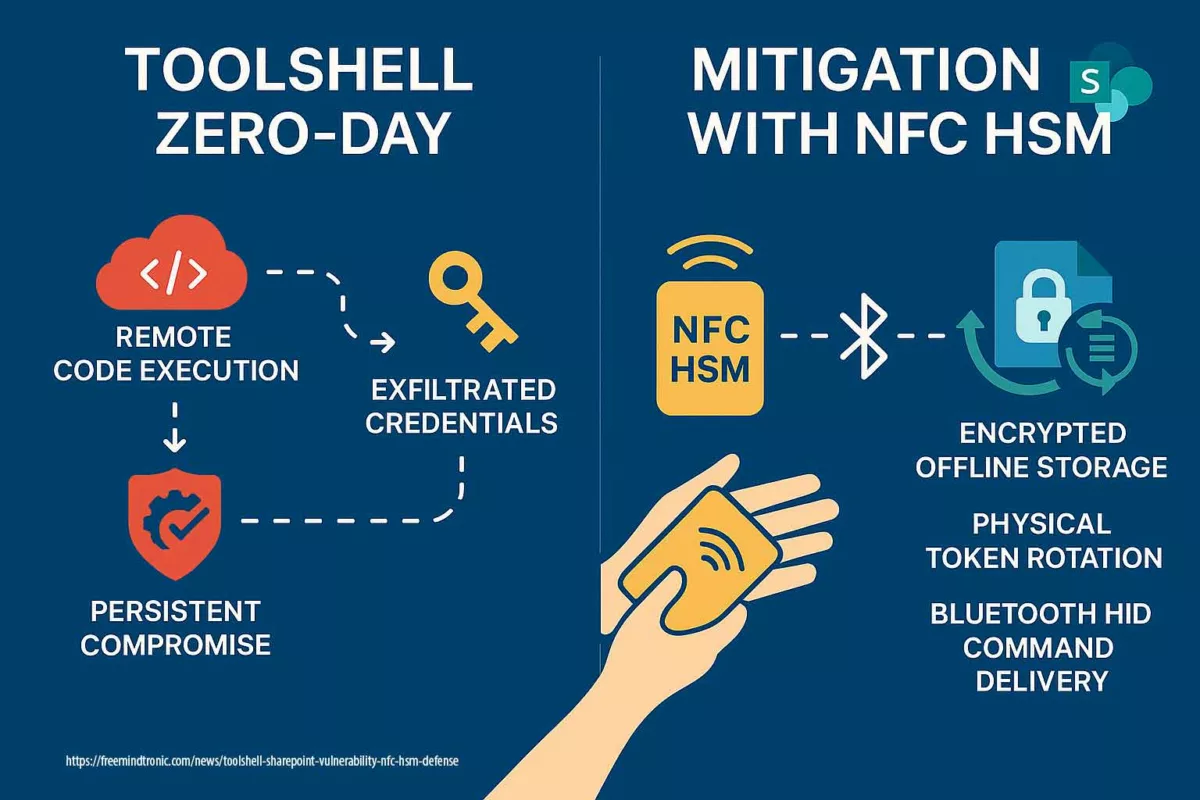
  • Hardware Origin — Credentials are generated and stored exclusively in the PassCypher HSM; immutable at rest and accessible only via NFC or PIN authentication.
  • Local Middleware — Secure injection via HID or sandbox URL; no third-party or cloud service processes the secrets.
  • Application Layer — The Tchap client validates ephemeral session tokens but never holds long-term secrets.
  • Transport Layer — Protected by TLS 1.3 mutual authentication, strengthened with HSM-controlled OTPs for session hardening.
  • Server Validation — The Matrix server stack enforces end-to-end encryption with hardware anchors; it cannot decrypt HSM-protected pre-authentication or metadata keys.
⮞ Strategic insight:
No single breach at the application, transport, or server layer can compromise user credentials. The sovereign trust anchor remains entirely in the user’s possession, enforcing zero cloud trust architecture principles.

Sovereign Dependency Mapping

Maintaining **sovereign control** over Tchap’s operational ecosystem requires a clear, auditable map of all **technical, infrastructure, and supply chain dependencies**. When extended with PassCypher NFC HSM or PassCypher HSM PGP, this mapping ensures every component—from client code to authentication workflows—is verified for jurisdictional integrity and security compliance.

  • Direct Dependencies — Matrix protocol stack (Synapse, Olm/Megolm), Tchap-specific forks, and OS cryptographic APIs.
  • Indirect Dependencies — External libraries, packaging frameworks, plugin ecosystems, and build toolchains.
  • Sovereign Hardware Layer — PassCypher firmware, NFC interface libraries, secure element microcode—audited and maintained in a trusted environment.
  • Infrastructure Control — On-premise hosting (OpenStack), state-controlled PKI, sovereign DNS resolution.
  • Operational Workflows — Credential provisioning, OTP generation, and recovery processes anchored to hardware modules with offline key custody.

This dependency classification allows **selective hardening** of the most critical elements for national resilience, aligning with ANSSI supply chain security guidelines and Zero Trust Architecture doctrine.

⮞ Sovereign advantage: Full-spectrum dependency visibility enables proactive isolation of non-sovereign elements and rapid substitution with trusted, state-controlled alternatives.

Crisis System Interoperability

In high-pressure scenarios—ranging from nation-state cyberattacks to large-scale infrastructure outages—Tchap must interconnect seamlessly with other sovereign crisis communication platforms without compromising identity integrity or jurisdictional control. By pairing with PassCypher NFC HSM or PassCypher HSM PGP, authentication and key custody remain fully hardware-rooted across heterogeneous systems.

  • Unified Cross-Platform Authentication — Single sovereign HSM credential usable across Tchap, GovSat, IRIS², and inter-ministerial coordination tools.
  • Metadata Containment — Prevents identity trace leakage when bridging sovereign and sector-specific networks.
  • Protocol Flexibility — Supports Matrix E2EE and external encrypted channels, with HSM-segmented key custody.
  • Failover Readiness — Pre-provisioned crisis accounts and OTP workflows securely stored in HSM for rapid redeployment.

This architecture guarantees *operational continuity during emergencies without reverting to non-sovereign or ad-hoc insecure channels. The HSM acts as the **permanent trust anchor** across all interconnected systems.

⮞ Sovereign advantage: Hardware-rooted authentication ensures identity trust is never diluted, even under extreme operational stress.

Interoperability in Health & Education

Extending Tchap into sensitive domains such as healthcare and education demands strict compliance with sector-specific regulations, privacy mandates, and sovereign infrastructure controls. The integration of PassCypher NFC HSM or PassCypher HSM PGP brings offline, hardware-rooted credential custody and sovereign key management to these environments.

  • Healthcare Integration — Secure linkage with Mon Espace Santé and hospital information systems, ensuring that professional identifiers, OTPs, and access tokens remain under sovereign HSM control.
  • Education Systems — Seamless authentication with ENT (Espaces Numériques de Travail) platforms, eliminating the need to store staff or student credentials in third-party systems.
  • Cross-Domain Identity Isolation — Dedicated slot-based credentials for each sector (e.g., Ministry, Hospital, University), preventing credential cross-contamination.
  • Regulatory Compliance — Full alignment with ASIP Santé, MENJ security standards, GDPR, and RGAA accessibility requirements.

This targeted interoperability transforms Tchap into a sovereign backbone for cross-sector collaboration, keeping high-value credentials and encryption keys entirely within national jurisdiction.

⮞ Sovereign advantage: Enables health and education services to leverage Tchap’s secure collaboration model without sacrificing sovereignty or compliance.

Ministerial Field Feedback

Operational deployments of Tchap in ministries and local administrations reveal that field conditions impose unique constraints on authentication, connectivity, and device security. When paired with PassCypher NFC HSM or PassCypher HSM PGP, several ministries report increased operator confidence and reduced credential compromise incidents.

  • Interior & Security Forces — Mobile use in low-connectivity zones benefits from offline OTP generation and pre-provisioned crisis credentials stored on HSM.
  • Prefectures — Staff rotation and multi-device use simplified via portable sovereign credential storage, eliminating the need for server-stored passwords.
  • Defence & Diplomacy — Sensitive mission keys remain isolated in hardware; revocation possible even if the host device is lost or seized.
  • Inter-ministerial Operations — Cross-team trust maintained via dedicated HSM slots per mission, preventing accidental credential overlap.

Feedback underscores that sovereign hardware custody reduces reliance on potentially compromised endpoints and fosters a higher adherence to Zero Trust operational discipline.

⮞ Sovereign advantage:
Field users value tangible, hardware-based trust anchors that remain operational under adverse conditions and disconnected environments.

Legal & Regulatory Framework

The deployment of Tchap in conjunction with PassCypher NFC HSM and PassCypher HSM PGP must comply with a robust set of French and European legal instruments, ensuring that every aspect of credential custody, encryption, and operational governance remains sovereign, compliant, and enforceable.

  • French Doctrine Interministérielle — Circular of 25 July 2025 mandating sovereign control over all state communication platforms.
  • ANSSI Guidelines — Full compliance with Référentiel Général de Sécurité (RGS) and alignment with SecNumCloud principles for certified secure infrastructure.
  • GDPR (RGPD) — Adherence to European privacy protections, data minimisation, and lawful processing principles within sovereign jurisdiction.
  • NIS2 Directive — Strengthening network and information system security, particularly for critical and strategic infrastructure.
  • LPM (Loi de Programmation Militaire) — Reinforced cybersecurity measures for national defence and strategic communications.
  • Zero Trust State Architecture — Integration of hardware-rooted identities, segmentation, and continuous verification in line with ANSSI’s 2024 doctrine.

Embedding these legal and regulatory safeguards into the technical design of Tchap + PassCypher ensures that digital sovereignty is not only a security posture but also a legally binding standard enforceable under national law.

⮞ Sovereign advantage: Legal alignment transforms sovereign communication systems from isolated technical tools into recognised state policy instruments.

Strategic Metrics & ROI

Evaluating the strategic return on investment for integrating PassCypher NFC HSM or PassCypher HSM PGP into the Tchap ecosystem requires performance metrics that extend beyond cost optimisation. The assessment must capture sovereignty gains, operational resilience, and measurable risk reduction — ensuring alignment with ANSSI’s Zero Trust guidelines and the NIS2 Directive.

  • Credential Compromise Rate — Percentage reduction in password or cryptographic key leakage incidents per 1 000 active users following HSM deployment.
  • Incident Response Time — Average reduction in time to revoke and reissue credentials during a security event.
  • Operational Continuity Index — Share of uninterrupted Tchap sessions maintained during simulated or real crisis conditions.
  • Sovereign Control Ratio — Proportion of authentication events executed exclusively within sovereign infrastructure and hardware-rooted credential custody.
  • Training Efficiency — Average time for new operators to master secure login and OTP workflows with HSM integration.

These KPIs enable ministries and agencies to justify investment in sovereign hardware not merely as a security cost, but as a verifiable driver of digital sovereignty, operational assurance, and long-term strategic autonomy.

⮞ Sovereign advantage:
Quantifiable, reproducible metrics transform sovereignty from an abstract political principle into a validated, data-driven operational standard.

Academic Indexing & Citation

Positioning the integration of Tchap with PassCypher NFC HSM or PassCypher HSM PGP within academic research and policy studies ensures that sovereign communication strategies gain visibility, credibility, and replicability. By embedding the sovereign model into peer-reviewed and policy-referenced contexts, France reinforces its digital sovereignty leadership while encouraging cross-sector adoption.

  • Standardised Citation Format — Use persistent identifiers (DOI, URN) for technical documentation, operational guides, and case studies.
  • Repository Inclusion — Deposit white papers, audits, and security analyses into trusted repositories such as HAL and Zenodo.
  • Cross-Disciplinary Integration — Link cybersecurity findings with political science, legal, and public administration research to address sovereignty holistically.
  • Bibliometric Tracking — Monitor the citation impact of sovereign security implementations in academic literature and policy briefs.
  • Peer-Reviewed Validation — Submit methods and results to independent academic review to enhance legitimacy and adoption potential.

Through structured academic referencing and open-access indexing, the Tchap + PassCypher integration evolves from an operational deployment to a documented reference model that can be replicated in allied jurisdictions and across strategic sectors.

⮞ Sovereign advantage:
Academic visibility transforms sovereign technology into a validated, globally recognised digital sovereignty framework.

Strategic Synthesis & Sovereign Recommendations

The integration of Tchap with PassCypher NFC HSM and PassCypher HSM PGP proves that sovereign communication platforms can combine operational efficiency with hardware-rooted, jurisdiction-controlled credential custody. This synergy mitigates immediate operational risks while fulfilling long-term digital sovereignty objectives.

  • Maintain Hardware Custody by Default — All authentication, encryption, and recovery credentials should be generated, stored, and managed within sovereign-certified HSMs.
  • Context-Specific Credential Segmentation — Use dedicated HSM slots for each mission, ministry, or sector to prevent cross-contamination of identities.
  • Institutionalise Crisis Protocols — Predefine credential rotation and recovery workflows anchored in hardware trust to ensure continuity during incidents.
  • Audit the Sovereign Supply Chain — Regularly verify firmware, microcode, and build environments for both PassCypher and Tchap to comply with ANSSI and legal requirements.
  • Measure & Publish KPIs — Track sovereign performance metrics such as credential compromise rate, operational continuity index, and sovereign control ratio.

By embedding these sovereign-by-design principles into governance frameworks and operational doctrine, France strengthens its capacity to resist extraterritorial interference, maintain confidentiality, and ensure continuity of critical communications under all conditions.

⮞ Sovereign advantage:
Institutional adoption of sovereign communication security ensures that protection is not an afterthought but a permanent, verifiable state.

Strategic Synthesis & Sovereign Recommendations

1. Observations

To begin with, the mandatory deployment of Tchap across French ministries marks a pivotal shift toward sovereign digital infrastructure. Built on the Matrix protocol and hosted within SecNumCloud-compliant environments, Tchap clearly embodies France’s commitment to Zero Trust principles, GDPR alignment, and national resilience. Moreover, its open-source nature and strong institutional backing position it as a credible and strategic alternative to foreign messaging platforms.

However, it is important to note that sovereignty is not a static achievement — rather, it is a dynamic posture that requires continuous reinforcement across hardware, software, and operational layers.

2. Strategic Limitations

Despite its strengths, Tchap still presents certain limitations:

  • Firstly, default E2EE is not enforced, leaving room for metadata exposure and unencrypted exchanges.
  • Secondly, there is no native support for hardware-based cryptographic attestation, which limits runtime trust validation.
  • Thirdly, the absence of offline continuity mechanisms makes it vulnerable in blackout or disconnected environments.
  • Additionally, there is no integration of decentralised identity or multi-factor authentication via physical tokens (e.g., NFC HSMs).
  • Finally, interoperability with sovereign enclaves or post-quantum cryptographic modules remains limited.

Consequently, these gaps expose Tchap to strategic risks in high-stakes environments such as diplomacy, defence, and crisis response.

3. Sovereign Recommendations

In order to address these challenges, several strategic measures are recommended:

  • Integrate PassCypher NFC HSM modules to enable offline identity validation, secure OTP management, and cryptographic attestation without cloud reliance.
  • Deploy DataShielder to govern metadata flows, enforce traceability, and visualise trust chains in real time.
  • Extend encryption layers with OpenPGP support for diplomatic-grade confidentiality.
  • Embed runtime sovereignty through hardware enclaves that isolate secrets and validate execution integrity.
  • Establish a sovereign UX layer that cognitively reinforces trust perception and alerts users to potential compromise vectors.

Ultimately, these enhancements do not replace Tchap — instead, they complete it. In fact, they transform it from a secure communication channel into a resilient, sovereign ecosystem capable of withstanding hybrid threats and geopolitical pressure.

⧉ What We Didn’t Cover

Although this chronicle addresses the core components of the Tchap + PassCypher + DataShielder sovereign security model, certain complementary strategic and technical aspects remain beyond its current scope. Nevertheless, they are essential to achieving a fully comprehensive and future-proof architecture.

  • Post-Quantum Roadmap — At present, PassCypher and DataShielder already implement AES-256 CBC with segmented keys, a symmetric encryption method widely regarded as quantum-resistant. Furthermore, this approach ensures that even in the face of quantum computing threats, confidentiality is preserved. However, a formal integration plan for post-quantum asymmetric algorithms — such as Kyber and Dilithium — across all Tchap clients is still under evaluation. For additional insights into the impact of quantum computing on current encryption standards, see Freemindtronic’s quantum computing threat analysis.
  • SecNumCloud Evidence Pack — In addition, the full compliance documentation specific to Tchap hosting, aligned with ANSSI SecNumCloud certification requirements, remains to be formally compiled and published.
  • Red Team Testing — Finally, the comprehensive results of adversarial penetration tests, particularly those targeting dual-encryption workflows under operational stress conditions, have yet to be released. These tests will play a pivotal role in validating the robustness of the proposed security architecture.

By addressing these points in forthcoming dedicated reports, the digital sovereignty and quantum security framework for state communications will move from a highly secure model to a demonstrably unassailable standard.

ToolShell SharePoint vulnerability: NFC HSM mitigates token forgery & zero-day RCE

Comparative infographic contrasting ToolShell SharePoint zero-day with NFC HSM mitigation strategies

Executive Summary

This Chronicle dissects the ToolShell SharePoint vulnerability, which exemplifies the structural risks inherent in server-side token validation mechanisms and underscores the value of sovereign credential isolation. It illustrates how credential exfiltration and token forgery erode server-centric trust models. By contrast, Freemindtronic’s sovereign NFC HSM architectures restore control through off-host credential storage, deterministic command delivery, and token-level cryptographic separation.

TL;DR — ToolShell abuses MachineKey forgery and VIEWSTATE injection to persist across SharePoint services. NFC HSM mitigates this by injecting HTTPS renewal commands from offline tokens — no DNS, no clipboard, no software dependency.

2026 Digital Security

EviDNA DNA Cryptography | Jacques Gascuel Memory

2022 2026 Digital Security

EviDNA cryptographie ADN | mémoire Jacques Gascuel

2025 2026 Digital Security Technical News

Quantum computer 6100 qubits ⮞ Historic 2025 breakthrough

2025 2026 Digital Security

WhatsApp zero-click vulnerability and runtime compromise

2026 Cyber Doctrine Digital Security

Whisper Leak side-channel and LLM token leakage

2023 2026 Digital Security Phishing

BITB Attacks: How to Avoid Phishing by iFrame

2026 Digital Security

Zero-Knowledge Downgrade Attacks — Structural Risks

2025 Cyberculture Digital Security

Browser Fingerprinting Tracking: Metadata Surveillance in 2026

2023 2026 Digital Security

CVE-2023-32784 : Pourquoi PassCypher protège vos secrets

2023 2026 Digital Security

CVE-2023-32784 Protection with PassCypher NFC HSM

2024 Digital Security

Why Encrypt SMS? FBI and CISA Recommendations

2025 Digital Security

Persistent OAuth Flaw: How Tycoon 2FA Hijacks Cloud Access

In Digital Security Correlate this Chronicle with other sovereign threat analyses in the same editorial rubric.

Key insights include:

  • Post-exploitation persists via cryptographic key theft
  • NFC HSM disrupts trust hijacking through isolated storage
  • Hardware-injected workflows remove runtime risk
  • ToolShell renders MFA ineffective by reusing stolen keys

About the Author – Jacques Gascuel, inventor of multiple internationally patented encryption technologies and founder of Freemindtronic Andorra, is a pioneer in sovereign cybersecurity. In this Digital Security Chronicle, he dissects the ToolShell SharePoint zero-day vulnerability and provides a pragmatic defense framework leveraging NFC HSMs and EviKeyboard BLE. His analysis merges hands-on mitigation with field-tested resilience through Bluetooth-injected, offline certificate provisioning.

ToolShell: Context & Exploit Strategy

⮞ Summary The ToolShell exploit abuses SharePoint token validation mechanisms by exfiltrating MachineKeys and injecting persistent RCE payloads into trusted services, making post-compromise persistence trivial.


Severity Level: 🔴 Critical (CVSS 9.8) – remote unauthenticated RCE exploit. CVE Reference: CVE-2025-53770 | CVE-2025-53771 Vendor Bulletin: Microsoft Security Update Guide – CVE-2025-53770 First documented by Eye Security, ToolShell is a fileless backdoor exploiting CVE‑2025‑53770 to gain persistent access to on-prem SharePoint servers. It leverages in-memory payloads and .NET reflection to access MachineKeys like ValidationKey and DecryptionKey, enabling valid payload signature forgery. Security firms observed active exploitation tactics: Symantec flagged PowerShell and Certutil use to deploy binaries such as “client.exe”, while Orca Security reported 13% exposure among hybrid SharePoint cloud deployments. Attribution links these campaigns to APT actors like Linen Typhoon and Storm‑2603. Recorded Future describes ToolShell as an in-memory loader bypassing EDR detection. Microsoft and CISA have acknowledged the active exploitation and advise isolation and immediate patching (see CISA Alert – July 20, 2025).

Flowchart showing ToolShell exploitation stages from VIEWSTATE injection to MachineKey theft and remote code execution in SharePoint
Exploitation stages of ToolShell: how attackers hijack SharePoint MachineKeys to achieve persistence and remote code execution


⮞ Attribution & APT Actors
Partial attribution confirmed by Microsoft and Reuters:
APT41 (a.k.a. Linen Typhoon / Salt Typhoon) — a China-based, state-affiliated cluster previously linked to CVE-2023-23397 exploits and credential theft
Storm-2603 — an emerging threat group observed injecting payloads derived from the Warlock ransomware family
We observed both threat groups using MachineKey forgery to sustain long-term access across SharePoint environments and hybrid cloud systems.
Related Chronicles:
– Chronicle: APT41 – Cyberespionage and Cybercrimehttps://freemindtronic.com/apt41-cyberespionage-and-cybercrime/
– Chronicle: Salt Typhoon – Cyber Threats to Government Securityhttps://freemindtronic.com/salt-typhoon-cyber-threats-government-security/
Explore how sovereign credential exfiltration and state-linked persistence mechanisms deployed by Salt Typhoon and APT41 intersect with ToolShell’s exploitation chain, reinforcing their long-term strategic objectives.

Comparative Insights: Salt Typhoon (APT41) vs ToolShell Attack Chain

Both Salt Typhoon and ToolShell clusters reveal long-term persistence tactics, yet only the ToolShell SharePoint vulnerability leverages MachineKey reuse across hybrid AD join environments.

Tactic / Vector Salt Typhoon (APT41) ToolShell
Credential Theft Harvested plaintext credentials via CVE-2023-23397 in Outlook Extracted MachineKeys (ValidationKey/DecryptionKey) from memory
Persistence Method Registry injection, MSI payloads, webshells VIEWSTATE forgery, fileless PowerShell loaders
Target Scope Gov networks, diplomatic mail servers, supply chain vendors Hybrid SharePoint deployments (on-prem/cloud join)
Payload Technique Signed DLL side-loading, image steganography Certutil.exe, client.exe binaries, memory-resident loaders
Command & Control Steganographic beaconing + encrypted tunnels Local payload injection (offline, no active beaconing)

This comparison highlights the evolution of state-affiliated TTPs toward stealthier, credential-centric persistence across heterogeneous infrastructures. Both campaigns demonstrate how hardware-based credential isolation can neutralize these vectors.

NFC HSM Sovereign Countermeasures

✓ Sovereign Countermeasures – Use offline HSM with no telemetry – Favor air-gapped transfers – Avoid cloud MFA for critical assets

Freemindtronic’s NFC HSM technology directly addresses ToolShell’s attack surfaces. It:

  • Secures credentials outside the OS using AES-256 CBC encrypted storage
  • Delivers commands via Bluetooth HID over a paired NFC phone, avoiding RCE-exposed vectors
  • Supports token injection workflows without scripts residing on the compromised server
  • Physically rotates up to 100 ACME labels per token, ensuring breach containment

Regulatory Response & Threat Landscape

⮞ Summary CISA and international CERTs issued emergency guidance, while threat intelligence reports from Symantec, Palo Alto Networks, and Recorded Future confirmed attribution, impact metrics, and defense gaps.

On July 20, 2025, CISA added CVE‑2025‑53770/53771 to its Known Exploited Vulnerabilities (KEV) catalog. Recommended actions include:

  • Rotate MachineKeys immediately
  • Enable AMSI for command inspection
  • Deploy WAF rules against abnormal POST requests
  • Isolate or disconnect vulnerable SharePoint servers

Defensive Deployment Scenario

⮞ Summary Using NFC HSM in SharePoint infrastructure allows instant certificate revocation, local reissuance, and DNS-less recovery via physical admin control.

During ToolShell exploitation, a SharePoint deployment integrated with DataShielder NFC HSM enables administrators to:

    • Immediately revoke affected credentials with no exposure to central PKI
    • Inject new signed certificates using offline physical commands
    • Isolate and contain server breach impacts without resetting whole environments
Infographic showing air-gapped token injection with NFC HSM to mitigate SharePoint ToolShell vulnerability
Sovereign workflow: NFC HSM performs offline token injection to bypass ToolShell-style SharePoint zero-day exploits

Sovereign deployment architecture — Secure SharePoint trust management using Freemindtronic NFC HSM with Bluetooth HID transmission and air-gapped administrator control.

Related resource… Trigger HTTPS Certificate Issuance DNS-less – Another application of NFC HSM to secure SSL/TLS certificate issuance without relying on DNS, reinforcing decentralized trust models.

Our analysis reveals significant global exposure despite Microsoft’s emergency patch, driven by legacy on-prem deployments. The table presents verified threat metrics and authoritative sources that quantify the vulnerability landscape.

Metric Value Source
Confirmed victims ~400 organizations Reuters
Potentially exposed servers 8,000–9,000 Wiz.io
Initial detections 75 compromised servers Times of India
Cloud-like hybrid vulnerable rate 9% self-managed deployments Orca Security
💸 Estimated Damage: Analysts project long-term remediation costs could exceed $50M globally, considering incident response, forensic audits, and credential resets. (Source: Silent Breach, Hive Systems, Abnormal.ai, 10Guards)

Real-World NFC HSM Mitigation — ToolShell Reproduction & Protection

This section demonstrates how to configure a sovereign NFC HSM (AES-256 CDC Encryption) to neutralize ToolShell-like threats via a deterministic, DNS-less and OS-isolated certificate issuance command.

  • Label example: (6 chars max)SPDEF1
  • Payload: (55 chars max)~/.acme.sh/acme.sh --issue --standalone -d 10.10.10.10
  • Tested Tools: PassCypher NFC HSM, DataShielder NFC HSM
  • Transmission Chain: Android NFC ⬢ AES-128 HID Bluetooth BLE (low energy) ⬢ Windows 11 (EviKeyboard-InputStick) or Linux (hidraw)

Use Case: The injected ACME command issues a new HTTPS certificate to a specified IP without DNS or clipboard, restoring trust anchor independently from the SharePoint server post-compromise.

Field Validation: Successfully tested on Windows 11 Pro using Git + MSYS2 + acme.sh + InputStick dongle. Also reproducible under hardened Linux with + .socatudev
  • Strategic Benefit: Even if ToolShell exfiltrates server credentials, NFC HSM enables local reissuance of trust chains fully isolated from the infected OS.
Diagram showing NFC HSM mitigation flow against ToolShell SharePoint vulnerability via BLE HID and ACME command injection
Sovereign countermeasure flow against ToolShell: NFC HSM triggering ACME SSL issuance via Bluetooth HID

Deconstructing the ToolShell SharePoint Vulnerability Exploitation Chain

⮞ Analysis ToolShell demonstrates a post-exploitation pivot strategy where attackers escalate from configuration theft to full application control. This is achieved through:
  • Abuse of VIEWSTATE deserialization with stolen MachineKeys
  • Use of .NET method invocation without leaving artifacts
  • Insertion of loader binaries via signed PowerShell or system tools like Certutil

Such fileless payloads effectively bypass signature-based antivirus and EDR solutions. The attack chain favors stealth and persistence over overt command-and-control traffic, complicating detection.

Beyond Patching: Lessons in Architectural Sovereignty

The ToolShell SharePoint vulnerability reaffirms that patching alone cannot reestablish cryptographic integrity once secrets are compromised. Only physical key segregation ensures post-breach resilience.

Why the ToolShell SharePoint vulnerability invalidates patch-only defense strategies

⮞ Insight ToolShell’s impact reveals the strategic limitations of patching-centric models. Sovereign digital infrastructures demand:
  • Non-centralized credential issuance and rotation (PKI independence)
  • Client-side trust anchors that bypass server-side compromise
  • Automation workflows with air-gapped execution paths

NFC HSM fits this paradigm by anchoring identity and authorization logic outside vulnerable systems. This enforces zero-access trust models by default and mitigates post-patch reentry by adversaries with credential remnants.

Breakout Prevention Matrix

Attack Phase ToolShell Action NFC HSM Response
Access Gain RCE via VIEWSTATE forging Physical HSM stores no secrets on host
Credential Theft Read MachineKeys from memory Offline AES-256 CBC storage in HSM
Persistence Install fileless ToolShell loader No executable context accessible to attacker
Privilege Escalation Reuse token for lateral movement Token rotation blocks reuse vector
Diagram showing ToolShell attack phases mapped to NFC HSM countermeasures in a breakout prevention flow
Visual matrix mapping ToolShell’s attack stages—RCE, credential theft, persistence, lateral movement—to NFC HSM’s hardware-based prevention mechanisms

Weak Signal Watch

  • Emergence of VIEWSTATE forgery patterns in Exchange Server and Outlook Web Access (OWA)
  • Reappearance of ToolShell-style loaders in signed PowerShell execution chains
  • Transition from beacon-based C2 to steganographic delivery mechanisms such as image-encoded payloads.
  • Reuse of stolen MachineKeys across hybrid Azure AD join infrastructures
⮞ Post-ToolShell Weak Signals
ToolShell’s exploitation chain appears to have seeded new attack patterns beyond SharePoint:
Exchange and OWA now exhibit signs of credential forgery via deserialization vectors
Warlock ransomware variants use image steganography to silently load persistence payloads
PowerShell-based implants inherit ToolShell’s memory-resident design to bypass telemetry
MachineKey reuse across identity-bound Azure environments raises systemic trust decay issues

Server Trust Decay Test

Even after mitigation, the ToolShell SharePoint vulnerability demonstrates how credential remnants allow adversaries to retain stealth access, unless a sovereign hardware countermeasure is applied.

An attacker steals the MachineKeys on a Friday. The following Monday, the organization applies the patch but fails to rotate the credentials. The access persists. With NFC HSM::

  • Compromise is contained via off-host cryptographic separation
  • Token usage policies enforce short-term validity
  • No command lives on the server long enough to be hijacked

CVE ≠ Loss of Control

Being vulnerable does not equal being compromised — unless critical secrets reside on vulnerable systems. NFC HSM inverts this logic by anchoring control points in hardware, off the network, and out of reach from any CVE-based exploit.

Related resource… Trigger HTTPS Certificate Issuance DNS-less – Another application of NFC HSM to secure SSL/TLS certificate issuance without relying on DNS, reinforcing decentralized trust models.

ToolShell Timeline & Impact Exposure

⏱️ Timeline Analysis The time between the initial unknown presence of the vulnerability and its public mitigation reveals the persistent exposure period common to zero-day scenarios. This uncertainty underscores the strategic advantage of sovereign technologies like NFC HSM, which isolate secrets physically, rendering CVE-based attacks structurally ineffective.Microsoft Advisory for CVE-2025-53770 | CVE-2025-53771
Event Date Comment
Vulnerability exploitation begins (undisclosed phase) ~Early July 2025 (est.) Attributed to stealth campaigns before detection (Eye Security)
First mass detection by Eye Security July 18, 2025 Dozens of compromised servers spotted
Microsoft public disclosure July 20, 2025 Emergency advisory + patch instructions
CISA KEV catalog update July 20, 2025 CVE-2025-53770/53771 classified as actively exploited
Widespread patch availability July 21–23, 2025 Full mitigation for supported SharePoint editions
💸 Estimated Damage: Analysts project long-term remediation costs could exceed $50M globally, considering incident response, forensic audits, and credential resets. (Source: Silent Breach, Hive Systems, Abnormal.ai, 10Guards)
Infographic showing the timeline of ToolShell zero-day in SharePoint from exploitation to public patch and global impact
Chronological overview of the ToolShell exploit lifecycle—from initial stealth exploitation, through detection and disclosure, to emergency patch deployment by Microsoft and CISA
⮞ Sovereign Use Case | Field-Proven Resilience with Freemindtronic
In my deployments, I validated that both DataShielder NFC HSM and PassCypher NFC HSM securely store and inject a 55-character offline command like:
This deterministic payload is physically embedded and cryptographically sealed in the NFC HSM. No clipboard. No DNS. No runtime script on the compromised host. Just a sovereign injection path that stays off the radar — and off the network.In a ToolShell-type breach, these tokens allow administrators to revoke, reissue, and restore certificate trust locally. The attack chain is not just mitigated — it’s rendered structurally ineffective.~/.acme.sh/acme.sh --issue --standalone -d 10.10.10.10

NFC HSM SSL Cert IP: Trigger HTTPS Certificate Issuance DNS-less

Secure IP certificate injection in DNS-less air-gapped environment using Android, ACME and BLE keyboard

Executive Summary

This method of issuing a “NFC HSM SSL Cert IP” enhances sovereign cryptographic automation.This strategic chronique unveils a sovereign method to issue HTTPS certificates DNS-less, leveraging the patented PassCypher NFC HSM and DataShielder NFC HSM. These Freemindtronic devices, designed for air-gapped environments, embed full ACME commands within an encrypted Bluetooth USB keyboard emulator. As a result, the issuance of IP SSL certificates from Let’s Encrypt can be securely triggered on Linux or Windows terminals, without relying on domains or manual input. This implementation marks a significant advancement in cyber defense, DevSecOps automation, and critical infrastructure resilience.

TL;DR — With a sovereign NFC HSM, you can trigger Let’s Encrypt IP SSL certificates without any domain or keyboard. The encrypted Bluetooth USB keyboard emulator securely inputs an ACME command into a terminal, launching certificate issuance in air-gapped mode. Compatible with DevOps, IoT, and secure LANs.

2025 Digital Security Tech Fixes Security Solutions Technical News

SSH Key PassCypher HSM PGP — Sécuriser l’accès multi-OS à un VPS

2025 Tech Fixes Security Solutions

Secure SSH key for VPS with PassCypher HSM PGP

2025 Tech Fixes Security Solutions Technical News

SSH VPS Sécurisé avec PassCypher HSM

2025 Tech Fixes Security Solutions

Let’s Encrypt IP SSL: Secure HTTPS Without a Domain

2024 Tech Fixes Security Solutions

How to Defending Against Keyloggers: A Complete Guide

2024 Tech Fixes Security Solutions

Unlock Write-Protected USB Easily (Free Methods Only)

2023 EviKey & EviDisk EviKey NFC HSM NFC HSM technology Tech Fixes Security Solutions Technical News

Secure SSH Key Storage with EviKey NFC HSM

About the Author – Jacques Gascuel, inventor of patented encryption devices and founder of Freemindtronic Andorra, specializes in sovereign cybersecurity. In this Tech Fixes & Security Solutions chronique, he demonstrates how trusted NFC HSMs and EviKeyboard BLE enable offline HTTPS provisioning via encrypted Bluetooth keyboard emulation.

Key Insights

Bluetooth Security & HID Injection Logic

Let’s Encrypt now actively provides free SSL/TLS certificates for public IP addresses, thereby eliminating any reliance on domain names. This evolution directly supports ACME automation and is valid for 6 days—making it ideal for sovereign DevOps workflows, air-gapped devices, and containerized staging setups.

Freemindtronic’s architecture reinforces this capability by introducing a critical layer of physical trust. Through the NFC HSM, each certificate issuance command becomes encrypted, deterministic, and physically validated before execution.

To secure this pathway, the integration of Bluetooth HID emulators based on InputStick, operating under AES-128 CBC, mitigates known vulnerabilities like CVE‑2023‑45866. These dongles neutralize spoofing and injection attempts that typically compromise HID interfaces.

While HID emulation minimizes exposure to keyloggers—particularly those relying on software vectors—it does not ensure universal protection. Since the command never appears on-screen or uses the clipboard, conventional surveillance tools often miss it. Still, firmware-based interception remains a realistic concern in sensitive contexts.

Another layer of protection stems from the consistent rhythm of injected keystrokes. This predictability inherently circumvents profiling methods like keystroke dynamics, which attackers use for behavioral fingerprinting.

Beyond SSL — Triggering Sovereign Automation

Most critically, this method extends well beyond HTTPS provisioning. The architecture permits any shell-level action to be securely triggered—whether toggling firewalls, initiating VPN connections, or unlocking OTP-based workflows.

Such command injection remains deterministic, reproducible, and physically scoped to authorized personnel. It aligns with zero-trust architectures and supports sovereign automation in environments where human error, remote compromise, or credential leakage must be structurally eliminated.

Why Trigger HTTPS via NFC HSM?

⮞ Summary</br />Triggering a NFC HSM SSL Cert IP from an NFC HSM enhances sovereignty, reduces exposure, and removes dependency on DNS infrastructure. It is especially relevant in constrained environments where trust, reproducibility, and minimal attack surface are paramount.

In conventional PKI workflows, HTTPS certificates are issued via domain-validated mechanisms. These involve online DNS challenges, public exposure of metadata, and centralized trust anchors. While suitable for general web hosting, such methods are problematic for air-gapped systems, sovereign networks, and critical infrastructures.

An NFC HSM—especially one like DataShielder or PassCypher—bypasses these limitations by embedding a pre-configured ACME command within a secure, tamper-resistant module. Upon physical NFC validation, it injects this command into a terminal using encrypted Bluetooth HID emulation, triggering immediate certificate issuance for a public IP address, DNS-less resolution or manual typing.

This process ensures:

  • Full autonomy: No user interaction beyond NFC scan
  • Domainless provisioning: Perfect for IP-only infrastructure
  • Operational secrecy: No domain names to query or monitor
  • Cryptographic trust: Execution only via validated hardware

Unlike browser-integrated certificate requests, this method is scriptable, repeatable, and isolated. It supports compliance with sovereign architecture principles, where infrastructure must operate without internet reliance, telemetry, or cloud-based identity.

✓ Sovereign Countermeasures
– Eliminate DNS metadata exposure for sensitive endpoints
– Enforce HTTPS issuance via local NFC physical validation
– Minimize human input to reduce injection risks and keystroke profiling

Sovereign Certificate Deployment

⮞ Summary
Deploying HTTPS certificates through an NFC HSM enables a sovereign infrastructure free from DNS, browser, or cloud dependencies. This method ensures deterministic and auditable certificate generation, fully compliant with air-gapped or classified operational models.This guarantees reproducible NFC HSM SSL Cert IP issuance even in air-gapped infrastructure.

Traditional HTTPS deployment relies on central authorities, DNS records, and domain validation—all of which introduce third-party dependencies and potential metadata leaks. In contrast, Freemindtronic’s architecture leverages a hardware-controlled trigger (the NFC HSM) to initiate certificate issuance via a secure command injection mechanism. This reduces the trust surface to a physical, user-held device.

The key innovation lies in the out-of-band orchestration: The ACME client resides on the target host, while the initiation command is stored encrypted on the HSM. No intermediate server, cloud API, or domain registry is needed. The device injects the issuance command via Bluetooth HID over AES-128 CBC, ensuring both authenticity and confidentiality.

Such deployments are ideal for:

  • Defense or classified networks under COMSEC restrictions
  • Offline DevSecOps environments with no external exposure
  • Critical systems requiring deterministic, reproducible PKI actions

The process supports issuance for public IP addresses using Let’s Encrypt’s new IP SSL policy (valid 6 days). Renewal can be re-triggered via the same HSM, ensuring cryptographic continuity under operator control.

✓ Sovereign Countermeasures
– Host the ACME client in a hardened, offline container
– Store issuance commands in sealed HSM compartments
– Trigger issuance only upon physical presence (NFC + HID)

ACME Injection for NFC HSM SSL Cert IP

⮞ Summary
The NFC HSM securely injects a complete ACME command into the terminal, automating IP-based certificate issuance without keyboard input. This mechanism merges cryptographic determinism with physical-layer control.

The NFC HSM SSL Cert IP architecture ensures every issuance is deterministic and hardware-bound. At the heart of this architecture lies a simple yet powerful mechanism: the injection of an command into a terminal session using an emulated keyboard interface. The command itself is stored as a secure “password” inside the NFC HSM, encrypted with AES-128 CBC and transmitted via Bluetooth HID only upon NFC validation.acme.sh

Typical payload format:

~/.acme.sh/acme.sh --issue --standalone -d 198.51.100.12

This command initiates the certificate issuance for a specific public IP, using the standalone HTTP challenge method. The NFC HSM handles the timing and structure of input, including the final “Enter” keystroke, ensuring that no user interaction is needed once the terminal is focused and ready.

Because the device behaves as a hardware keyboard, there is no software stack to compromise, and no plaintext command ever resides on disk or in clipboard memory. This prevents logging, injection, or interception from conventional malware or keyloggers.

The injected command can also include renewal or deployment flags, depending on operational needs:

~/.acme.sh/acme.sh --renew -d 198.51.100.12 --deploy-hook "systemctl reload nginx"

This physical injection model aligns with sovereign DevSecOps practices: zero trust, physical validation, no telemetry.

✓ Sovereign Countermeasures
– Avoid clipboard usage and on-screen input
– Limit exposure by using ephemeral ACME sessions
– Control terminal focus strictly to prevent accidental command leaks

ACME Command Injection

⮞ Summary
The NFC HSM securely injects a complete ACME command into the terminal, automating IP-based certificate issuance without keyboard input. This mechanism merges cryptographic determinism with physical-layer control.

At the heart of this architecture lies a simple yet powerful mechanism: the injection of an command into a terminal session using an emulated keyboard interface. The command itself is stored as a secure “password” inside the NFC HSM, encrypted with AES-128 CBC and transmitted via Bluetooth HID only upon NFC validation.acme.sh

Typical payload format:

~/.acme.sh/acme.sh --issue --standalone -d 198.51.100.12

This command initiates the certificate issuance for a specific public IP, using the standalone HTTP challenge method. The NFC HSM handles the timing and structure of input, including the final “Enter” keystroke, ensuring that no user interaction is needed once the terminal is focused and ready.

Because the device behaves as a hardware keyboard, there is no software stack to compromise, and no plaintext command ever resides on disk or in clipboard memory. This prevents logging, injection, or interception from conventional malware or keyloggers.

The injected command can also include renewal or deployment flags, depending on operational needs:

~/.acme.sh/acme.sh --renew -d 198.51.100.12 --deploy-hook "systemctl reload nginx"

This physical injection model aligns with sovereign DevSecOps practices: zero trust, physical validation, no telemetry.

✓ Sovereign Countermeasures
– Avoid clipboard usage and on-screen input
– Limit exposure by using ephemeral ACME sessions
– Control terminal focus strictly to prevent accidental command leaks

Threat Modeling & Attack Surface Reduction

⮞ Summary⮞ Summary
Injecting HTTPS issuance commands via NFC HSM significantly reduces exposure to credential theft, remote compromise, and biometric profiling. However, physical layer risks, firmware compromise, and misconfigured terminals remain key vectors.

In a typical PKI deployment, multiple layers expose the certificate lifecycle to threats: DNS hijacking, clipboard interception, keystroke logging, and man-in-the-browser attacks. By shifting the trigger mechanism to a sealed NFC HSM, most software vectors are eliminated.

Remaining risks include:

  • Terminal pre-infection: If malware is already resident, it may capture the injected command output or intercept post-issuance files.
  • HID spoofing attacks: Emulated keyboards can be impersonated unless verified through MAC binding or secure pairing protocols.
  • Compromised firmware: If the InputStick or equivalent dongle is tampered with, it could alter the command or inject additional payloads.

Nonetheless, the attack surface is drastically narrowed by limiting interaction to a physical device performing a single-purpose task with no writable memory exposed to the host.

Further hardening strategies include:

  • USB port control and filtering (e.g., usbguard)
  • Privilege isolation of ACME clients
  • Separation between issuance terminal and production services

This model aligns with threat-aware infrastructure design, promoting predictability, reproducibility, and low-residue command execution.

✓ Sovereign Countermeasures
– Bind InputStick to a single MAC address with secure pairing
– Use read-only terminals or ephemeral VMs for injection
– Monitor for unexpected keystroke patterns or USB device signatures

Use Cases

⮞ Summary
NFC-triggered HTTPS certificate deployment unlocks secure automation in domains where DNS is unavailable, interaction must be minimized, and reproducibility is critical. From DevSecOps to defense-grade SCADA, this architecture serves environments requiring absolute trust control.

The following scenarios illustrate how the NFC HSM method enables trusted and repeatable HTTPS certificate issuance workflows in constrained, regulated, or sensitive networks:

  • Offline DevSecOps Pipelines
    Teams managing infrastructure-as-code or staging environments without internet access can preconfigure NFC HSM SSL Cert IP workflows for staging environments to issue IP-based certificates, ensuring that test environments are reproducible and consistent without any external dependency.
  • SCADA / OT Infrastructure
    Industrial systems often avoid DNS integration for security reasons. Using an NFC HSM allows localized HTTPS activation without exposing endpoints to domain-based resolution or remote management layers.
  • IoT / Embedded Systems
    Devices in disconnected or partially isolated networks can still receive TLS credentials via NFC-triggered issuance, avoiding factory default certs or static keys, and ensuring field-level provisioning control.
  • Field Operations in Defense or Law Enforcement
    Operators in sovereign or tactical contexts can generate valid HTTPS credentials on-site, without contacting centralized authorities, by physically carrying a validated HSM token with embedded commands.
  • Certificate Renewal for Local Services
    NFC HSMs can be configured to perform periodic injections of commands, allowing HTTPS continuity in local-only networks or maintenance windows without login credentials.--renew

✓ Sovereign Countermeasures
– Preload HSMs for field deployments without backend dependency
– Enforce HTTPS consistency in LANs without internal CA
– Avoid DNS logging and upstream certificate transparency exposure

Advantages Over Conventional Certificate Deployment

⮞ Summary
Triggering HTTPS certificates from an NFC HSM provides deterministic provisioning, DNS independence, and air-gapped compatibility—surpassing traditional PKI methods in sovereign, offline, or security-hardened contexts.

Unlike conventional HTTPS deployment—which relies on online DNS validation, interactive browser workflows, or centralized CA integrations—this method centers on physical validation and cryptographic command injection. The result is a sovereign architecture that avoids metadata leaks, limits dependencies, and enhances reproducibility.

Key comparative advantages:

  • DNS-free issuance: Certificates can be requested directly for public IP addresses, eliminating exposure to DNS hijacking or telemetry.
  • Zero manual typing: The NFC HSM delivers a pre-signed command via Bluetooth HID, reducing human error and eliminating clipboard use.
  • Air-gapped operation: No need for internet connectivity during issuance—ideal for SCADA, OT, or classified zones.
  • Cross-platform support: Works natively on Linux and Windows terminals with terminal focus, including GUI-less shells.
  • Offline reproducibility: The same NFC HSM token can trigger identical issuance workflows across distinct devices or deployments.
Cloud HSM vs. Sovereign NFC HSM — While Let’s Encrypt relies on centralized HSMs (e.g., FIPS-certified Luna HSMs) housed in datacenter-grade infrastructures to manage its root and intermediate certificate keys, the sovereign NFC HSM SSL Cert IP method from Freemindtronic shifts full cryptographic authority to the device holder. It enables ACME command injection through air-gapped, hardware-authenticated triggers. Inside the NFC HSM, command containers are encrypted using AES-256 CBC with segmented keys (patented design). For transmission to the host, the emulated Bluetooth USB keyboard channel is secured using AES-128 CBC, mitigating signal-layer spoofing risks. This dual-layer cryptographic model eliminates telemetry, decentralizes trust, and ensures reproducible offline issuance workflows—ideal for sovereign, air-gapped, or classified infrastructures.

✓ Sovereign Countermeasures
– Avoid third-party telemetry via direct IP-based ACME workflows
– Use physical validation to remove keyboard input from trust equation
– Standardize issuance using sealed, immutable NFC HSM command blocks

Market PKI Models vs. NFC HSM SSL Cert IP

⮞ Summary
Commercial PKI models rely on centralized trust architectures, whereas Freemindtronic’s NFC HSM SSL Cert IP model decentralizes certificate control and aligns with offline sovereignty requirements.

State of the Market: Providers like DigiCert, AWS ACM, and Google Certificate Authority Service offer managed PKI ecosystems. While robust and scalable, these solutions depend on trusted third-party infrastructures, online key lifecycle management, and domain-based validation workflows.

Freemindtronic’s NFC HSM SSL Cert IP model contrasts with:

  • AWS Certificate Manager (ACM) — automated domain validation and SSL provisioning for AWS workloads, but entirely cloud-tethered.
  • Google CA Service — enterprise-focused PKI with global root distribution, but no local control over key injection.
  • Entrust or GlobalSign PKIaaS — high-assurance certificate lifecycle services, but designed for regulated environments with consistent network access.

In contrast, the NFC HSM SSL Cert IP model is physically anchored, deterministic, and offline-capable, making it uniquely suited for air-gapped, sovereign, or classified environments where no telemetry or external PKI is permitted.

✓ Sovereign Countermeasures

  • Replace centralized CA trust chains with localized issuance
  • Avoid reliance on global DNS, root stores, and telemetry
  • Use NFC-triggered hardware validation to control all issuance events

Criteria Conventional PKI (Cloud HSM) NFC HSM SSL Cert IP (Freemindtronic)
Key Storage HSMs in cloud datacenters (e.g., FIPS-certified Luna HSMs) On-chip secure memory, per user device
Certificate Trigger API-based orchestration from CA infrastructure Physical NFC scan and Bluetooth HID injection
Metadata Exposure Public domain names, DNS logs, CA telemetry None — issues IP certs offline DNS-less
Operational Model Centralized, requires internet connectivity Decentralized, works in air-gapped contexts
Sovereign Control Controlled by Certificate Authority Fully under user and device holder control

✪ Distributed Offline Issuance — Each NFC HSM can securely store up to 100 independent labels, each embedding a full ACME issuance or renewal command. This enables operators to maintain deterministic, auditable certificate lifecycles across 100 distinct endpoints—without relying on DNS, server access, or online CA workflows.

Strategic Differentiators — NFC HSM SSL Cert IP vs. Cloud HSM

⮞ Summary
Compared to conventional cloud-based HSM solutions, Freemindtronic’s NFC HSM SSL Cert IP model offers a fully offline, sovereign, and metadata-free method for issuing HTTPS certificates—making it unmatched in security, autonomy, and scalability.
Criteria NFC HSM SSL Cert IP (Freemindtronic) Cloud HSM (AWS, Google, etc.)
Offline Capability Fully functional in air-gapped environments Impossible — internet connection mandatory
Sovereign Control Full user-side control, no third-party reliance CA or cloud provider retains authority
DNS Independence Let’s Encrypt IP SSL triggered via NFC Domain and DNS validation mandatory
Command Storage Encrypted in EEPROM with AES-256 CBC Cleartext in orchestration scripts or APIs
Bluetooth HID Security AES-128 CBC (BLE), no software installation needed Not applicable, not physically triggered
Telemetry Exposure Zero telemetry, no cloud or DNS persistence High — logs, DNS traces, CA activity trails
Scalability & Distribution Up to 100 secure labels per NFC HSM Requires scripts, APIs, and cloud orchestration
✪ Use Case Leverage:
The NFC HSM SSL Cert IP architecture is ideal for DevSecOps, critical infrastructure, IoT, and tactical IT deployments requiring deterministic control over certificate issuance—with no metadata footprint and no internet trust anchors.
Available in Freemindtronic Solutions —
All of these sovereign capabilities are natively included in both DataShielder NFC HSM and PassCypher NFC HSM. In addition to secure NFC-triggered SSL certificate issuance via Bluetooth HID, both devices embed advanced functionalities—offline password management, AES-256 CBC encrypted EEPROM, and air-gapped command injection—at no additional cost, unlike comparable single-feature commercial offerings.

Real-World Implementation Scenario

⮞ Summary This scenario illustrates how a DevSecOps team can deploy HTTPS certificates offline, without domain names or keyboard input, using a single NFC HSM device. The workflow minimizes risk while ensuring cryptographic reproducibility across multiple systems.

A sovereign DevSecOps team maintains an internal staging infrastructure composed of multiple servers, each accessible via public IP, but with no domain name assigned. To provision secure HTTPS endpoints, they adopt a physical key approach using a DataShielder NFC HSM. Each operator receives a token preconfigured with a validated ACME command such as:

~/.acme.sh/acme.sh --issue --standalone -d 203.0.113.10

During server provisioning, the operator focuses a terminal session on the target system and activates the NFC HSM over Bluetooth. The secure command is injected in real time via HID emulation, initiating HTTPS certificate issuance locally, without relying on DNS or typing. The process results in:

  • No secret stored on disk
  • No manual interaction beyond physical validation
  • No DNS contact or metadata exposure

Renewals follow the same offline procedure. Each NFC HSM can be reused cyclically, enforcing consistent operational workflows and reducing the attack surface associated with digital credentials or shared provisioning scripts.

NFC HSM certificate trigger diagram for DevSecOps teams in offline IP-only networks
✪ Illustration — Offline SSL provisioning in air-gapped networks using a sovereign NFC HSM device with AES 128 CBC Bluetooth keyboard injection.

✓ Sovereign Countermeasures – Delegate issuance authority to hardware tokens only. Avoid persistent credentials or renewal daemons. Rotate HSMs per site or per operator to enforce physical trust boundaries.

Keyboard Emulation Security

⮞ Summary
Secure NFC HSM SSL Cert IP provisioning relies on keyboard emulation via NFC-triggered HID injection, delivering encrypted commands without user interaction. While resilient against software-based keyloggers, this method still depends on dongle integrity, terminal focus, and strict physical access control.

The Freemindtronic architecture relies on Bluetooth HID keyboard emulation to input a pre-defined ACME command into a terminal. This approach avoids clipboard use, bypasses browser interfaces, and limits the attack surface to physical vectors. Communication is secured using AES-128 CBC encryption, typically via InputStick-compatible dongles.

Advantages:

  • Bypasses traditional keystroke logging malware
  • Works in both GUI and CLI-only contexts
  • Evades behavioral profiling (e.g., typing speed, cadence)
  • Injects full command strings deterministically

Limitations:

  • Relies on terminal focus: any background app may intercept keystrokes if hijacked
  • Cannot distinguish user intent—no dynamic validation layer
  • Firmware-level compromise of the HID dongle remains a plausible threat

Despite these considerations, NFC-triggered HID input remains more secure than local typing or shell-based provisioning—especially in air-gapped networks. It minimizes cognitive load and human error while ensuring consistent syntax execution.

✓ Sovereign Countermeasures
– Validate terminal window state before injection.
– Secure HID dongles using hardware-based pairing and trusted device filtering mechanisms.
– Physically isolate trusted input endpoints from internet-connected interfaces.

Web Interface Variant

⮞ Summary
In controlled environments requiring GUI validation, the NFC HSM can inject commands into a web interface with an autofocused field. This variant enables HTTPS provisioning through privileged backend scripts, maintaining traceability and physical-layer initiation.

While terminal-based workflows are ideal for sovereign and CLI-dominant deployments, some regulatory or enterprise environments require a graphical layer for auditability, accessibility, or operator ergonomics. To meet this need, Freemindtronic supports an alternative mode: NFC-triggered command injection into a local HTTPS web form.

This method involves a locally hosted, air-gapped web interface with an element. When the NFC HSM is scanned, its command is injected directly into this field via the Bluetooth HID emulator. The browser captures the string and relays it to a local backend daemon (e.g., Python Flask, Node.js) that executes the ACME command securely.<input autofocus>

Workflow highlights:

  • No need for system-level terminal access
  • Improves auditability and UX in regulated environments
  • Allows integration with role-based web dashboards

This variant preserves the sovereign principle: no data leaves the machine, and execution still requires physical validation via NFC. It also opens the door to multistep approval flows, graphical logs, or on-screen HSM verification feedback.

✓ Sovereign Countermeasures
– Host the web interface locally on loopback or hardened LAN
– Prevent remote form submission or cross-site injection
– Validate command syntax on server side before execution

Create a Secure NFC HSM Label

⮞ Summary
This step prepares your NFC HSM with a deterministic, DNS-less certificate command. You can either scan a secure QR code or manually input the command to harden the provisioning chain.

Android device importing NFC HSM SSL Cert IP QR code label into Freemindtronic’s PassCypher or DataShielder
✪ Secure QR code scan — PassCypher or DataShielder app importing a DNS-less NFC HSM SSL Cert IP label into encrypted memory via Android NFC, forming the trusted first step in sovereign certificate injection.
  1. Label: LEIP25 (6 characters max)
  2. Payload (55 characters max):
    ~/.acme.sh/acme.sh --issue --standalone -d 203.0.113.10
  3. Use PassCypher HSM to generate a QR code instantly (Evipass module).
  4. Optionally, insert the command manually for higher trust against keylogger vectors.
ℹ️ Security Insight — Each NFC HSM label embeds a sealed 61-byte EEPROM block encrypted in AES-256 CBC. It can trigger certificate issuance across air-gapped infrastructures with zero domain or DNS reliance.

Step-by-Step Tutorial on Windows 11

⮞ Summary This guide shows how to trigger an NFC HSM SSL Cert IP securely from Windows 11 using a Bluetooth HID emulator and ACME, bypassing all DNS and clipboard dependencies.

NFC HSM SSL Cert IP triggered via Bluetooth HID on Windows 11
✪ Diagram — NFC HSM encrypted label triggers a DNS-less SSL certificate issuance on Windows 11 via a Bluetooth HID emulator. This flow leverages ACME and Freemindtronic’s offline cryptographic infrastructure.
  1. Install Git for Windows: git-scm.com
  2. Install MSYS2: msys2.org Update with: pacman -Syu
  3. Install Socat: Check with: pacman -S socatsocat -V
  4. Install acme.sh: Verify with: curl https://get.acme.sh | sh~/.acme.sh/acme.sh --help
  5. Trigger NFC HSM: Activate Bluetooth HID, plug InputStick, scan the NFC HSM to inject the ACME command via keyboard emulation.

NFC HSM Trigger for HTTPS Certificate

This terminal output illustrates the sovereign automation of issuing an HTTPS certificate for a public IP using Freemindtronic’s NFC HSM and Bluetooth HID keyboard emulation. It confirms the ACME command injection without any DNS requirement.

NFC HSM HID Bluetooth Emulation triggering HTTPS Cert Issuance
✪ Screenshot — acme.sh triggered via NFC HSM HID keyboard emulation to issue HTTPS certificate for public IP 203.0.113.10.
Note: Register your ZeroSSL account with: ~/.acme.sh/acme.sh --register-account -m your@email.com

Linux Implementation Notes

⮞ Summary
Although not yet validated under Linux, this sovereign method for domainless HTTPS certificate issuance is inherently compatible with Unix-based systems. Thanks to standard CLI tools and terminal-centric workflows, its adaptation requires minimal adjustments.

The core architecture of this NFC-triggered SSL certificate method is platform-agnostic. It is built on command-line principles, which are foundational in Linux distributions. Tools such as and are widely available through most package managers, enabling seamless porting.socatacme.sh

Bluetooth HID support is also accessible under Linux, via and interfaces. Furthermore, USB HID emulation through InputStick or compatible AES-128-CBC Bluetooth dongles can be managed using rules or manually mounted as trusted devices in headless environments.bluezhidrawudev

Freemindtronic anticipates a CLI-only variant—entirely graphical-interface free—especially valuable in minimal server builds or embedded systems. This reinforces its utility in sovereign deployments and isolated networks.

⚠ Privileged access (root/sudo) will often be required for port binding (), USB device configuration, and real-time command injection via or ACME clients. This underscores the importance of trusted administrative control in production systems.443socat

Although no full test has been completed under native Linux environments as of this writing, technical compatibility is ensured by the universality of the tools involved. From a cyber-sovereignty standpoint, Linux remains a natural host for this methodology—offering deterministic, reproducible certificate issuance workflows DNS-less reliance.

Offline SSL certificate issuance using NFC HSM with AES-256 CBC and Bluetooth HID with AES-128 CBC
✪ Illustration — Air-gapped SSL certificate issuance using a sovereign NFC HSM (AES-256 CBC), Android NFC interface, and a Bluetooth HID emulator secured with AES-128 CBC.

✓ Sovereign Countermeasures
– Bind certificate issuance to air-gapped Linux environments
– Use encrypted Bluetooth HID with physical validation
– Automate renewal via preloaded CLI command sets stored in the NFC HSM

⮞ Weak Signals IdentifiedTrend: Expansion of IP-only HTTPS services bypassing DNS exposure – Pattern: Rise in physical-layer triggers (NFC, QR, USB HID) for digital workflows – Vector: Exploitation of unattended terminals via rogue HID emulation devices – Regulatory gap: Absence of standards for command-triggered cryptographic operations without interactive validation – Operational drift: Shadow issuance procedures escaping central IT visibility in DevSecOps pipelines

Beyond SSL: Generalized Command Triggering

⮞ Summary
The NFC HSM method is not limited to HTTPS certificate issuance. Its architecture supports secure, offline triggering of any shell-level command—making it a versatile sovereign automation tool for sensitive or disconnected infrastructures.

While originally designed for issuing IP-based SSL certificates via , the NFC HSM trigger mechanism is fundamentally command-agnostic. Any shell instruction can be stored in the encrypted memory block and injected securely into a terminal or web input form, provided it respects length and syntax constraints.acme.sh

Generalized sovereign use cases:

  • VPN toggles — trigger or commands in air-gapped environmentsopenvpnwg-quick
  • Firewall configuration — inject or rules for dynamic security posturesiptablesufw
  • System unlocks — initiate session-specific passwordless login scripts on hardened devices
  • Credential rotation — execute PGP key rotation or 2FA OTP sync triggers without exposing tokens
  • Audit commands — launch , , or integrity checkers during physical inspectionsha256sumjournalctl

This flexibility transforms the NFC HSM into a **sovereign hardware trigger for trusted automation**, particularly in high-assurance zones. Combined with contextual awareness (e.g. operator role, physical presence, device pairing), the method enables deterministic, reproducible and minimal-risk operations.

✓ Sovereign Countermeasures
– Restrict accepted commands to a known safe set on receiving systems
– Use NFC validation only in controlled physical perimeters
– Pair each command with logging or cryptographic attestation to ensure accountability

Visual Workflow

⮞ Summary
This visual sequence illustrates the complete offline workflow of sovereign certificate issuance triggered by an NFC HSM device, from physical validation to HTTPS activation on a target system.

Understanding the interaction flow between hardware, host OS, and the ACME client is crucial to ensure deterministic outcomes and reproducible deployment in sovereign infrastructures.

The sequence includes:

  1. NFC validation of the operator’s credential (physical control)
  2. Bluetooth pairing and HID readiness handshake
  3. Command injection to the focused shell or input field
  4. ACME client execution with preconfigured flags
  5. Key + CSR generation by the ACME engine
  6. HTTP challenge response via localhost (port 80/443)
  7. Retrieval of IP SSL cert and optional post-processing

This architecture supports both CLI and GUI variants, and maintains air-gapped integrity by ensuring no secret or domain is ever transmitted or stored online.

⧉ What We Didn’t Cover While this Chronicle focused on triggering HTTPS certificate issuance via NFC HSM devices in IP-only environments, several adjacent topics remain open for deeper exploration:

  • Zero-trust orchestration using chained HSM devices
  • Integration with sovereign enclaves and TPM attestation models
  • Secure destruction or rotation of command blocks after single use
  • Long-term auditability in decentralized PKI contexts
  • Legal implications of offline crypto orchestration under international law

These topics will be addressed in future sovereign chronicles.

FAQ

⮞ Summary>
This section clarifies operational and technical concerns about triggering HTTPS certificate issuance DNS-less using sovereign NFC HSM devices such as PassCypher or DataShielder.

➤ Can you alter the ACME command stored inside the NFC HSM?

No, you cannot. Once the ACME command is encrypted and securely embedded in the NFC HSM’s sealed memory, it becomes immutable. Modifying it requires complete erasure and full reinitialization. Therefore, this approach ensures deterministic execution and robust tamper resistance.

➤ Does the AES-128 CBC Bluetooth HID channel resist replay attacks?

Yes, it does. Each communication session encrypts and synchronizes independently, using AES-128 CBC. The HSM transmits no data unless the NFC validation occurs again. Furthermore, the HID dongle enforces Bluetooth pairing, and each session expires automatically—greatly minimizing the window for replay exploitation.

➤ What happens if the terminal window lacks focus during injection?

In that case, the injected command could land in an unintended application or background process. To mitigate this, Freemindtronic strongly recommends sandboxed launchers or explicit terminal focus validation. These measures guarantee command redirection doesn’t compromise the system.

➤ Is Linux inherently more secure than Windows for sovereign NFC-triggered issuance?

In most sovereign cybersecurity architectures, yes. Linux offers greater auditability, native CLI environments, and fewer proprietary dependencies. That said, when properly hardened, both Linux and Windows provide comparable integrity for NFC HSM-based HTTPS provisioning.

➤ Can this method operate inside virtual machines, containers, or cloud platforms?

Absolutely. As long as the virtual environment presents a HID-compatible interface and supports direct terminal focus, the NFC HSM injection works seamlessly. This includes ephemeral VMs, containerized services, and CI/CD agents configured with sovereign command workflows.

Eliminating SPOF in Sovereign Certificate Issuance

In critical infrastructures, a Single Point of Failure (SPOF) is not just a reliability issue — it constitutes a systemic security vulnerability. As defined by Wikipedia, a SPOF is any component whose failure could bring down the entire system. According to SC Media, SPOFs in digital trust infrastructures pose systemic threats to national security. This NFC HSM SSL Cert IP architecture removes SPOFs by replacing centralized, cloud-dependent elements with deterministic, sovereign hardware logic.
Centralized Component SPOF Risk Present? How It’s Eliminated
DNS Hijacking, downtime, telemetry leaks Direct issuance to IP (e.g. 203.0.113.10) with no domain validation
Cloud ACME servers Outage, revocation, unilateral policy change Command issued offline from NFC HSM, no external authority
Keyboard input stack Keyloggers, injection, human error Encrypted HID injection via Bluetooth emulator (AES-128-CBC)
Persistent cloud storage Data exposure, lateral pivoting Payload stored encrypted in EEPROM (AES-256-CBC)
Auto-renewal daemons Untraceable renewal failures Physically triggered per issuance by operator via NFC
⮞ Architectural Takeaway —
Every certificate issuance is traceable, deterministic, air-gapped, and governed by hardware. The use of up to 100 autonomous NFC HSM labels (AES-256-CBC) per device enables rotation per site, per operator, or per time slot — eliminating SPOFs and reinforcing cryptographic sovereignty.

What We Didn’t Cover

This strategic note intentionally narrows its scope to the offline, DNS-less issuance of HTTPS certificates using the NFC HSM SSL Cert IP model. It leaves aside centralized PKI hierarchies, cloud-native ACME automations, and online revocation channels like CRL or OCSP. Likewise, it does not explore smartcards, USB PKCS#11 tokens, TPM HSMs, or managed CA platforms. These were not overlooked, but purposefully set aside to maintain a focused view on sovereign, air-gapped certificate flows. Some of these areas may be revisited in future chronicles dedicated to hybrid trust architectures within Freemindtronic’s ecosystem.
🛈 Editorial Scope Notice — This article isolates a precise offline certificate workflow using NFC HSM SSL Cert IP triggers. Broader PKI domains—revocation, remote tokens, or cloud APIs—fall outside this frame and may be explored in later technical notes.